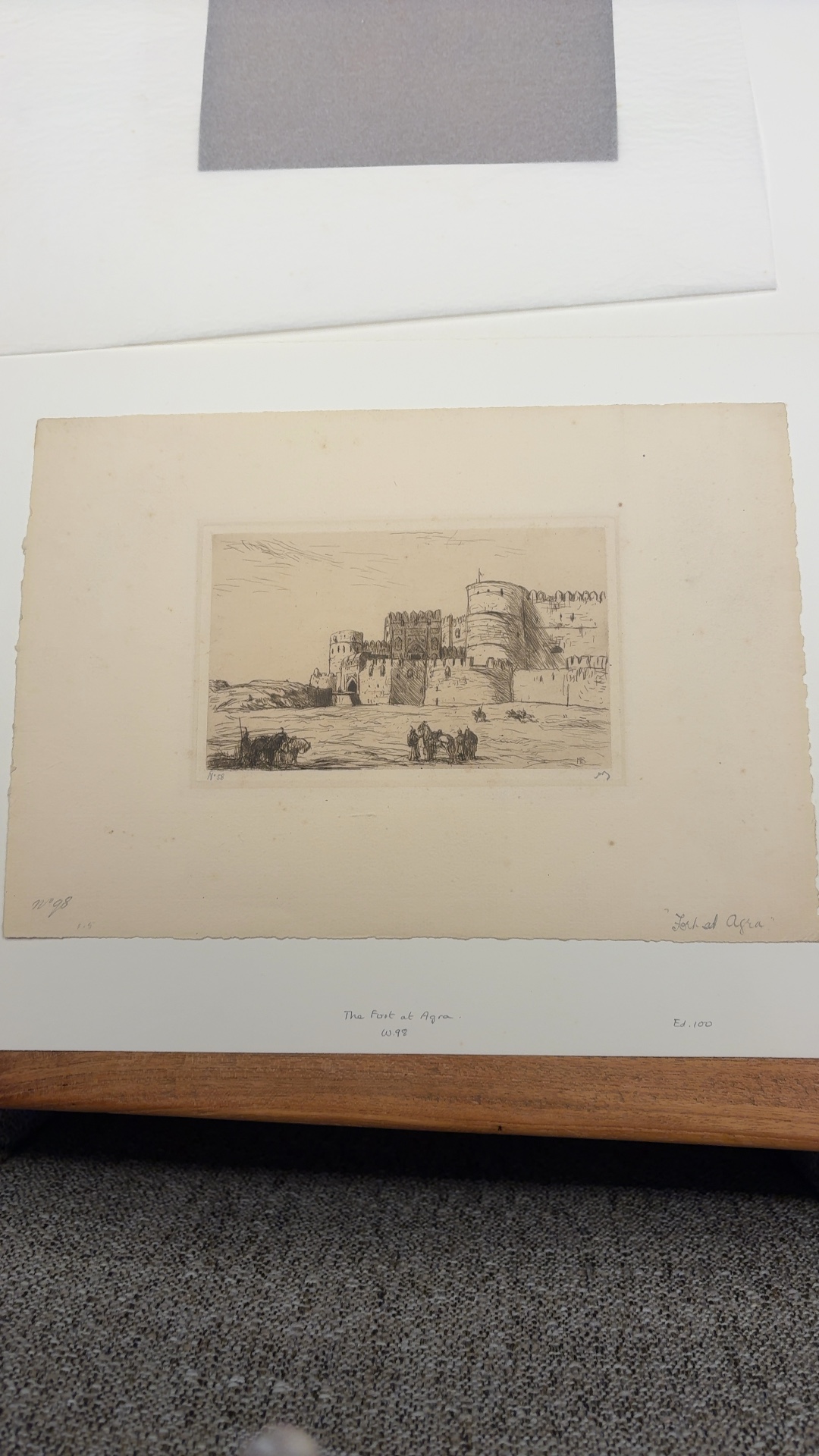
The Fort at Agra, Etching
QUICK FACTS
Categories
Era
Late 19th Century - Early 20th Century
Origin
🌍 International
Artist/Maker
Marius Bauer
Rarity
Average (4/10)
Discovered
Feb 5, 2026
3 weeks ago
DESCRIPTION
This appears to be an etching on paper depicting 'The Fort at Agra,' as indicated by the inscription below the image. The scene captures a walled structure, likely the Agra Fort, with intricate details in the architecture and a suggestion of movement with figures and possibly animals in the foreground. The linearity and fine cross-hatching are characteristic of the etching technique, which uses acid to create recessed lines in a metal plate to hold ink.
CULTURAL ECHOES
Where This Object Echoes
The fascination with exotic locales and grandiose architectural subjects, common in 19th-century European art, particularly in engravings and etchings, which served as 'souvenirs' of travel.
Ritual & Ceremonial Use
- •The role of prints, particularly etchings, in disseminating visual information about distant lands and cultures to a curious public, functioning as educational tools as well as decorative art.
Meaning Through Time
Views of foreign lands often carried connotations of colonial conquest, scientific exploration, and exoticism.
These types of prints are viewed more for their artistic merit, historical documentation, and as examples of specific printmaking techniques.
HISTORICAL STORY
DID YOU KNOW?
Etching, a form of intaglio printmaking, involves drawing into a ground-coated metal plate with a needle, exposing the metal. The plate is then immersed in acid, which 'bites' into the exposed lines, creating a durable matrix for printing.
The Agra Fort, an iconic UNESCO World Heritage site, served as the main residence of the emperors of the Mughal Dynasty until 1638 and is a prime example of Mughal architecture in India.
MATERIAL & CONDITION
Surface
The piece exhibits a clear print on off-white, slightly textured paper, indicative of a fine art paper typically used for etchings. The delicate, etched lines are discernible, showing consistent ink application without significant blurs or smudging. The paper appears somewhat aged with some minor discoloration.
Weight & Feel
Given the size of the paper and the medium, this piece would be quite lightweight, consistent with a single sheet of printmaking paper, possibly mounted or matted.
Condition
The paper shows signs of age, including some minor foxing (small brown spots) visible, particularly in the lower right portion of the margin. The edges appear deckled, which is typical for handmade papers. The print impression itself seems clear, with no obvious damage to the image area, though light handling creases are possible. The overall condition suggests a well-preserved but aged piece.
RARITY ANALYSIS
Typical antique shop fare. Requires some searching but regularly available. This is where most genuine antiques fall.
Typical Characteristics
- Standard antique shop items
- Regularly available
- Moderate collector interest
EXPERT ANALYSIS
Museum-Trained Art Historian
Confidence is good as the medium and subject are clearly identifiable. However, the lack of a full artist's name and specific impression number prevents higher certainty regarding definitive attribution and rarity within an edition.
KEY EVIDENCE
- 1The fine linear quality, cross-hatching, and subtle tonal variations are consistent with an etching.
- 2Inscriptions 'The Fort at Agra,' 'MB', and 'ED. 100' provide essential contextual and quantitative information.
- 3The paper's aging and deckled edges suggest a period appropriate for such printmaking.
- 4The general style aligns with landscape and architectural views popular in late 19th to early 20th-century printmaking.
UNCERTAINTIES
- •The artist's full name is abbreviated ('MB'), making definitive attribution difficult without further research.
- •The absence of an impression number (e.g., 1/100) next to the edition size ('ED. 100') is slightly unusual for some printmakers.
- •The pen signature on the image, if a signature, is not clearly integrated and requires scrutiny for authenticity.
WHAT WOULD IMPROVE CERTAINTY
- →Examine the print under magnification for plate marks and the consistency of line work, which can distinguish genuine etchings from photomechanical reproductions.
- →Perform a comprehensive search for printmakers active between the late 19th and early 20th centuries using the initials 'MB' who depicted Indian scenes, particularly Agra Fort.
- →Investigate if any known catalogues raisonnés or collections of prints feature this specific image or the 'MB' artist.
- →Inspect the reverse of the paper for any gallery labels, estate stamps, or other provenance details.
ESTIMATED VALUE
Updated: Feb 27, 2026
- Market comparables from auctions & retail
- Condition, completeness & craftsmanship
- Current collector demand & trends
- Low = quick sale, high = patient seller
For informational purposes only, not a formal appraisal.
ABOUT PRINTS & POSTERS
Vintage prints, posters, advertising signs, and graphic art.
Browse all Prints & PostersSHARE THIS CURIOSITY
Have your own curiosities to discover?
Scan Your Curiosity
COMMENTS
No comments yet. Be the first to share your thoughts!
Sign in to leave a comment