Russian Orthodox Feast Day Icon with Passion Cycle
QUICK FACTS
Type
Museum Object
Categories
Era
c. 1800-1850
Origin
🇷🇺 Russia
Rarity
Scarce (6/10)
Discovered
Jan 25, 2026
1 months ago
DESCRIPTION
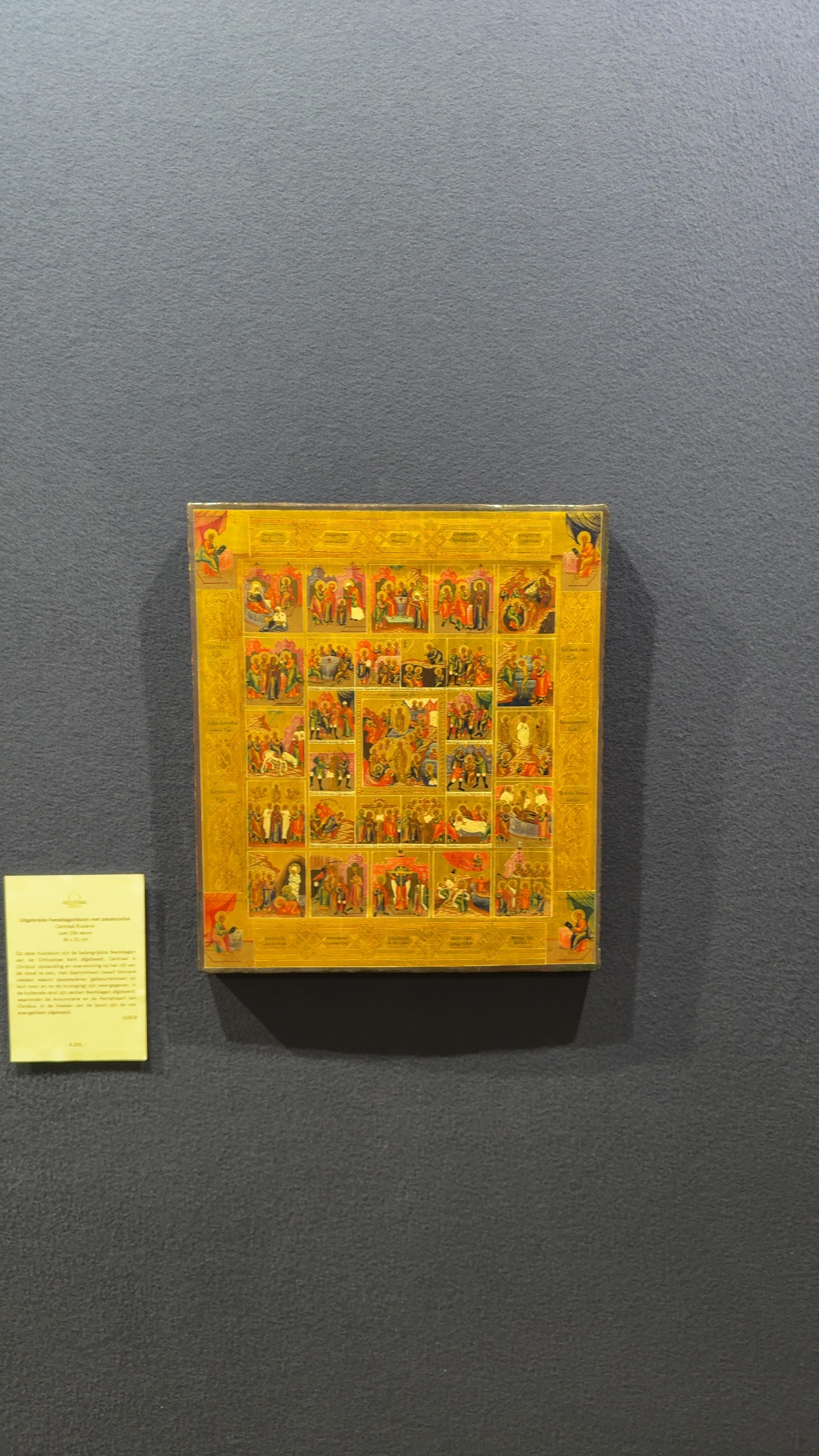
This is a fine and comprehensive example of a Russian 'hagiographical' or multi-scene icon, specifically an extended Feast Day icon (Prazdniki). The central panel correctly depicts the Anastasis, or the Harrowing of Hell, which is the traditional Orthodox representation of the Resurrection. This is surrounded by scenes from the Great Feasts of the Orthodox liturgical year. Further miniature scenes detail the Passion of Christ, and the corners are occupied by the four Evangelists. This piece functions as a complete 'spiritual calendar' for a devout household, a devotional object of considerable complexity and theological depth.
CULTURAL ECHOES
Where This Object Echoes
This icon's format of a central scene surrounded by smaller narrative panels echoes the structure of medieval polyptych altarpieces in Western Europe, which also served to educate an illiterate populace on biblical events.
Ritual & Ceremonial Use
- •This icon serves as the focus for the 'krasny ugol' or 'beautiful corner', the domestic shrine in an Orthodox home where daily prayers are said and feast days are observed.
Meaning Through Time
Primarily an object of private devotion, condensing the entire liturgical cycle for a household.
Became a suppressed form of religious expression, often hidden. Concurrently, it was re-contextualized by the state as 'folk art' or national heritage, stripped of its sacred function.
Experienced a resurgence in devotional use, while also becoming a highly sought-after category for international art collectors, valued for both its spiritual and aesthetic qualities.
HISTORICAL STORY
DID YOU KNOW?
The central scene is not the empty tomb, but the 'Anastasis' (Resurrection), where Christ stands on the broken gates of Hell, pulling Adam and Eve from their tombs, symbolizing salvation for all humanity.
The crisp, miniature painting style seen here has its roots in 16th-century traditions but was famously revived in the 18th and 19th centuries by villages like Palekh, which turned to icon painting after Peter the Great's reforms lessened the demand for other courtly arts.
MATERIAL & CONDITION
Surface
The surface is egg tempera on a meticulously prepared 'levkas' (gesso) ground over a wooden panel. The extensive background is gilded with gold leaf, which appears bright and largely intact. The entire work likely has a protective coating of 'olifa' (linseed oil varnish), which would have deepened the colors over time, though it may have been professionally cleaned.
Weight & Feel
As a solid wood panel of this size (approx. 36x31 cm), it would have a substantial, dense feel, weighing several pounds. It is not a lightweight print.
Condition
The icon presents in what appears to be excellent condition for its age, housed in a modern gallery display case. The paint layer shows no significant 'ponovleniya' (restorations) or loss from what is visible. The fine details are well-preserved, suggesting it has been cared for properly and likely spent little time in a harsh environment.
RARITY ANALYSIS
Genuinely harder to find. Perhaps only dozens come to market annually. Collectors actively watch for these pieces.
Typical Characteristics
- Dozens per year at market
- Documented provenance valued
- Active collector pursuit
EXPERT ANALYSIS
Sacred Art & Material Culture Specialist
Confidence is high because the detailed gallery label provides a professional assessment (origin, date, iconography) that is fully corroborated by the visual evidence. The icon's style, complexity, and materials are all consistent with the stated attribution.
KEY EVIDENCE
- 1The gallery label confirms the object type ('Feestdagenikoon'), origin ('Centraal-Rusland'), and date ('ca. 1e h. 19e eeuw').
- 2The central iconography is clearly the Anastasis (Harrowing of Hell), typical for a Resurrection/Feast Day cycle.
- 3The fine, miniature painting style is characteristic of workshops in the Palekh/Mstyora tradition.
- 4The presence of Church Slavonic text labeling the scenes is appropriate for an authentic icon of this period.
- 5The use of a gilded background ('svet') is a hallmark of traditional icon painting, symbolizing divine light.
- 6The listed price of €4,200 provides a strong anchor for its valuation in the specialized art market.
UNCERTAINTIES
- •The icon is sealed within a frame, preventing examination of the panel's back and edges, which are key for age verification.
- •Image resolution is insufficient for microscopic examination of the craquelure or pigment.
WHAT WOULD IMPROVE CERTAINTY
- →Examine the reverse of the panel for 'shponki' (wooden support slats), their shape and placement, which are indicative of age and school.
- →Analyze the wood grain and type to confirm a 19th-century origin.
- →Use magnification (a loupe) to inspect the brushwork and the craquelure of the gesso and paint layers.
- →A conservator could use UV light to check for any in-painting or modern restorations not visible to the naked eye.
ESTIMATED VALUE
Updated: Feb 27, 2026
- Market comparables from auctions & retail
- Condition, completeness & craftsmanship
- Current collector demand & trends
- Low = quick sale, high = patient seller
For informational purposes only, not a formal appraisal.

ABOUT RELIGIOUS & DEVOTIONAL
Icons, altar pieces, prayer items, and sacred objects from world religions.
Browse all Religious & DevotionalSHARE THIS CURIOSITY
Have your own curiosities to discover?
Scan Your Curiosity
COMMENTS
No comments yet. Be the first to share your thoughts!
Sign in to leave a comment