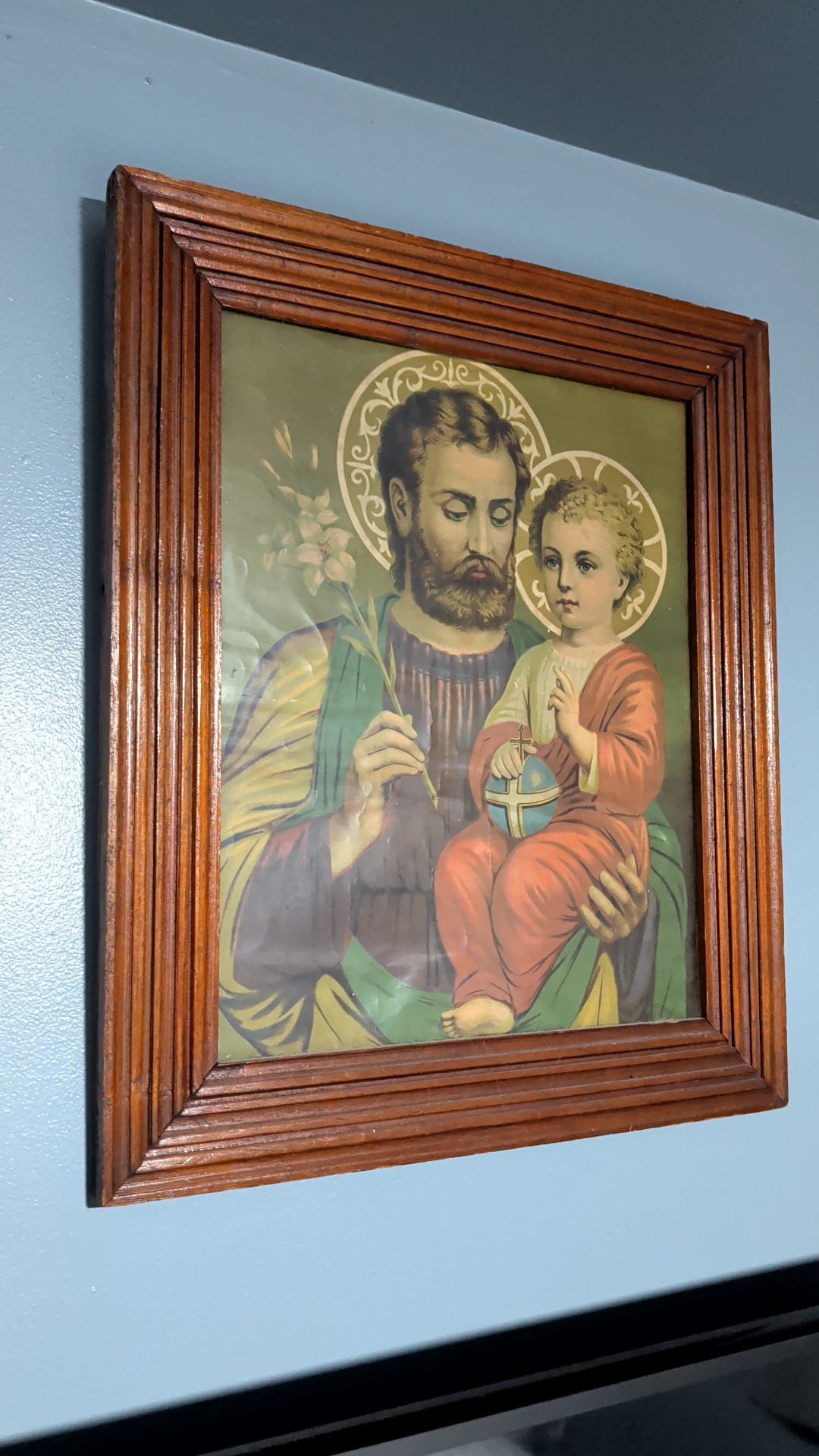
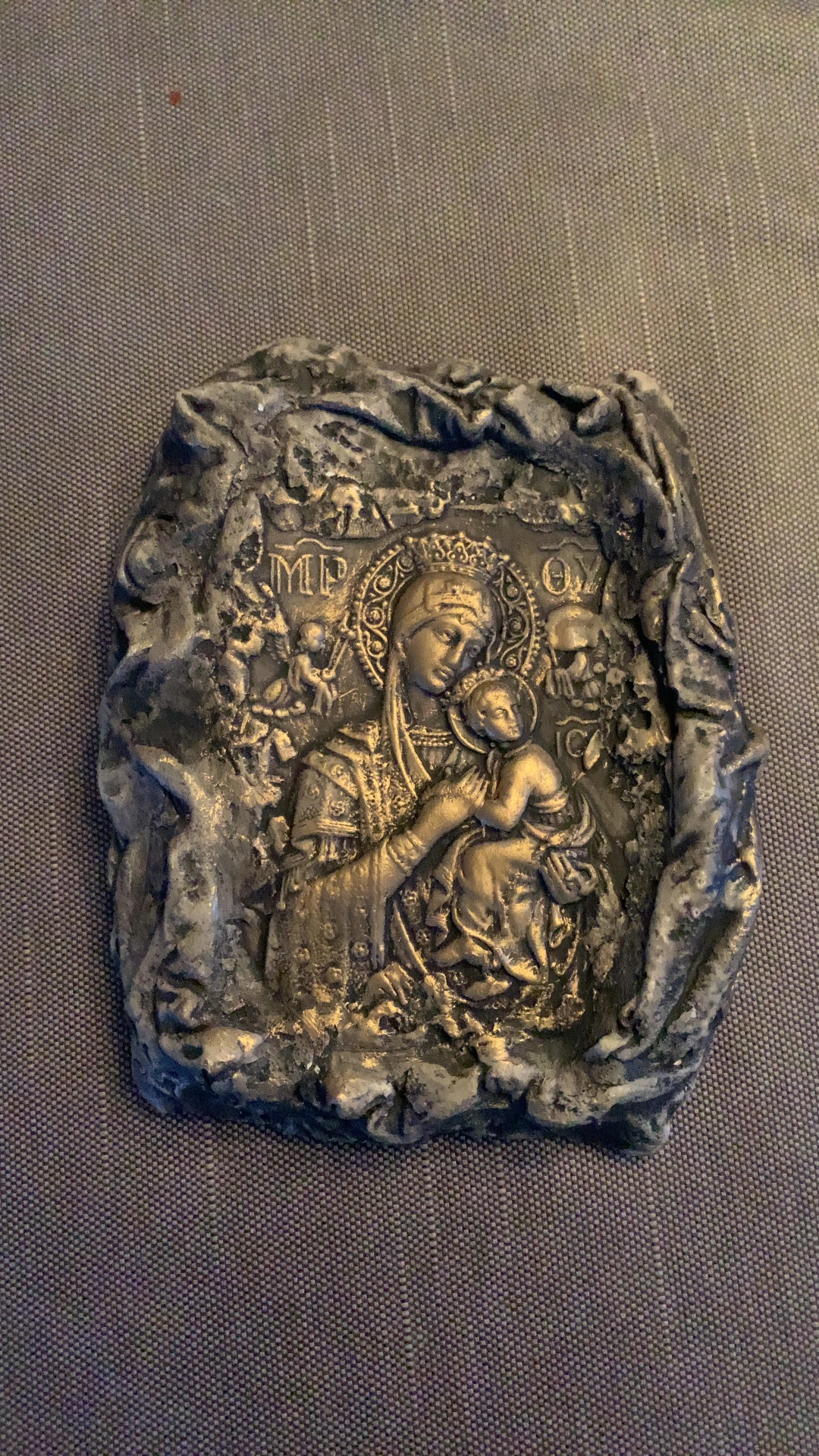
Mid-20th Century Lithographic Print of Saint Joseph and the Christ Child
QUICK FACTS
Era
Mid-20th Century (c. 1940s-1970s)
Origin
🌍 International
Rarity
Ordinary (3/10)
Discovered
Feb 12, 2026
2 weeks ago
DESCRIPTION
This appears to be a chromolithographic print depicting Saint Joseph holding the Christ Child. Saint Joseph is shown with his traditional attributes: a beard, a staff, and white lilies, symbolizing purity and his role as the Virgin Mary's chaste spouse. The Christ Child, seated on Joseph's lap, holds a globus cruciger, a symbol of Christ's dominion over the world, often featuring a cross, though here it appears as a globe. Both figures have halos rendered as decorative concentric circles, a common motif in popular religious prints to denote sanctity. The print is housed in a simple, machine-made wooden frame, likely pine or a similar softwood, with a grooved or reeded profile.
CULTURAL ECHOES
Where This Object Echoes
Devotional prints of saints and the Holy Family were a cornerstone of private religious practice in Catholic homes across Europe and the Americas, especially after the Council of Trent encouraged visual aids for piety.
Ritual & Ceremonial Use
- •Private prayer and veneration in homes, often placed on an altar or prayer corner.
- •Gift-giving for religious milestones such as First Communion, Confirmation, or weddings.
Meaning Through Time
These prints were primarily understood as accessible tools for fostering personal piety and decorating Catholic homes with sacred imagery, reflecting widespread devotion to specific saints.
While still serving devotional purposes for some, these prints are also collected as nostalgic Americana or 'vintage kitsch,' valued for their aesthetic and historical representation of popular religious iconography rather than solely for sacred function.
HISTORICAL STORY
DID YOU KNOW?
Saint Joseph is the patron saint of the Universal Church, fathers, workers, carpenters, and a happy death. He is often depicted with a lily, a symbol of purity, and a carpenter's tool.
The globus cruciger, held by the Christ Child in many depictions, has been a symbol of Christian authority since the Middle Ages, representing Christ's rule over the Earth, and by extension, the authority of Christian monarchs.
MATERIAL & CONDITION
Surface
The print itself appears to be a chromolithograph, characterized by its multiple layers of color, which can create a somewhat flat yet vibrant image. The surface behind the figures shows some visible aging and discoloration, likely foxing or general paper yellowing. The frame is a smooth, varnished wood with distinct machine-cut grooves.
Weight & Feel
Based on the frame and presumed paper print, the object is likely lightweight to moderately heavy, as would be typical for a framed graphic print of this size.
Condition
The print exhibits visible discoloration behind the figures. The frame shows minor wear consistent with age and display, but no significant damage like cracks or major chipping. The protective covering over the print (glass or acrylic) appears intact, though glare limits full assessment.
RARITY ANALYSIS
Standard antiques commonly found at estate sales and flea markets. Plentiful supply meets modest demand.
Typical Characteristics
- Moderate production runs
- Common at estate sales
- Entry-level collectibles
EXPERT ANALYSIS
Sacred Art & Material Culture Specialist
The iconography is distinct and the printing and framing techniques are characteristic of mid-20th century popular religious art, allowing for a strong identification of type and era.
KEY EVIDENCE
- 1Iconography clearly depicts Saint Joseph with Christ Child, identified by lilies and globus cruciger.
- 2Printing style (chromolithography) and visual quality suggest mass production common from mid-20th century.
- 3Frame characteristics (machine-grooved wood, simple construction) are consistent with prints of that era.
- 4General condition of paper (yellowing, possible foxing) aligns with typical aging for a print of its age.
WHAT WOULD IMPROVE CERTAINTY
- →Carefully remove the backing to check for any printer's marks, distributor labels, or edition information.
- →Inspect the print directly out of the frame for any signatures or dates that might be obscured.
- →Examine the paper quality and details of the image more closely to confirm printing technique.
ESTIMATED VALUE
Updated: Feb 27, 2026
- Market comparables from auctions & retail
- Condition, completeness & craftsmanship
- Current collector demand & trends
- Low = quick sale, high = patient seller
For informational purposes only, not a formal appraisal.
ABOUT RELIGIOUS & DEVOTIONAL
Icons, altar pieces, prayer items, and sacred objects from world religions.
Browse all Religious & DevotionalSHARE THIS CURIOSITY
Have your own curiosities to discover?
Scan Your Curiosity
COMMENTS
No comments yet. Be the first to share your thoughts!
Sign in to leave a comment