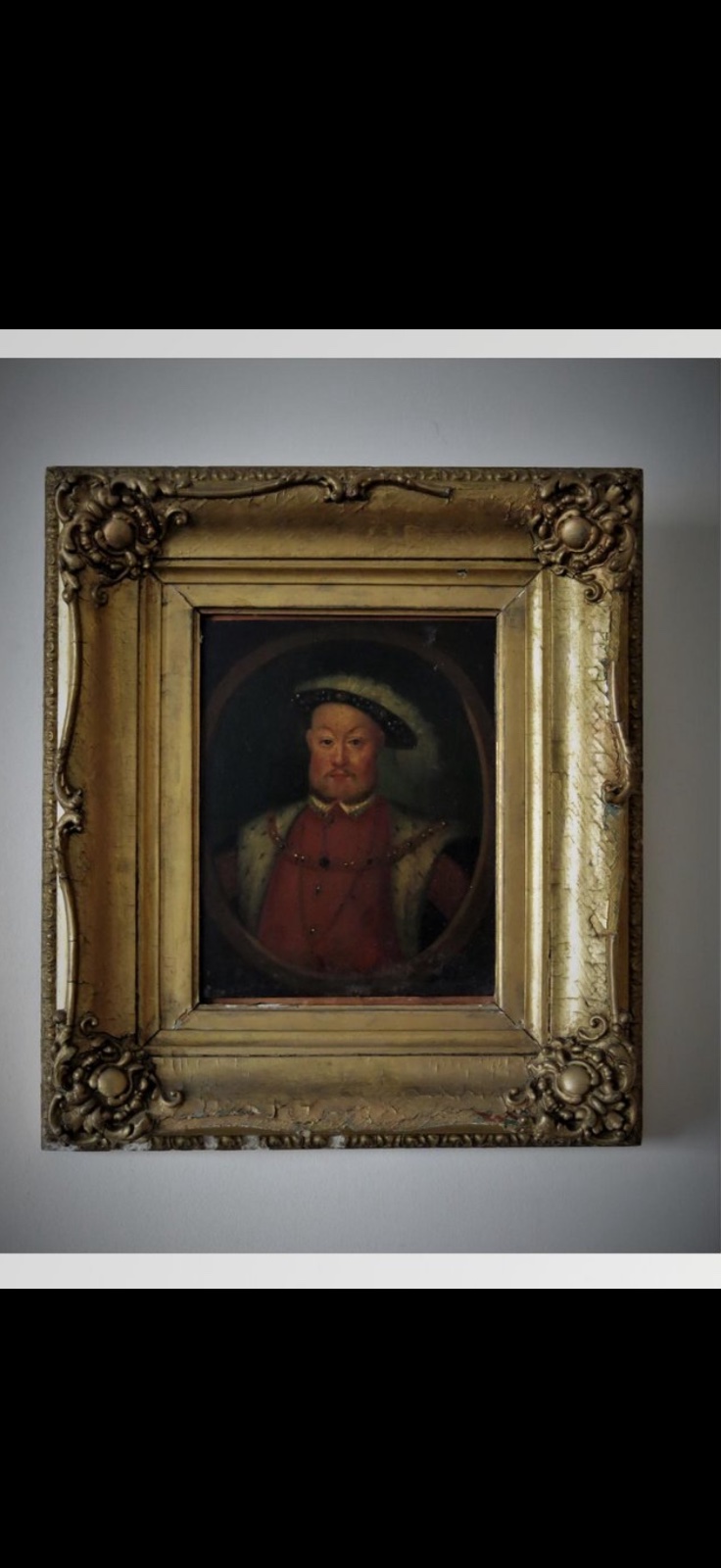
Portrait of King Henry VIII, after Hans Holbein the Younger
QUICK FACTS
Type
Museum Object
Categories
Era
c. 1820-1900
Origin
🇬🇧 United Kingdom
Rarity
Average (4/10)
Discovered
Jan 29, 2026
1 months ago
DESCRIPTION
This is a competently executed but stylistically formulaic copy of a well-established prototype of King Henry VIII, originally conceived by Hans Holbein the Younger. The artist has focused on the iconographic details—the ermine trim, the jeweled chain and doublet—which were signs of the King's immense wealth and power. However, the handling of the paint lacks the psychological depth and subtle modeling of flesh that are the hallmarks of Holbein's own hand. The work is likely painted on a wood panel, a common support for such historical copies, and set within a feigned oval cartouche.
CULTURAL ECHOES
Where This Object Echoes
The mass production of portrait busts of Emperors served a similar function: to distribute the image of power throughout the empire and reinforce the leader's authority and presence in public and private spaces.
Ritual & Ceremonial Use
- •The practice of creating a 'Long Gallery' in English and Scottish country houses, where a series of historical and family portraits were hung to demonstrate lineage, taste, and historical importance.
Meaning Through Time
A terrifying projection of absolute power and the divine right of kings, commissioned by the monarch himself.
A symbol of national history and ancestral prestige, often used by the gentry and rising industrial class to confer historical legitimacy on their homes.
A decorative object and historical curiosity, representing a famous and dramatic period of English history.
HISTORICAL STORY
DID YOU KNOW?
The original powerful, confrontational portrait of Henry VIII by Holbein was part of a large mural at Whitehall Palace, which was destroyed by fire in 1698. Our entire understanding of this seminal work comes from preparatory drawings and copies made before its destruction.
During the 19th-century 'Gothic Revival' and 'Tudor Revival' movements, owning a dark, 'ancestral-looking' portrait like this was a key element of interior design, suggesting a long and noble family history, even if it was purchased just the week before.
MATERIAL & CONDITION
Surface
The paint layer is obscured by a darkened, yellowed varnish, which creates a deep, 'ancestral' chiaroscuro but conceals the original palette. A network of fine age craquelure is likely present under the varnish, and a notable wide vertical crack or deep scratch mars the surface in the upper right. The gesso and bole of the frame are exposed through extensive chipping of the gilt.
Weight & Feel
Assuming an oil-on-panel construction, the work would feel dense and solid. The substantial giltwood frame would contribute significantly, making the entire object feel weighty and of some consequence.
Condition
The painting requires professional cleaning to remove the discolored varnish. There is a prominent vertical scratch or fissure. The frame is in poor to fair condition, with significant losses to the gesso and gilt surface, particularly on the outer edges and lower member, which detract from its overall decorative value.
RARITY ANALYSIS
Typical antique shop fare. Requires some searching but regularly available. This is where most genuine antiques fall.
Typical Characteristics
- Standard antique shop items
- Regularly available
- Moderate collector interest
EXPERT ANALYSIS
Museum-Trained Art Historian
Confidence is high that this is a 19th-century copy after Holbein. The convergence of the copyist's style and the period of the frame provide strong, corroborating evidence for this conclusion. Absolute certainty would require physical inspection of the materials.
KEY EVIDENCE
- 1The iconographic subject is clearly Henry VIII, based on prototypes by Hans Holbein the Younger.
- 2The painting exhibits a flattened, rigid execution typical of a copyist's hand, rather than the lifelike modeling of a 16th-century master.
- 3The heavy giltwood frame is in a Rococo-revival style, firmly dating it to the 19th century.
- 4The dark, yellowed varnish is consistent with an oil painting of significant age, likely 19th century.
- 5There is a prominent vertical crack or damage mark on the painting's surface that requires assessment.
UNCERTAINTIES
- •The image quality is insufficient to analyze the brushwork or craquelure pattern in detail.
- •The painting is obscured by a heavy, discolored varnish layer, making a true assessment of color and condition difficult.
- •The condition of the frame is poor, with significant losses that impact its value.
WHAT WOULD IMPROVE CERTAINTY
- →Photograph the painting out of its frame to inspect the edges and support (canvas or panel).
- →Take a clear, detailed image of the reverse of the painting and frame to look for labels, stamps, or inscriptions.
- →Examine the surface under raking light to better understand the texture, craquelure, and condition.
- →Consult a professional conservator for an opinion on cleaning and to assess the crack in the paint surface.
ESTIMATED VALUE
Updated: Feb 27, 2026
- Market comparables from auctions & retail
- Condition, completeness & craftsmanship
- Current collector demand & trends
- Low = quick sale, high = patient seller
For informational purposes only, not a formal appraisal.

SHARE THIS CURIOSITY
Have your own curiosities to discover?
Scan Your Curiosity
COMMENTS
No comments yet. Be the first to share your thoughts!
Sign in to leave a comment