Antique Engraving of Lumley Castle, County Durham
QUICK FACTS
Categories
Era
Circa 1820s-1840s
Origin
🇬🇧 United Kingdom
Artist/Maker
Edward Blore (draughtsman), Robert Kirkwood (engraver)
Rarity
Average (4/10)
Discovered
Jan 18, 2026
1 months ago
DESCRIPTION
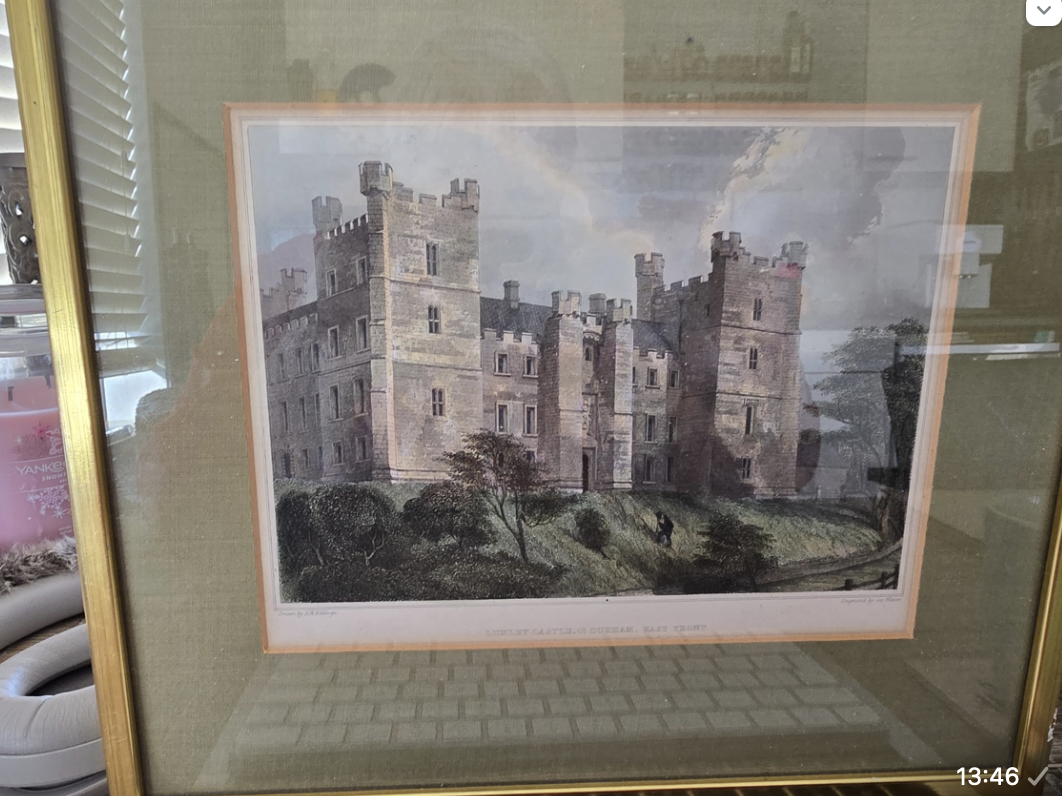
This appears to be an antique engraving depicting Lumley Castle in Chester-le-Street, County Durham, England. The image shows the impressive castellated structure from a slightly elevated perspective, with trees and figures in the foreground. The second image, likely a detail of another similar print from the same series, presents a different view of Lumley Castle, featuring an equestrian figure and additional architectural details. These prints would have been part of a larger publication documenting historical British architecture.
CULTURAL ECHOES
Where This Object Echoes
The appreciation for picturesque landscapes and historic ruins, often depicted with dramatic skies and detailed architectural accuracy, was a hallmark of the Romantic era in Britain.
The systematic study and documentation of ancient and historical artifacts, buildings, and sites, leading to the creation of detailed visual records like these engravings.
Ritual & Ceremonial Use
- •The custom of decorating homes and studies with prints reflecting historical architecture, natural beauty, or famous landmarks.
- •The practice of collecting 'extra-illustrated' books, where prints like these would be inserted into existing volumes to enhance their visual content.
Meaning Through Time
These prints served as 'travel souvenirs' or educational tools, allowing viewers to appreciate historical sites they might never visit in person.
Engravings like these are valued today for their aesthetic qualities, historical documentation, and as genuine period pieces, rather than purely informational content.
HISTORICAL STORY
DID YOU KNOW?
Lumley Castle, depicted in these engravings, was built in the late 14th century and is now a popular hotel, retaining much of its historic grandeur.
Engravings like these were often published in 'antiquarian' volumes dedicated to the history and architecture of specific regions or the country as a whole, making them vital records even today.
MATERIAL & CONDITION
Surface
The prints exhibit the characteristic finely-etched lines and tonal variations typical of copperplate engravings. The visible paper appears to have some foxing and age-toning, consistent with period paper. The overall impression is one of delicate detail.
Weight & Feel
Given the size visible in the image, assuming standard sheet paper, the print itself would be very lightweight. The framing, with glass and a wooden or metal frame, would add moderate weight, likely a few pounds.
Condition
The prints appear to be laid down and mounted within a matt, showing some signs of age-toning and potentially mild foxing on the paper. The frame itself shows some wear consistent with age and handling. Without a closer inspection of the print outside the frame, it is difficult to determine condition comprehensively, but typical signs of age are present.
RARITY ANALYSIS
Typical antique shop fare. Requires some searching but regularly available. This is where most genuine antiques fall.
Typical Characteristics
- Standard antique shop items
- Regularly available
- Moderate collector interest
EXPERT ANALYSIS
Museum-Trained Art Historian
The visible artist/engraver names and the identifiable architectural subject establish the core identification of the print. The stylistic execution is typical of the period, providing good confidence in the estimated era. A lack of visible publication details prevents a higher confidence without further inspection.
KEY EVIDENCE
- 1The visible inscription 'Drawn by E.W. Billings' (or E. Blore judging by typical collaborations) and 'Engraved by Rob. Kirkwood' specifically point to known artists and engravers of the period.
- 2The subject matter, Lumley Castle, is a well-documented historic English site, fitting the common themes of 19th-century topographical prints.
- 3The style of engraving, characterized by fine lines and cross-hatching for shading, is consistent with copperplate printing methods of the early to mid-19th century.
- 4The Dutch framer's label, 'Ouderal b.v., Inlijsten en Restaureren' ('Framing and Restoration'), indicates a professional handling at some point, often associated with a period of collecting or appreciation.
UNCERTAINTIES
- •The precise publication and edition are not immediately visible from these images, which would be helpful for more precise dating and context.
- •The quality of the images prevents a detailed examination of any potential damage or repairs to the print outside of general age-toning.
WHAT WOULD IMPROVE CERTAINTY
- →Carefully examine the full text below the image for publication details, such as the publisher's name and date.
- →Remove the print from the frame (if safely possible) to inspect the full sheet for watermarks, verso inscriptions, or other condition issues not visible through the glass.
- →High-resolution images of the engraved title and artist/engraver credits would allow for verification against known catalogues raisonnés for these artists.
- →Inspect the frame itself for any labels or stamps that might indicate its age or origin, as this can sometimes provide clues about the print's history.
ESTIMATED VALUE
Updated: Feb 26, 2026
- Market comparables from auctions & retail
- Condition, completeness & craftsmanship
- Current collector demand & trends
- Low = quick sale, high = patient seller
For informational purposes only, not a formal appraisal.
ABOUT PRINTS & POSTERS
Vintage prints, posters, advertising signs, and graphic art.
Browse all Prints & PostersSHARE THIS CURIOSITY
Have your own curiosities to discover?
Scan Your Curiosity
COMMENTS
No comments yet. Be the first to share your thoughts!
Sign in to leave a comment