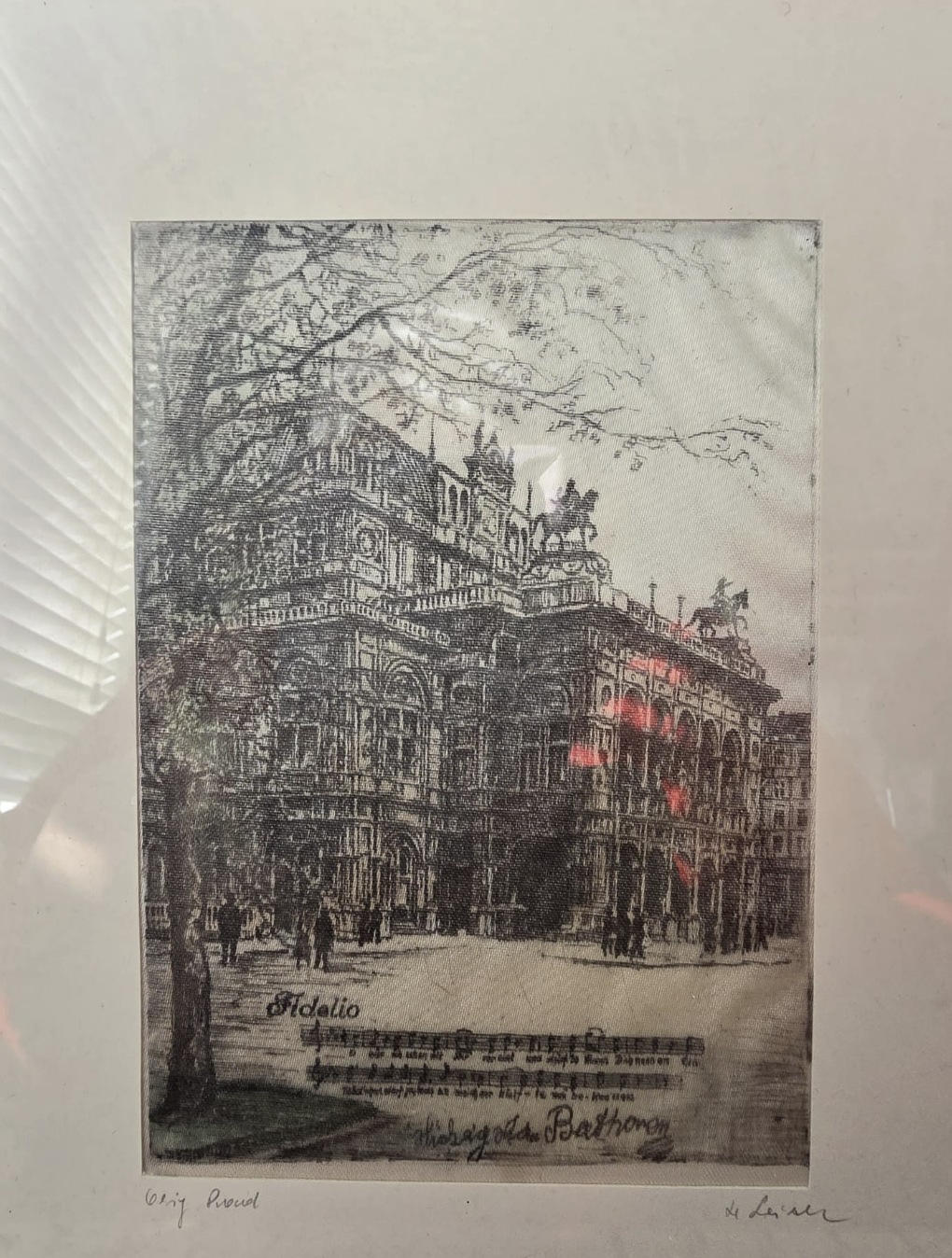
Engraved View of Vienna State Opera with 'Fidelio' Thematic Elements
QUICK FACTS
Categories
Era
Early 20th Century
Origin
🇦🇹 Austria
Artist/Maker
H. Leiser
Rarity
Average (4/10)
Discovered
Jan 18, 2026
1 months ago
DESCRIPTION
This appears to be a framed intaglio print, likely an etching or engraving, depicting a detailed architectural rendering of the Vienna State Opera (Wiener Staatsoper). The image is monochromatic, executed with fine lines and cross-hatching, suggesting a copper plate or similar printmaking technique. In the foreground, stylized branches frame the upper portion of the building, and figures are visible on the street below. Key thematic elements, 'Fidelio' and a fragment of musical notation, are incorporated into the composition, along with what appears to be a signature, 'W. Lesser', and perhaps 'Georg Proud' or similar script at the bottom left.
CULTURAL ECHOES
Where This Object Echoes
The grandeur of the Vienna State Opera aligns with the architectural aspirations of the Romantic era, celebrating public institutions and high culture.
Architectural views and cityscapes were popular subjects for printmakers across Europe, particularly as souvenirs or artistic representations, a tradition stretching back centuries.
Ritual & Ceremonial Use
- •Attending opera performances as a social and cultural ritual, particularly within the 'Ringstraße society' of late 19th and early 20th century Vienna.
- •Collecting city views and artistic prints as mementos of travel or cultural engagement.
Meaning Through Time
The opera house represented the cultural pinnacle of the Austro-Hungarian Empire, a symbol of its artistic prowess and societal sophistication.
After its destruction during the war and subsequent rebuilding, the Vienna State Opera became a symbol of national resilience and cultural revival.
HISTORICAL STORY
DID YOU KNOW?
Ludwig van Beethoven's only opera, 'Fidelio', premiered in 1805 and is a powerful tale of marital love and sacrifice overcoming tyranny, making it a fitting artistic association for many opera houses.
The Vienna State Opera was one of the first major buildings on the Vienna Ringstraße, a grand boulevard built during the mid-19th century that replaced the old city walls.
MATERIAL & CONDITION
Surface
The printing medium appears to be an intaglio process, likely an etching or engraving on what looks to be a woven paper, possibly laid paper, exhibiting a fine, slightly irregular texture consistent with early 20th-century printmaking practices. The dense lines create a rich tonal range, typical of such techniques.
Weight & Feel
Given the size appears to be moderate and it's framed under glass, it likely has a moderate weight, consistent with a framed paper print.
Condition
The print itself seems to exhibit some toning or discoloration across the paper, particularly towards the edges, which is common with age. The framing appears adequate, but without viewing the reverse or the print unframed, it's difficult to assess acidification or other preservation issues. The surface shows some reflections through the glass, but no obvious tears or major creases are visible.
RARITY ANALYSIS
Typical antique shop fare. Requires some searching but regularly available. This is where most genuine antiques fall.
Typical Characteristics
- Standard antique shop items
- Regularly available
- Moderate collector interest
EXPERT ANALYSIS
Museum-Trained Art Historian
Confidence is good as the imagery clearly identifies the subject and suggests an intaglio print. However, the precise nature of the print (original vs. reproduction, specific artist) and its exact age require clearer views of identifying marks.
KEY EVIDENCE
- 1The detailed architectural depiction is characteristic of intaglio printmaking techniques like etching or engraving.
- 2The visible 'Fidelio' text and musical notation link the subject directly to the famed opera by Beethoven.
- 3The signature 'W. Lesser' and other script indicates an artist and potentially a title or edition.
- 4The overall aesthetic, paper texture, and framing suggest an early-to-mid 20th-century period for the print.
UNCERTAINTIES
- •The legibility of the signature and additional text 'Georg Proud' is somewhat compromised by image resolution and reflections, hindering definitive artist attribution.
- •Without closer inspection, it's difficult to ascertain if this is an original artist's proof, a limited edition print, or a more widely distributed reproduction.
- •The exact printmaking technique (etching, engraving, drypoint, mezzotint) is hard to confirm without examining plate marks or texture more closely.
WHAT WOULD IMPROVE CERTAINTY
- →Obtain high-resolution close-up images of the signature(s) and any numerical markings (edition numbers).
- →Examine the edges of the print for a plate mark, which would confirm an intaglio process.
- →Photograph the reverse of the frame/print for any gallery labels, stamps, or inventory numbers.
- →Carefully remove the print from the frame to inspect the paper quality, watermarks, and full sheet dimensions.
ESTIMATED VALUE
Updated: Feb 26, 2026
- Market comparables from auctions & retail
- Condition, completeness & craftsmanship
- Current collector demand & trends
- Low = quick sale, high = patient seller
For informational purposes only, not a formal appraisal.
ABOUT PRINTS & POSTERS
Vintage prints, posters, advertising signs, and graphic art.
Browse all Prints & PostersSHARE THIS CURIOSITY
Have your own curiosities to discover?
Scan Your Curiosity
COMMENTS
No comments yet. Be the first to share your thoughts!
Sign in to leave a comment