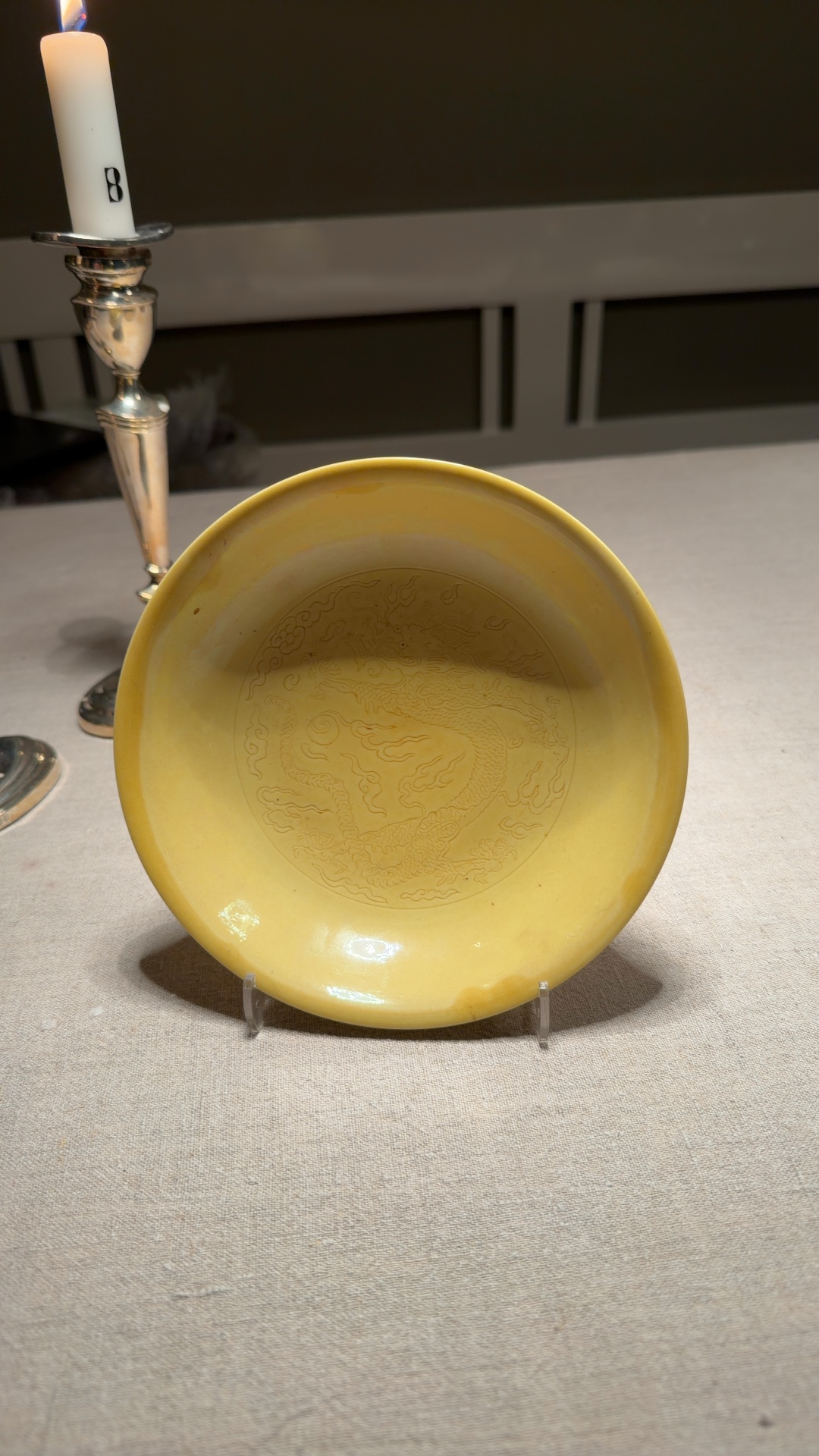
Chinese Yellow-Glazed Incised 'Dragon' Dish with Apocryphal Kangxi Mark
DESCRIPTION
This appears to be a Chinese porcelain shallow dish or saucer, monochromatic yellow-glazed, with a finely incised (anhua) decoration of what seems to be a five-clawed dragon amid clouds within the central medallion, and possibly a border motif around the rim. The underside reveals a white-glazed footring area with a blue underglaze six-character reign mark, which reads 'Da Qing Kangxi Nian Zhi' (大清康熙年製), meaning 'Made during the Great Qing, Kangxi Period'. The yellow glaze is typically associated with imperial wares.
CULTURAL ECHOES
Where This Object Echoes
The use of yellow imperial wares with dragon motifs during the Qing dynasty was restricted to the emperor's court.
The mastery of monochrome glazes was also a hallmark of certain Japanese traditions, though their specific colors and functions differed.
Ritual & Ceremonial Use
- •Serving food or tea in imperial ceremonies or daily court life.
- •Gift-giving within the imperial family or to favored officials.
- •Display as symbols of power and status within imperial residences.
Meaning Through Time
A direct representation of imperial power, exclusivity, and divine right. Usage by commoners was forbidden.
An object of aspiration, reflecting a desire to produce wares of imperial quality; also a collectible item for a burgeoning middle class.
An art object and historical artifact, valued for its craftsmanship, aesthetic appeal, and connection to imperial history, even if apocryphal.
HISTORICAL STORY
DID YOU KNOW?
The five-clawed dragon was an exclusive symbol of the Chinese emperor; its presence on porcelain indicates an imperial connection or aspiration.
The yellow glaze, known as 'imperial yellow,' was created by adding iron to the glaze and firing it at a relatively low temperature, a technique perfected during the Ming and Qing dynasties.
MATERIAL & CONDITION
Surface
The dish exhibits a glossy, vibrant imperial yellow glaze with subtle variations in tone. The central decoration appears to be incised (anhua), creating a barely perceptible relief under the glaze. The footrim is unglazed with a bisque-fired surface, while the inner well of the base is white-glazed, contrasting the external yellow.
Weight & Feel
Based on its size and porcelain construction, the dish would feel substantial yet refined, likely moderately weighty.
Condition
The overall condition appears good with minor surface wear. There are visible firing imperfections and some glaze irregularities, particularly on the footrim and around the mark, which are common for wares of this type and age. A small dark stain or inclusion is visible on the inner base near the mark.
RARITY ANALYSIS
Typical antique shop fare. Requires some searching but regularly available. This is where most genuine antiques fall.
Typical Characteristics
- Standard antique shop items
- Regularly available
- Moderate collector interest
EXPERT ANALYSIS
Asian Art Specialist
Confidence is moderate due to the clear visual indicators of imperial-style yellow glaze and incised dragon, typical of Chinese porcelain. However, the omnipresent issue of apocryphal Kangxi marks means definitive dating without further in-hand inspection or scientific testing is not possible.
KEY EVIDENCE
- 1The deep yellow monochrome glaze is characteristic of imperial Chinese porcelain.
- 2The incised five-clawed dragon motif is a royal symbol, indicating imperial association.
- 3The base bears a six-character 'Da Qing Kangxi Nian Zhi' reign mark in underglaze blue, a common marker on Chinese imperial-style ceramics.
- 4The footrim has a natural, unglazed finish characteristic of traditional Chinese porcelain.
UNCERTAINTIES
- •The Kangxi reign mark is extremely common for later copies and reproductions; its presence alone does not guarantee Kangxi period manufacture.
- •The specific shade of yellow and the clarity of the incised detail would need close examination to determine period authenticity beyond style.
WHAT WOULD IMPROVE CERTAINTY
- →Obtain high-resolution, clear photographs of the incised dragon detail and the rim for closer examination of the decoration's fineness.
- →Examine photographs of the footrim and the inner paste for signs of age and typical Kangxi era ceramic body characteristics.
- →Consult with a reputable dealer or auction house specializing in Chinese ceramics for an in-hand examination and comparison with known authentic pieces.
- →If significant value is suspected, consider thermoluminescence (TL) testing to ascertain the firing date of the porcelain body.
ESTIMATED VALUE
Updated: Feb 27, 2026
- Market comparables from auctions & retail
- Condition, completeness & craftsmanship
- Current collector demand & trends
- Low = quick sale, high = patient seller
For informational purposes only, not a formal appraisal.
SHARE THIS CURIOSITY
Have your own curiosities to discover?
Scan Your Curiosity
COMMENTS
No comments yet. Be the first to share your thoughts!
Sign in to leave a comment