De Porceleyne Fles Delft Charger/Plate with Handwritten Marks
QUICK FACTS
Categories
Era
Early 20th Century (circa 1900-1930)
Origin
🇳🇱 Netherlands
Brand
De Porceleyne Fles
Artist/Maker
Leon Senf
Rarity
Uncommon (5/10)
Discovered
Jan 25, 2026
1 months ago
DESCRIPTION
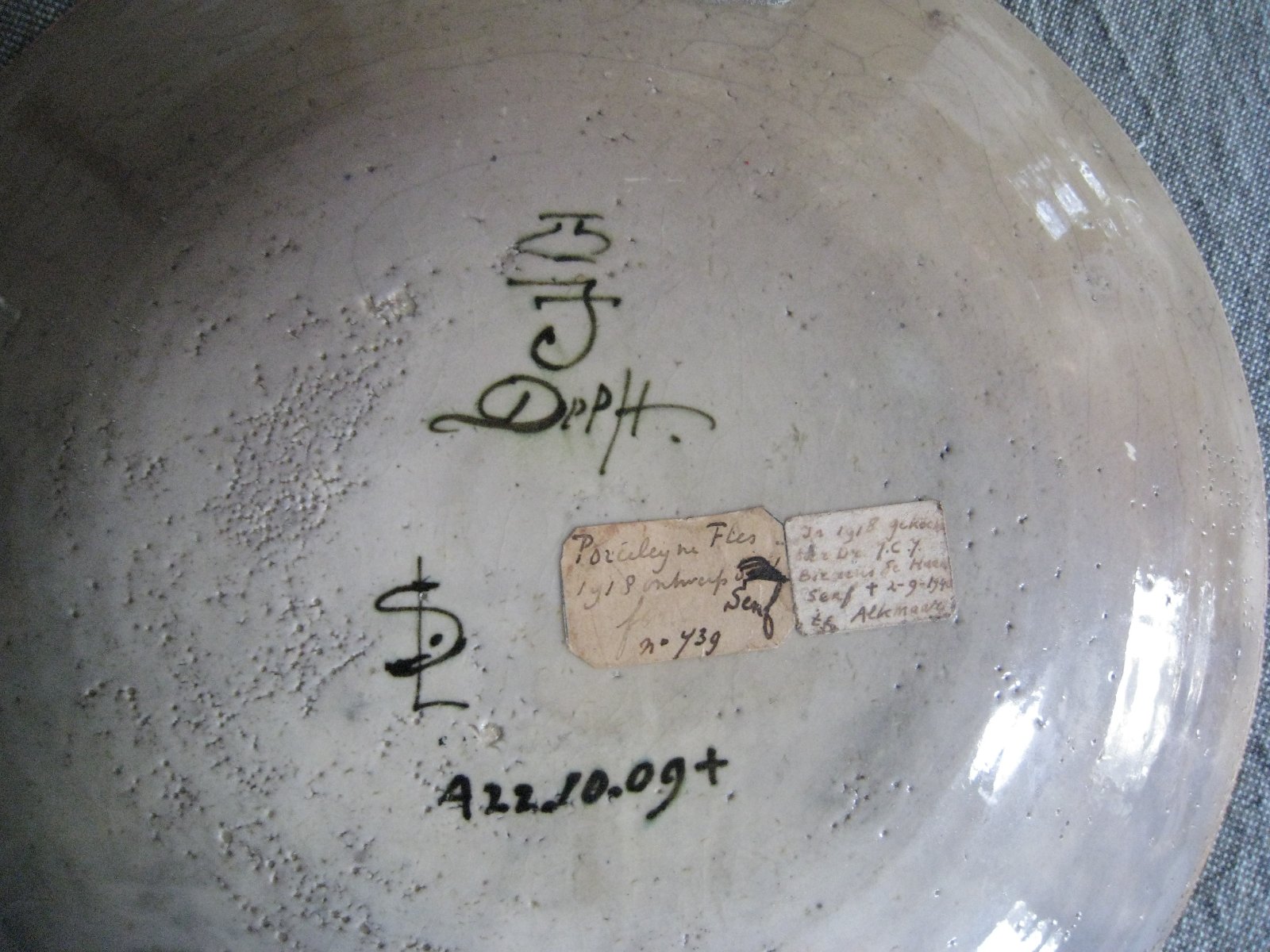
This appears to be the underside of a ceramic charger or plate, likely Delftware. What immediately catches my eye is the distinctive 'DP' monogram with a flourish and a single capital 'F' above it, a known mark for De Porceleyne Fles (The Porcelain Jar) factory in Delft, Netherlands. The hand-painted nature of the mark, rather than a transfer, suggests a period item from this renowned factory. There are also several handwritten paper labels, one of which explicitly mentions 'Porceleyne Fles' and an 'n. 439', possibly an inventory or pattern number. The glaze exhibits fine crazing and pinprick imperfections typical of traditional tin-glazed earthenware.
CULTURAL ECHOES
Where This Object Echoes
Delftware production in the Netherlands began in the 17th century, heavily influenced by the blue-and-white porcelain imported from China, particularly during the Ming Dynasty.
Tin-glazed earthenware, known as faience in France and majolica in Italy, was a widespread technique across Europe, allowing for vibrant painted decoration on an opaque white ground.
Ritual & Ceremonial Use
- •Display in formal dining rooms or cabinets: Large decorative chargers and plates like this were often intended for display as status symbols rather than for daily use.
- •Gift-giving: High-quality Delftware from renowned factories was a popular gift, particularly commemorating special occasions.
Meaning Through Time
Delftware symbolized trade, innovation, and national pride in the Netherlands, offering a European equivalent to coveted Asian imports.
During the Arts & Crafts movement and renewed interest in historical styles, Delftware became a symbol of traditional craftsmanship and national heritage, particularly for collectors.
HISTORICAL STORY
DID YOU KNOW?
Delftware was originally created in the Netherlands in the 17th century as a more affordable alternative to imported Chinese porcelain, often mimicking its blue and white aesthetics.
De Porceleyne Fles is the sole remaining Delftware factory from the 17th century that still produces hand-painted Delft Blue ceramics today.
MATERIAL & CONDITION
Surface
The underside presents a creamy, off-white tin glaze with visible crazing, hinting at the earthenware body beneath. Scattered pinprick imperfections and slight variations in glaze thickness are present, indicative of the hand-glazing process. There's also some rough, gritty texture in places, possibly from kiln residue or under-fired glaze.
Weight & Feel
Based on the typical construction of Delftware plates of this size, it would likely feel substantial but not overly heavy, consistent with tin-glazed earthenware.
Condition
The surface shows clear crazing, which is a network of fine cracks in the glaze, common with older earthenware due to differing expansion rates of the body and glaze. There are also signs of surface grime and age-related discoloration, along with visible paper labels, suggesting minimal intervention or restoration.
RARITY ANALYSIS
Genuine antiques with fewer examples on the market. Named makers, documented provenance, or early production examples.
Typical Characteristics
- Limited production
- Named makers
- Growing collector demand
EXPERT ANALYSIS
Decorative Arts Specialist
The visible factory mark is a strong indicator of the manufacturer, and the overall ceramic characteristics are consistent with Delftware of the perceived period. The paper labels provide additional contextual clues, leading to a high level of confidence in the identification of the maker and general era.
KEY EVIDENCE
- 1Distinctive hand-painted 'DP' monogram with 'F' mark, consistent with De Porceleyne Fles Delft.
- 2Visible crazing and glaze imperfections typical of tin-glazed earthenware.
- 3Handwritten paper labels, one explicitly naming 'Porceleyne Fles' and mentioning '1918', suggesting early 20th-century documentation.
- 4The overall appearance and specific mark style align with known production from the factory's revitalization period.
UNCERTAINTIES
- •Image clarity for specific numerical details on the paper labels is limited, making precise dating or inventory verification difficult.
- •Without seeing the decorated face, assessing the specific pattern or artist at the factory level is speculative.
WHAT WOULD IMPROVE CERTAINTY
- →Obtain clear, high-resolution images of the decorated face of the plate.
- →Carefully photograph all paper labels and any other marks, preferably with a magnifying lens, to decipher all text.
- →Measure the diameter of the plate for a more complete description.
- →Examine the footrim for additional wear patterns or unglazed areas that can reveal body color and firing characteristics.
ESTIMATED VALUE
Updated: Feb 27, 2026
- Market comparables from auctions & retail
- Condition, completeness & craftsmanship
- Current collector demand & trends
- Low = quick sale, high = patient seller
For informational purposes only, not a formal appraisal.
ABOUT DECORATIVE OBJECTS
Ceramics, silver, porcelain, glassware, and decorative arts.
Browse all Decorative ObjectsSHARE THIS CURIOSITY
Have your own curiosities to discover?
Scan Your Curiosity
COMMENTS
No comments yet. Be the first to share your thoughts!
Sign in to leave a comment