Danzig Inflationary Period Stamps (Reproduction/Novelty Item)
QUICK FACTS
Categories
Era
Mid-20th Century (1940s-1970s) for the souvenir mounting; stamps are circa 1923.
Origin
🌍 International
Rarity
Common (2/10)
Discovered
Jan 13, 2026
1 months ago
DESCRIPTION
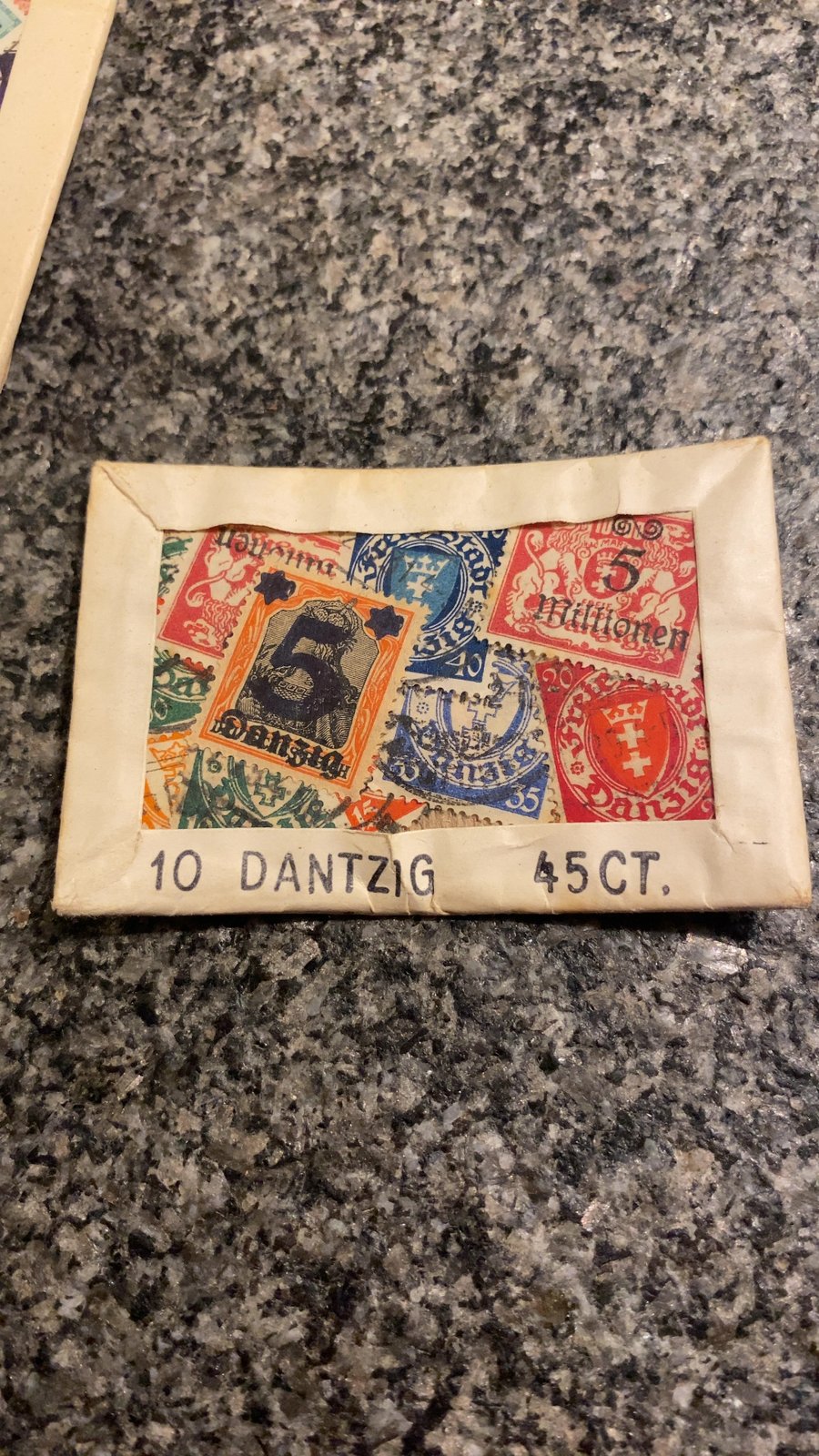
What we have here is what appears to be a novelty item or souvenir, likely from the mid-20th century, displaying reproductions of various Danzig inflationary period stamps. The pieces are arranged and mounted within a folded paper border, with '10 DANTZIG 45 CT.' printed on the front, suggesting a retail price or perhaps a catalog number from the time of its sale as a collectible item, rather than the face value or current value of the stamps themselves. These are not individual, postage-valid stamps but a composite display.
CULTURAL ECHOES
Where This Object Echoes
Similar souvenir display cards were created for hyperinflationary banknotes (e.g., German Papiermark) from the same period, allowing collectors to acquire a 'representative sample' of the era's currency.
Meaning Through Time
These denominations represented actual postal values, rapidly changing as the economy collapsed.
Mounted as a souvenir, these stamps became a tangible historical artifact representing economic instability, rather than functioning as postage.
HISTORICAL STORY
DID YOU KNOW?
During the Danzig hyperinflation, stamp values often became obsolete so quickly that post offices would issue new, higher denomination stamps within days, or even hours.
Many stamps from this period were not primarily used for postage but were hoarded by speculators or purchased by collectors keen to document the economic turmoil.
MATERIAL & CONDITION
Surface
The surface consists of several printed paper rectangles, each resembling a postage stamp, visibly glued down within a folded, cream-colored paper frame. The individual 'stamps' appear matte, consistent with printed paper, though some show slight discoloration or age toning. The outer frame is creased and shows signs of handling and slight yellowing along the edges.
Weight & Feel
Extremely lightweight, likely weighing only a few grams, consistent with thin paper and a small amount of adhesive.
Condition
The item is in fair condition, consistent with its age as a paper novelty. The paper frame shows significant creasing and some discoloration. The 'stamps' themselves appear intact, without major tears or missing pieces, but their edges are somewhat obscured by the mounting process. Given this is a souvenir with reproductions, typical stamp condition metrics (like gum or perforations) are not applicable to the 'stamps' themselves.
RARITY ANALYSIS
Older mass-produced items still widely available. Easy to find on eBay, antique malls, and estate sales in large quantities.
Typical Characteristics
- Mass produced historically
- High survival rate
- Readily available everywhere
EXPERT ANALYSIS
Philatelist
I am highly confident that this is a souvenir or novelty item containing reproductions of Danzig inflationary stamps, rather than a collection of individual, valid philatelic items, based on the clear mounting, absence of perforations, and the printed retail information.
KEY EVIDENCE
- 1The stamps are clearly mounted together in a pre-arranged, decorative fashion, encased in a folded paper frame.
- 2The text '10 DANTZIG 45 CT.' on the frame appears to be a selling price or catalog identifier for the mounted souvenir itself, not a stamp denomination.
- 3Individual perforations for separation between "stamps" are absent, strongly suggesting they were printed as a single block and cut, characteristic of reproductions.
- 4The 'stamps' depicted are consistent in design and denomination with known hyperinflationary issues from the Free City of Danzig (circa 1923).
UNCERTAINTIES
- •Lack of genuine perforations or individual gummed backs on the 'stamps.'
- •The presence of a retail price on the mounting rather than philatelic details.
WHAT WOULD IMPROVE CERTAINTY
- →Carefully inspect the reverse of the entire mounted piece for any additional markings or manufacturer information.
- →Use a magnifying glass to check if the individual 'stamps' show signs of being offset printed or digitally reproduced, which would confirm them as facsimiles.
- →Examine if the 'stamps' are actually die-cut reproductions or if they were once separate, then cut down and glued.
ESTIMATED VALUE
Updated: Feb 26, 2026
- Market comparables from auctions & retail
- Condition, completeness & craftsmanship
- Current collector demand & trends
- Low = quick sale, high = patient seller
For informational purposes only, not a formal appraisal.
ABOUT STAMPS
Rare stamps, postal history, first day covers, and philatelic treasures.
Browse all StampsSHARE THIS CURIOSITY
Have your own curiosities to discover?
Scan Your Curiosity
COMMENTS
No comments yet. Be the first to share your thoughts!
Sign in to leave a comment