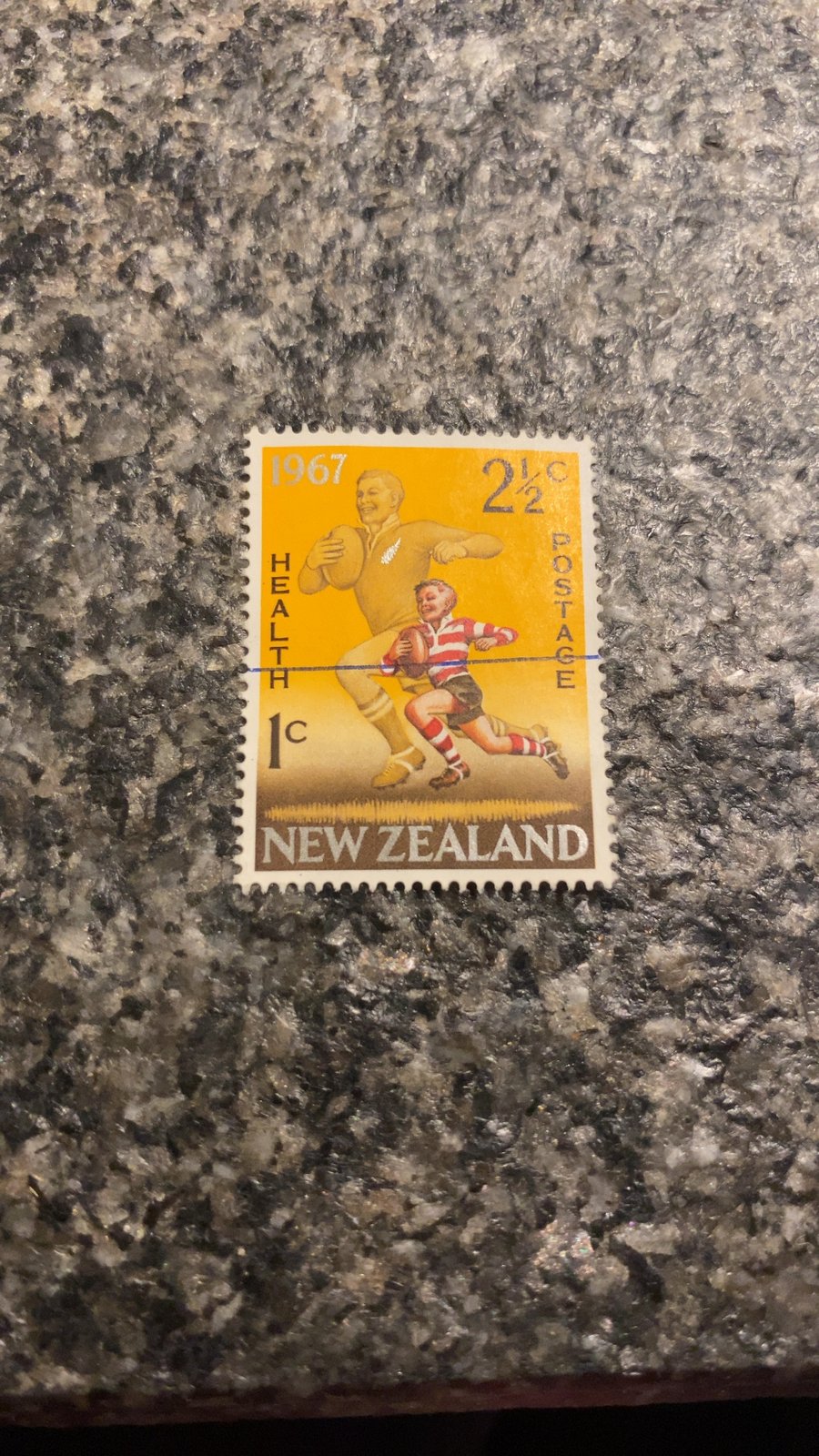
New Zealand 1967 Health Stamp - Rugby Player with Boy
QUICK FACTS
Categories
Era
Mid-20th Century (1967)
Origin
🇳🇿 New Zealand
Brand
New Zealand Post
Rarity
Average (4/10)
Discovered
Jan 13, 2026
1 months ago
DESCRIPTION
This is a New Zealand Health stamp from 1967, depicting a rugby player (likely an All Black due to the fern emblem) running with a young boy, both holding rugby balls. Health stamps typically carried a surcharge for charitable causes in addition to the postal value. The stamp shows the year '1967' and the denominations '1c HEALTH' and '2½c POSTAGE'.
CULTURAL ECHOES
Where This Object Echoes
Many Commonwealth nations, influenced by the United Kingdom, issued similar 'charity' or 'health' stamps with surcharges for public welfare causes.
Ritual & Ceremonial Use
- •The act of purchasing a Health stamp as a small philanthropic gesture, contributing to children's well-being while fulfilling postal needs.
- •The collection and display of stamps like this in albums, reflecting a broader interest in national history, sports, and social initiatives.
Meaning Through Time
These stamps represented a blend of civic duty and national identity, raising funds for health while promoting national sportsmanship and pride.
While still collected, the direct societal impact of Health stamps has lessened with changes in fundraising, making them primarily historical artifacts for collectors.
HISTORICAL STORY
DID YOU KNOW?
New Zealand was one of the first countries in the world to issue regular charitable stamps with a surcharge for public welfare, a tradition that continues to this day for children's health organizations.
The rugby player depicted on this stamp is often associated with the 'All Blacks,' New Zealand's national rugby union team, symbolizing national pride and sporting excellence.
MATERIAL & CONDITION
Surface
The stamp exhibits a matte paper surface, typical of mid-20th century photogravure printing methods. The colors appear generally well-preserved, with no obvious fading.
Weight & Feel
As a single stamp, it is exceptionally lightweight and delicate, weighing less than a gram.
Condition
The stamp appears used, indicated by the light purple cancellation mark across the center, which obscures a portion of the design, specifically the young boy and the word 'POSTAGE'. The perforations seem intact, though a precise count cannot be made from these images. Centering appears slightly off-center to the left, which is common for this era.
RARITY ANALYSIS
Typical antique shop fare. Requires some searching but regularly available. This is where most genuine antiques fall.
Typical Characteristics
- Standard antique shop items
- Regularly available
- Moderate collector interest
EXPERT ANALYSIS
Philatelist
The essential identifying characteristics—country, year, and denominations—are clearly visible, establishing a strong identification for this common issue. The condition is consistent with a used stamp of this vintage.
KEY EVIDENCE
- 1The prominent 'NEW ZEALAND' country identification at the bottom of the stamp.
- 2The '1967' date clearly visible in the upper-left, indicating the year of issue.
- 3The dual denominations '1c HEALTH' and '2½c POSTAGE', characteristic of New Zealand Health stamps.
- 4The central cancellation mark, indicating that the stamp has been used for postal services.
- 5The depiction of rugby, a strong national symbol for New Zealand, aligning with common themes on their stamps.
UNCERTAINTIES
- •The precise nature of the cancellation is somewhat indistinct due to image quality, making it difficult to identify the postmark type or originating city.
WHAT WOULD IMPROVE CERTAINTY
- →A high-resolution scan of the front and back to assess gum condition (if mint) and any potential thins or faults.
- →Measurement of the perforation gauge using a specialized tool.
- →Examination under UV light to check for watermarks or paper variations.
- →A check against a definitive catalog (e.g., Scott or Stanley Gibbons) for specific varieties or printings.
ESTIMATED VALUE
Updated: Feb 26, 2026
- Market comparables from auctions & retail
- Condition, completeness & craftsmanship
- Current collector demand & trends
- Low = quick sale, high = patient seller
For informational purposes only, not a formal appraisal.
ABOUT STAMPS
Rare stamps, postal history, first day covers, and philatelic treasures.
Browse all StampsSHARE THIS CURIOSITY
Have your own curiosities to discover?
Scan Your Curiosity
COMMENTS
No comments yet. Be the first to share your thoughts!
Sign in to leave a comment