Carved Sardonyx Gemstone Beads
QUICK FACTS
Categories
Era
Mid-20th Century to Contemporary
Origin
🌍 International
Rarity
Ordinary (3/10)
Discovered
Feb 12, 2026
2 weeks ago
DESCRIPTION
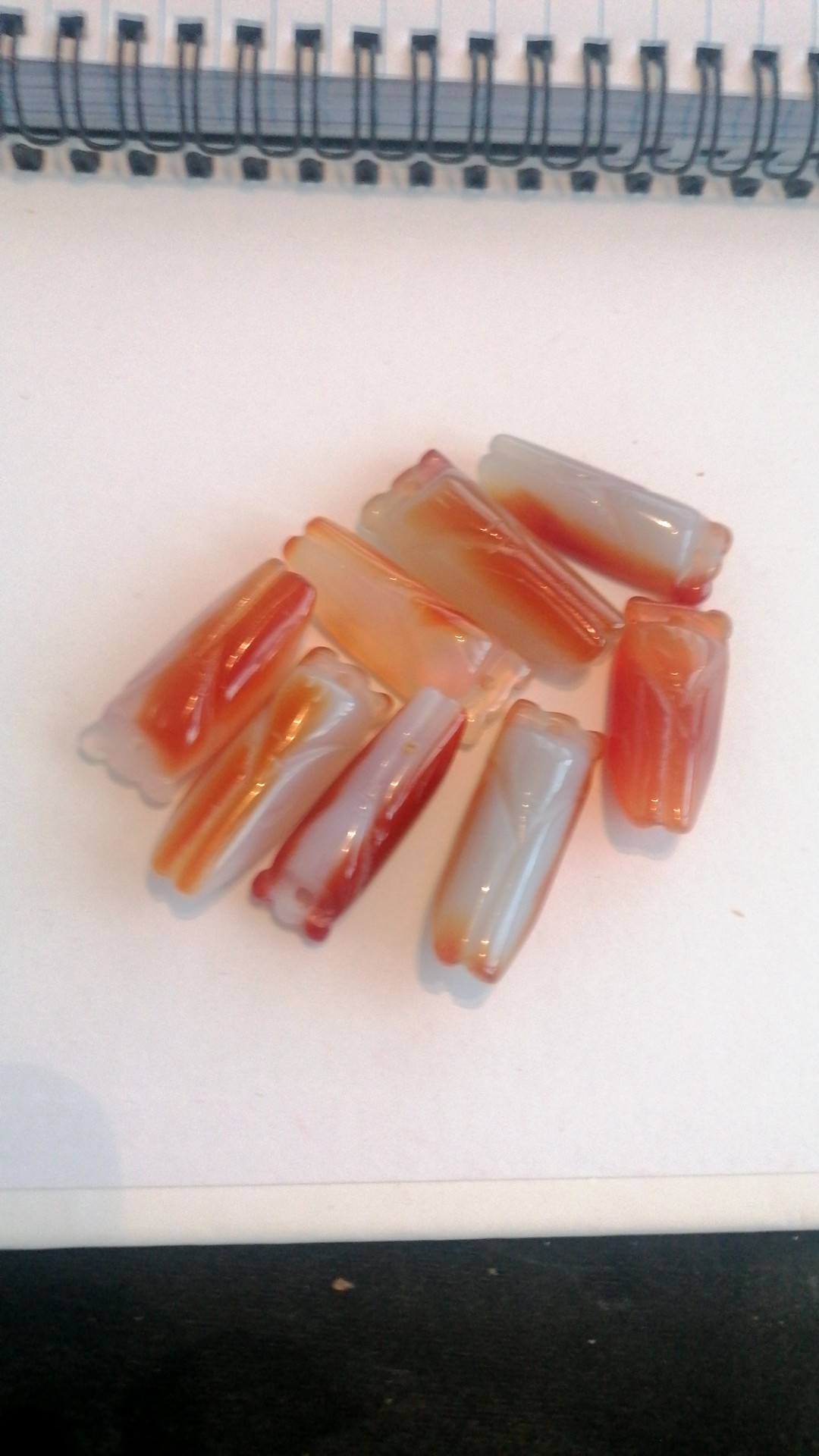
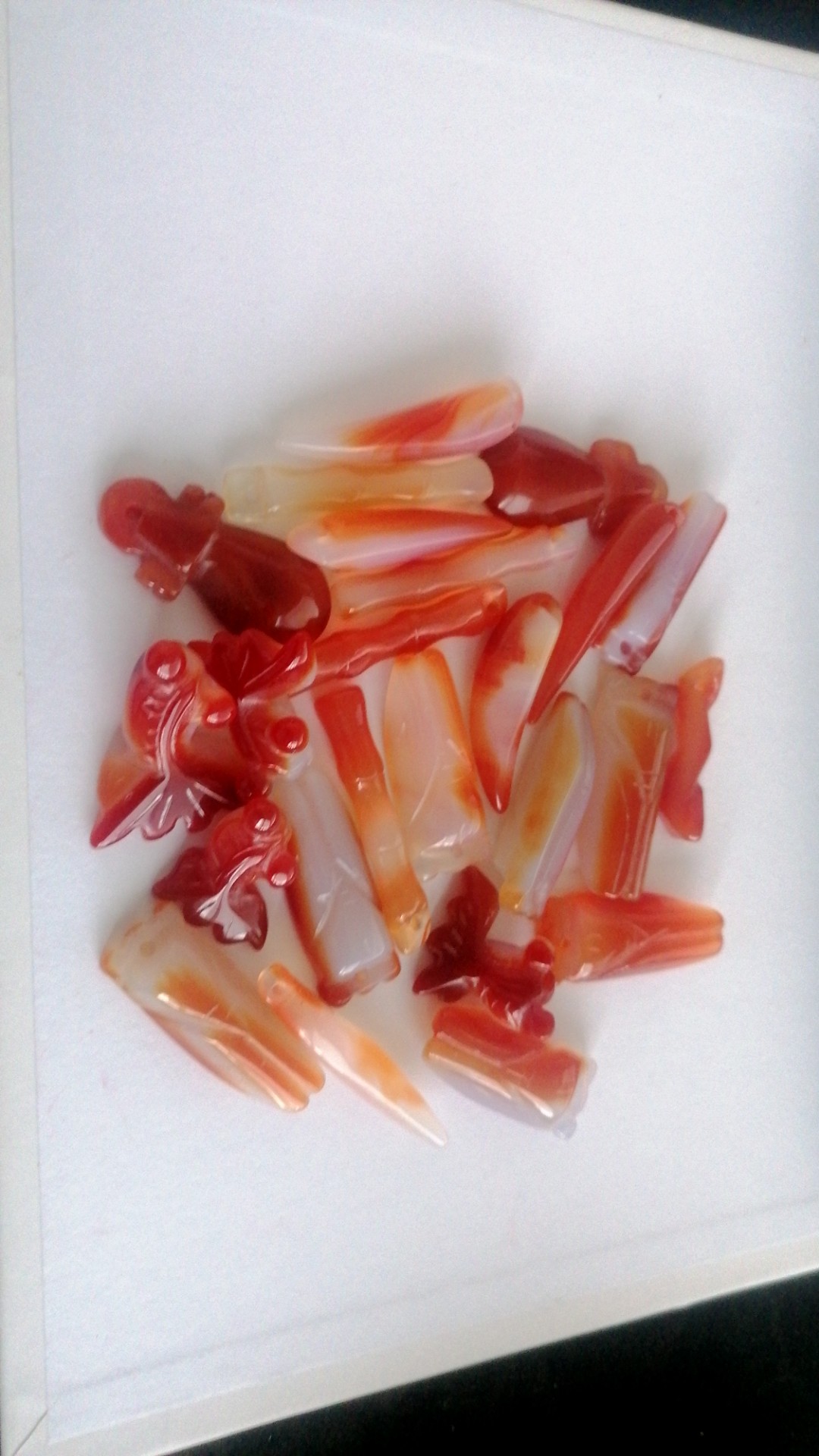
This parcel consists of approximately nine individual, elongated, barrel-shaped beads, or possibly components intended for jewelry, carved from what appears to be sardonyx. Each piece exhibits distinct banding of opaque white and translucent reddish-orange colors, characteristic of agate or onyx varieties. The form suggests they are either unstrung beads, pendant components, or elements awaiting setting into a larger piece of jewelry. Their polished, smooth surfaces and carved fluted ends indicate artisanal craftsmanship.
CULTURAL ECHOES
Where This Object Echoes
Sardonyx was frequently used for intaglios and finger rings, believed to provide protection and courage, especially for soldiers.
The carving style, particularly the subtle fluting, resonates with some traditional jade and hardstone bead carving popular in Chinese and Japanese jewelry, where natural banding is often highlighted.
Ritual & Ceremonial Use
- •Personal adornment and jewelry making, where such beads are strung into necklaces, bracelets, or incorporated into other decorative items.
- •Collector's pursuit, where gemstones are admired and categorized for their natural beauty and geological properties.
Meaning Through Time
A gemstone of protection, courage, and eloquence, often engraved with symbolic imagery.
Popular in cameos and mourning jewelry, where its dark bands provided contrast for carved white figures.
Primarily valued for its aesthetic appeal in jewelry, often appreciated for its natural color variations and durability.
HISTORICAL STORY
DID YOU KNOW?
Sardonyx is a variety of onyx with parallel bands of sard (reddish-brown chalcedony) and white, often used for carving cameos due to this distinct layering.
Historically, sardonyx was believed to bring courage and happiness, and was a favorite stone for talismans by military leaders, notably used by Roman soldiers who wore it for protection in battle.
MATERIAL & CONDITION
Surface
The surfaces are uniformly polished and glossy, reflecting light brightly across both the translucent orange-red and opaque white bands. There are no obvious signs of surface abrasion or significant scratching, indicating either careful handling or recent production. The patterns of banding appear natural, typical of chalcedony varieties.
Weight & Feel
Given their size and the density of chalcedony, these beads would feel moderately substantial for their individual volume, neither excessively heavy nor unusually light. They would have a cool, smooth feel to the touch, characteristic of polished stone.
Condition
The beads appear to be in excellent condition, with no visible chips, cracks, or significant wear. The polish is well-maintained across all visible facets. As loose beads, their 'condition' largely pertains to their integrity as individual components, which seems unimpaired.
RARITY ANALYSIS
Standard antiques commonly found at estate sales and flea markets. Plentiful supply meets modest demand.
Typical Characteristics
- Moderate production runs
- Common at estate sales
- Entry-level collectibles
EXPERT ANALYSIS
Jewelry Historian & Gemologist-Informed Appraiser
Confidence is good as the visual characteristics strongly point to carved chalcedony (sardonyx or banded agate). The consistent form and polish suggest these are lapidary products intended for jewelry.
KEY EVIDENCE
- 1Distinct parallel banding of opaque white and translucent reddish-orange hues, characteristic of sardonyx.
- 2Elongated, barrel-shaped form with possibly carved or fluted ends, indicating intentional shaping.
- 3Uniformly polished, glossy surfaces reflective of careful lapidary work.
- 4Absence of metal fittings suggests these are loose beads or components, not finished jewelry.
- 5The material appears to be a variety of chalcedony, a common and durable gemstone.
UNCERTAINTIES
- •Without magnification, it's impossible to confirm if the 'fluted' ends are carved or molded, though natural stone generally implies carving.
- •The exact identification of 'sardonyx' versus 'carnelian agate' or simply 'banded agate' would require closer examination of color saturation and banding details under magnification.
WHAT WOULD IMPROVE CERTAINTY
- →Examine under 10x loupe to confirm natural banding and carving details.
- →Perform a specific gravity test to confirm the chalcedony family.
- →Obtain accurate measurements of bead length and diameter for comparison.
- →If intended for resale, high-resolution close-up photographs are advised to showcase the banding and carving.
ESTIMATED VALUE
Updated: Feb 27, 2026
- Market comparables from auctions & retail
- Condition, completeness & craftsmanship
- Current collector demand & trends
- Low = quick sale, high = patient seller
For informational purposes only, not a formal appraisal.
ABOUT GEMSTONES
Precious stones, semi-precious gems, minerals, crystals, and geological specimens.
Browse all GemstonesSHARE THIS CURIOSITY
Have your own curiosities to discover?
Scan Your Curiosity
COMMENTS
No comments yet. Be the first to share your thoughts!
Sign in to leave a comment