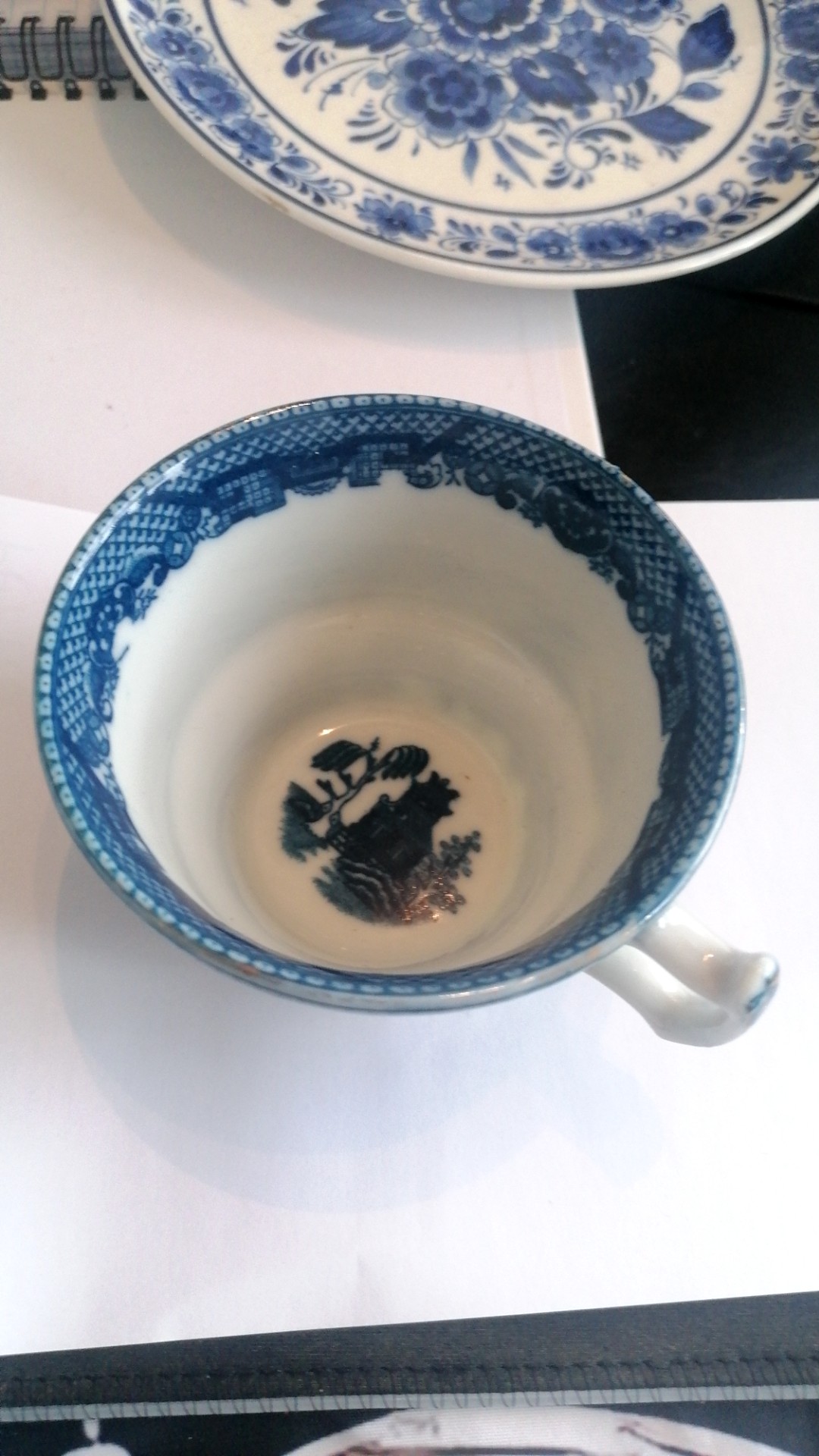
Chinese Blue and White Porcelain Teacup in Willow Pattern
QUICK FACTS
Categories
Era
Early to Mid 20th Century
Origin
🌍 International
Rarity
Common (2/10)
Discovered
Feb 12, 2026
2 weeks ago
DESCRIPTION
This appears to be a porcelain teacup decorated in the ubiquitous blue and white 'Willow Pattern.' The decoration features a landscape with pagodas, bridges, willow trees, and figures, rendered in an underglaze cobalt blue. The pattern is applied as a transfer print, a common manufacturing technique for this enduring design. The interior of the cup has a small decorative motif at the bottom, and the rim and handle also show elements of the pattern. The cup itself exhibits a typical flared, footed form.
CULTURAL ECHOES
Where This Object Echoes
The Willow Pattern was a European invention directly inspired by the popularity of hand-painted blue and white Chinese porcelain imported in vast quantities during the 17th and 18th centuries.
Many English potteries, particularly in Staffordshire, adopted and popularized the Willow Pattern as a staple of their transferware production, making it a quintessential English ceramic design.
Ritual & Ceremonial Use
- •Tea drinking ceremony: Teacups like this were central to the domestic ritual of tea consumption, particularly in Britain and its colonies, symbolizing comfort, hospitality, and a connection to exoticism.
- •Gift-giving and heirlooms: Sets of Willow Pattern ceramics were commonly given as wedding gifts or passed down through generations, embodying family tradition and domestic utility.
Meaning Through Time
Represented exotic 'Chinoiserie' and the aspirational taste for oriental aesthetics among European consumers.
Became a symbol of domestic comfort, tradition, and widespread availability, an affordable luxury for many households.
Associated with nostalgia, vintage appeal, and a classic, almost archetypal 'blue and white' look, often found in everyday kitchenware.
HISTORICAL STORY
DID YOU KNOW?
The Willow Pattern story describes a pair of lovers, Koong-se and Chang, who elope and are pursued by her father. They eventually escape across a bridge and are transformed into a pair of doves, immortalized in the design.
Despite its Chinese appearance, the Willow Pattern was designed in England by companies like Caughley Porcelain Works and Spode, capitalizing on the popularity of oriental motifs in the European market.
MATERIAL & CONDITION
Surface
The surface is glossy, typical of glazed porcelain. The blue decoration is an underglaze transfer print, exhibiting the characteristic crispness and fine lines of this technique. Small variations in color saturation within the blue suggest the firing process and the nature of the cobalt pigment.
Weight & Feel
Based on its size and porcelain composition, the cup likely feels light yet durable in hand, with a finely potted body.
Condition
The cup appears to be in good overall condition with no obvious chips or cracks. There might be some wear to the gilding on the handle, if present, but the primary pattern seems intact. The slight discoloration or faintness in some areas of the blue could be due to age or manufacturing variations.
RARITY ANALYSIS
Older mass-produced items still widely available. Easy to find on eBay, antique malls, and estate sales in large quantities.
Typical Characteristics
- Mass produced historically
- High survival rate
- Readily available everywhere
EXPERT ANALYSIS
Decorative Arts Specialist
The identification of the Willow Pattern is very strong due to its distinct and recognizable design elements. However, without a maker's mark or clearer images of the base, precise attribution to a specific factory or a tighter date range remains an estimation, hence the confidence level.
KEY EVIDENCE
- 1Blue and white underglaze transfer print decoration, characteristic of the 'Willow Pattern'.
- 2Typical landscape motifs including pagodas, bridges, willow trees, and figures.
- 3Small decorative motif present on the interior bottom of the cup, a common feature.
- 4Fired porcelain body with a glossy glaze finish.
- 5Flarred cup shape with a simple handle.
UNCERTAINTIES
- •Absence of any visible maker's mark or backstamp, which would aid in attributing a specific manufacturer and dating.
- •The image resolution does not allow for a detailed examination of the footrim for age-related wear or potting details.
WHAT WOULD IMPROVE CERTAINTY
- →Provide clear images of the base of the cup, including any backstamps or impressed marks.
- →Photograph the handle and rim for closer inspection of any wear or finer details.
- →A size comparison (e.g., with a ruler) would help confirm its exact function as a tea or coffee cup.
- →A UV light examination could reveal any hidden repairs or restorations not visible to the naked eye.
ESTIMATED VALUE
Updated: Feb 27, 2026
- Market comparables from auctions & retail
- Condition, completeness & craftsmanship
- Current collector demand & trends
- Low = quick sale, high = patient seller
For informational purposes only, not a formal appraisal.

ABOUT DECORATIVE OBJECTS
Ceramics, silver, porcelain, glassware, and decorative arts.
Browse all Decorative ObjectsSHARE THIS CURIOSITY
Have your own curiosities to discover?
Scan Your Curiosity
COMMENTS
No comments yet. Be the first to share your thoughts!
Sign in to leave a comment