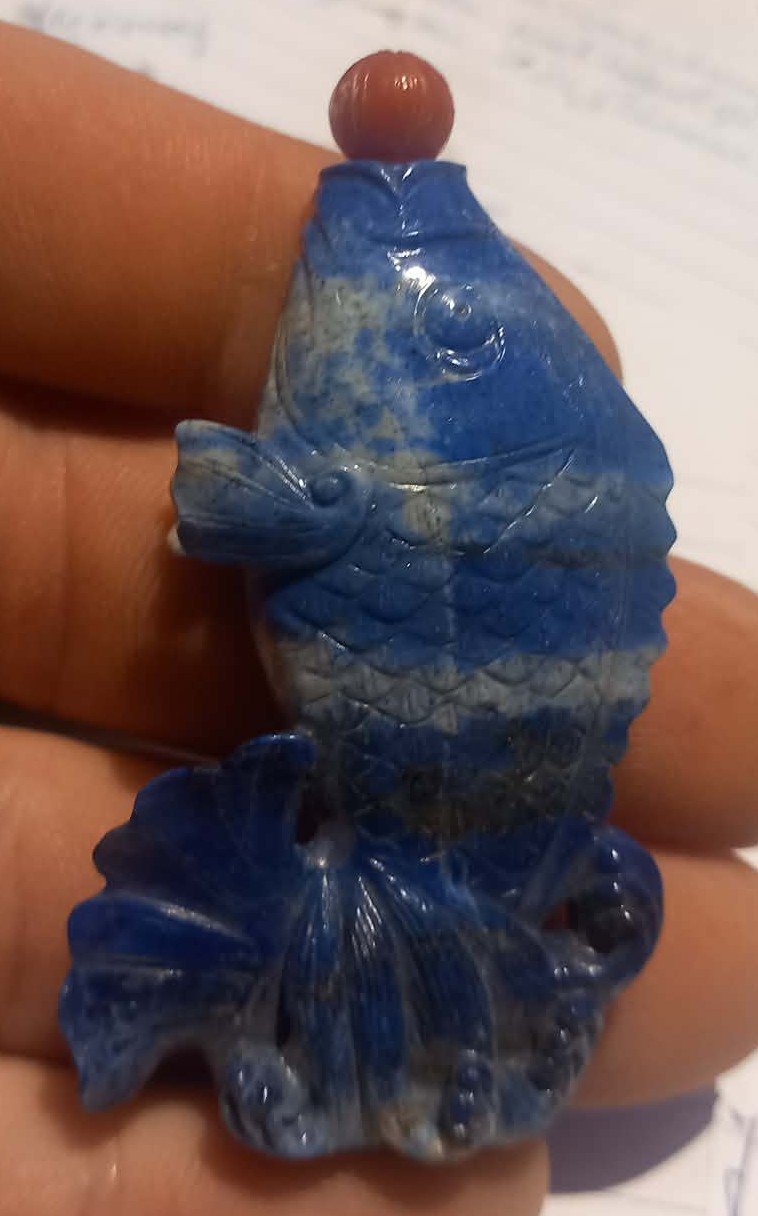
Carved Lapis Lazuli Fish Pendant with Carnelian Bead
QUICK FACTS
Categories
Era
1880
Origin
🇨🇳 China
Artist/Maker
chinese snuiffles
Rarity
Average (4/10)
Discovered
Mar 2, 2026
1 day ago
DESCRIPTION
This appears to be a carved pendant depicting a fish, likely a carp or similar ornamental fish, fashioned from lapis lazuli. The carving shows distinct scales and fins, with a stylized representation of the fish's form. A small, spherical carnelian bead is affixed to the top, suggesting it might serve as an attachment point for a necklace or as an ornamental top. The lapis lazuli exhibits natural variations in blue, with some visible white and grayish inclusions, characteristic of the stone. The carving technique suggests hand-finishing, capturing the dynamic movement often associated with fish in traditional East Asian iconography.
CULTURAL ECHOES
Where This Object Echoes
Stylized fish, especially carp, are recurring motifs across Chinese, Japanese, and Korean art, symbolizing perseverance, prosperity, and success.
Ritual & Ceremonial Use
- •Wearing such pendants as personal amulets for good fortune, wealth attraction, or protection.
- •Gift-giving during festivals or significant life events, where the fish motif imbues the recipient with auspicious blessings.
- •Incorporation into scholarly or spiritual practices where natural materials and symbolic forms held significance.
Meaning Through Time
Lapis lazuli was a highly prized material, often reserved for royalty or high-ranking officials due to its rarity and connection to the heavens. Fish carvings would symbolize status and spiritual connection.
While still valued, increased trade allowed for wider access to such materials, making intricately carved ornaments more accessible to a burgeoning merchant class or as gifts between gentry, retaining their auspicious meanings.
Today, such pieces are appreciated for their artistic craftsmanship, material beauty, and historical significance, often collected for aesthetic display or as part of a broader collection of Asian art or gemstone carvings.
HISTORICAL STORY
DID YOU KNOW?
Lapis lazuli, primarily sourced from Afghanistan, was prized in ancient civilizations, including Egypt and Mesopotamia, long before it reached China, suggesting a vast historical trade network for luxury goods.
The carp (specifically the 'koi' in Japanese culture, a concept widely adopted in East Asia) is famously associated with the legend of 'Dragon's Gate' where a carp that swims upstream and leaps over the gate transforms into a dragon, symbolizing success and ambition.
MATERIAL & CONDITION
Surface
The surface of the lapis lazuli is polished, displaying a characteristic vitreous to greasy luster. The carving shows distinct incised lines for scales and fins, creating a textured, almost layered effect. The material visibly contains white calcite and possibly golden pyrite flecks, typical inclusions in natural lapis lazuli, contributing to its varied coloration.
Weight & Feel
Given its size and material, the item would feel substantial yet not excessively heavy, possessing the satisfying density of a carved stone ornament.
Condition
The carving appears to be in excellent condition, with no visible chips, cracks, or significant abrasions on the lapis lazuli. The carnelian bead also seems intact. Without tactile inspection, it's difficult to confirm 'mint' condition, but visually it presents very well.
RARITY ANALYSIS
Typical antique shop fare. Requires some searching but regularly available. This is where most genuine antiques fall.
Typical Characteristics
- Standard antique shop items
- Regularly available
- Moderate collector interest
EXPERT ANALYSIS
Cabinet of Curiosities Generalist
The visual evidence strongly supports the material being carved lapis lazuli in a traditional Chinese fish motif. Confidence is moderate due to the inability to verify precise age or confirm the 'Mint' condition and specific origin without physical inspection or clearer identifying marks.
KEY EVIDENCE
- 1Material's color and inclusions are consistent with natural lapis lazuli.
- 2Carving technique shows defined scales and fins, indicative of skilled handwork.
- 3The fish motif is a traditional and auspicious symbol in Chinese culture.
- 4The attached carnelian bead serves as a decorative and functional element (suspension point).
UNCERTAINTIES
- •Difficulty in verifying the exact age (1880) and origin (China) solely from images, as similar items have been produced over a long period.
- •The clarity of the images does not allow for a definitive assessment of minor surface wear that might contradict 'Mint' condition.
WHAT WOULD IMPROVE CERTAINTY
- →Acquire high-resolution close-up photographs from multiple angles, especially of the drill holes for the bead and any potential tool marks.
- →Obtain accurate dimensions and weight to better estimate material volume and craftsmanship.
- →Consider a certified gemological examination of the lapis lazuli to confirm its natural origin and identify any treatments.
- →Research known carving styles and workshops from the late 19th century in China for carvers working with lapis lazuli.
ESTIMATED VALUE
Updated: Mar 2, 2026
- Market comparables from auctions & retail
- Condition, completeness & craftsmanship
- Current collector demand & trends
- Low = quick sale, high = patient seller
For informational purposes only, not a formal appraisal.
CONTEXT ANALYSIS
How your provided context compares with Curiosa.com scanner findings.
What Aligned
- The visual characteristics of the blue stone with white and grey inclusions strongly align with the user's belief that the material is lapis lazuli.
- The carving style is consistent with traditional Chinese aesthetics, supporting the 'Origin/Language: china' context.
- The perceived lack of damage from the images is generally consistent with a claim of 'Mint' condition, though expert verification would be needed to affirm this for an item of its presumed age.
What Conflicted
- The 'Artist/Maker/Brand: chinese snuiffles' appears to be a description rather than a recognized artist or brand name. Without further information, attributing it specifically to 'chinese snuiffles' is not feasible as a proper artist or brand.

ABOUT DECORATIVE OBJECTS
Ceramics, silver, porcelain, glassware, and decorative arts.
Browse all Decorative ObjectsSHARE THIS CURIOSITY
Have your own curiosities to discover?
Scan Your Curiosity
COMMENTS
No comments yet. Be the first to share your thoughts!
Sign in to leave a comment