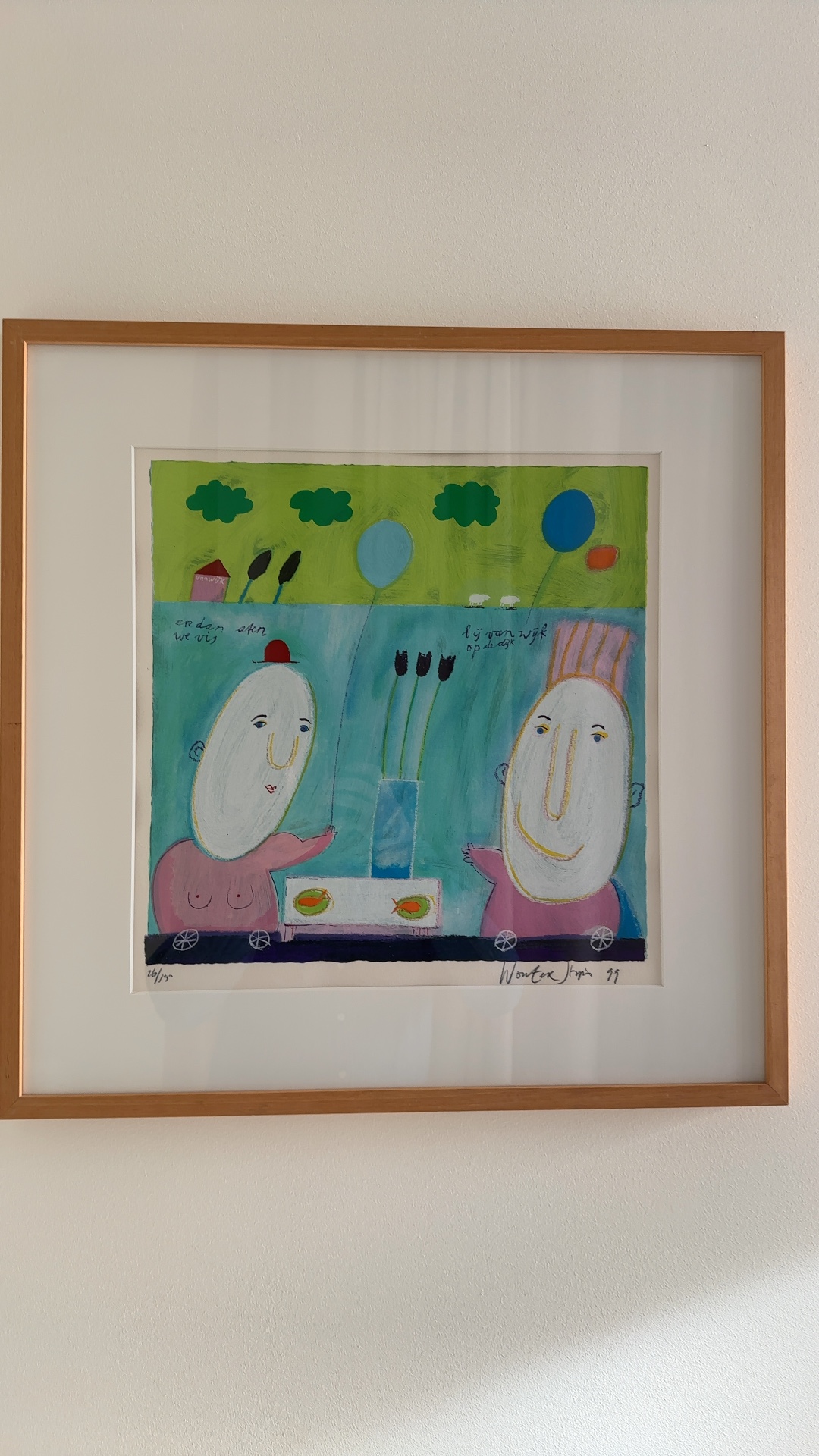
Wouter Tulp, 'Erden aan wie wij zijn' (We are what we are), Print, 1999
QUICK FACTS
Categories
Era
Late 20th Century (1999)
Origin
🇳🇱 Netherlands
Artist/Maker
Wouter Tulp
Rarity
Uncommon (5/10)
Discovered
Feb 15, 2026
2 weeks ago
DESCRIPTION
This appears to be a framed limited edition print, likely a silkscreen or lithograph, by the artist Wouter Tulp, dated 1999. The whimsical style, characterized by simplified figures and vibrant, almost childlike coloring, suggests a narrative or illustrative quality. The composition features two large-headed figures with minimal facial features, a vase of tulips, and balloons, set against a two-part background of a green landscape and a blue sky. The signature and edition number '26/199' are visible at the bottom.
CULTURAL ECHOES
Where This Object Echoes
The simplified forms, bold outlines, and direct narrative are characteristic of Naïve art, which prioritizes emotional expressiveness over academic technique. This resonates with a broader appreciation for untrained or self-taught artistic expression across various cultures.
The whimsical characters and vibrant palette bear a strong resemblance to the aesthetic often found in European children's book illustrations, which prioritize clarity of storytelling and approachable visual language.
Ritual & Ceremonial Use
- •The act of collecting contemporary prints for personal enjoyment and interior decoration, reflecting individual taste and an engagement with modern artistic expressions.
- •The use of illustrative art in domestic spaces to evoke atmosphere, conversation, or to simply bring a sense of joy and whimsy to an environment.
Meaning Through Time
Simplistic or childlike drawing could be seen as primitive or unskilled, often relegated outside the realm of 'fine art'.
The adoption of naive aesthetics by trained artists, often termed 'outsider art' or 'kindergarten art,' became a deliberate stylistic choice, celebrated for its authenticity, charm, and ability to convey complex ideas through accessible imagery.
HISTORICAL STORY
DID YOU KNOW?
Wouter Tulp (born 1971) is a Dutch illustrator and character designer known for his work in animation and publishing, suggesting this print might be an early personal artistic exploration or a commissioned piece related to his illustrative style.
The title, 'Erden aan wie wij zijn' (literally 'Earth to whom we are' or more idiomatically 'We are what we are'), points to a philosophical or observational theme often found in illustrative art that explores human nature and identity.
MATERIAL & CONDITION
Surface
The print itself exhibits a flat, matte surface typical of silkscreen or lithographic techniques, though the brushwork visible in the original painting would have provided texture. Currently, it is protected behind glass, preventing direct assessment of the print's paper and ink texture.
Weight & Feel
Given the size of the image and the framing, the item would likely feel moderately heavy, primarily due to the glass, matboard, and wooden frame.
Condition
The print appears to be in very good condition, carefully matted and framed. No obvious signs of foxing, discoloration, or paper degradation are visible through the glass. The colors remain vibrant, suggesting it has been kept out of direct sunlight.
RARITY ANALYSIS
Genuine antiques with fewer examples on the market. Named makers, documented provenance, or early production examples.
Typical Characteristics
- Limited production
- Named makers
- Growing collector demand
EXPERT ANALYSIS
Museum-Trained Art Historian
The visible signature, date, edition number, and highly recognizable style strongly attribute this to Wouter Tulp. The framing and condition appear appropriate for a print of this era, allowing for high confidence in its identification as a genuine limited edition print by the artist.
KEY EVIDENCE
- 1Visible artist's signature 'Wouter Tulp' and date '99' (1999) in the lower right.
- 2Limited edition numbering '26/199' in the lower left, indicating a print.
- 3Distinctive illustrative style consistent with known works by Wouter Tulp, a Dutch artist.
- 4Composition and color palette typical of contemporary whimsical or narrative art.
UNCERTAINTIES
- •Without direct examination of the paper and printing technique, the exact printmaking method (e.g., lithograph, silkscreen, giclée) cannot be definitively confirmed from images alone. This would affect secondary market value for some collectors.
WHAT WOULD IMPROVE CERTAINTY
- →Examine the edges of the print for deckled (rough) edges or plate marks, which can help identify printmaking technique.
- →Verify the specific paper type and its condition outside the frame, if possible.
- →Conduct a more thorough search for comparable prints by Wouter Tulp from the same period to establish a more precise market value.
- →Research the specific title 'Erden aan wie wij zijn' for any documented exhibition history or scholarly mentions.
ESTIMATED VALUE
Updated: Feb 27, 2026
- Market comparables from auctions & retail
- Condition, completeness & craftsmanship
- Current collector demand & trends
- Low = quick sale, high = patient seller
For informational purposes only, not a formal appraisal.
ABOUT PRINTS & POSTERS
Vintage prints, posters, advertising signs, and graphic art.
Browse all Prints & PostersSHARE THIS CURIOSITY
Have your own curiosities to discover?
Scan Your Curiosity
COMMENTS
No comments yet. Be the first to share your thoughts!
Sign in to leave a comment