Aletai Iron Meteorite Slice (IIIE-an, Om)
Estimated value
$100 - $250Rarity
Average(4/10)Category
Science & CuriositiesEra
Found 1898 (Formation >4 billion years ago)Origin
ChinaAuthenticity
ALETAI IRON METEORITE SLICE (IIIE-AN, OM): IDENTIFICATION
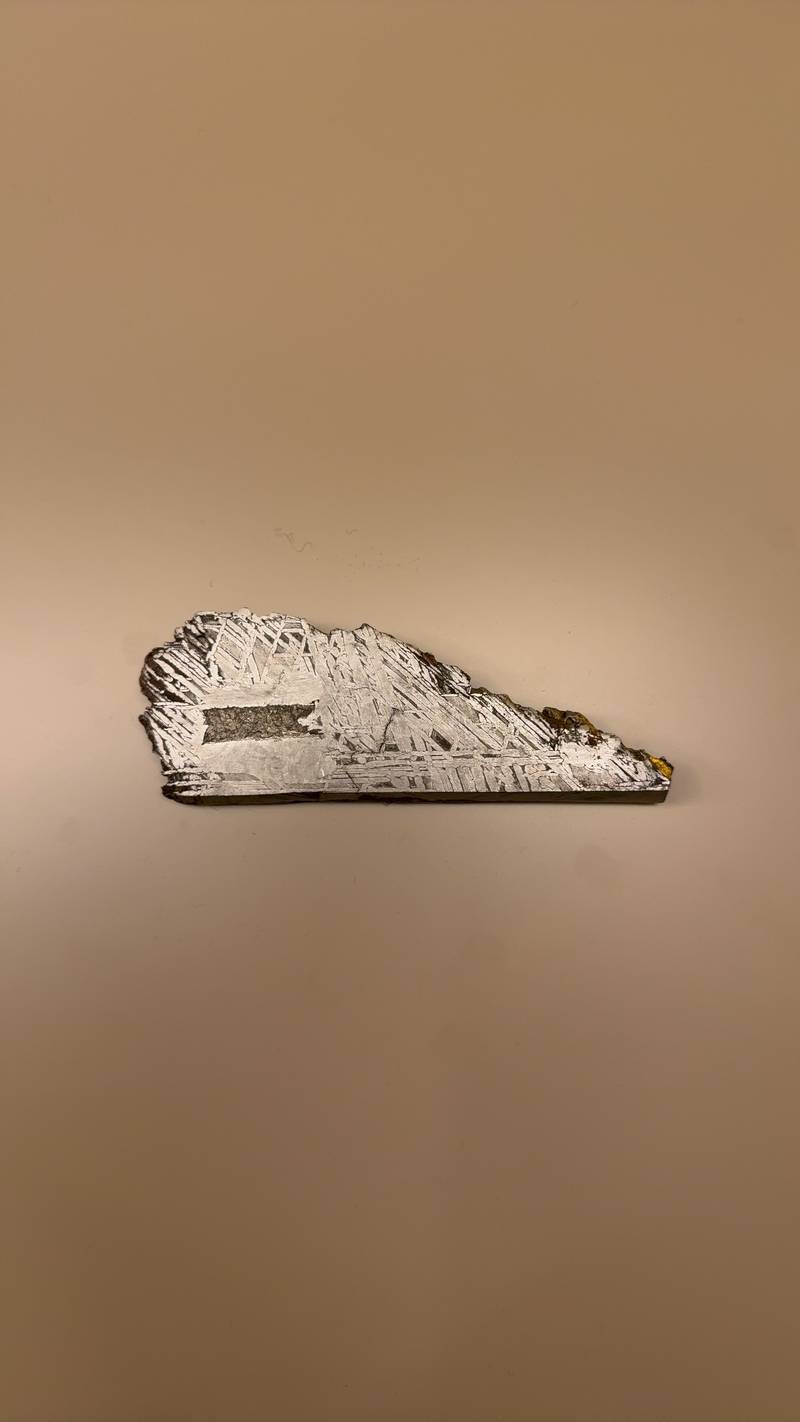
An etched, part-slice of the Aletai iron meteorite, exhibiting a distinct Widmanstätten pattern typical of octahedrites. This specimen features an irregular natural edge along one side and a straight, cut edge on the opposing side. Notably, there is a prominent, roughly rectangular troilite (iron sulfide) inclusion near the center of the etched face. It is accompanied by a modern identification plaque detailing its classification (Iron, IIIE-an, Om), origin (Xinjiang, China), find year (1898), and Total Known Weight (TKW: > 50 t).
PRODUCTION PERIOD
SCARCITY
Typical antique shop fare. Requires some searching but regularly available. This is where most genuine antiques fall.
Typical Characteristics
- Standard antique shop items
- Regularly available
- Moderate collector interest
Confidence Factors
- The Widmanstätten pattern is an unmistakable diagnostic feature of octahedral iron meteorites, formed by extremely slow cooling in space, and cannot be perfectly replicated by modern artificial means.
- The presence of characteristic inclusions, such as the prominent troilite nodule, further secures the identification.
- The Aletai material is abundant on the current market, reducing the financial incentive for sophisticated forgery of this specific type.
INSTRUMENT SPECIALIST'S TAKE
Dr. Aris Thorne
The visual evidence of the distinct Widmanstätten pattern, which is practically impossible to artificially replicate with this clarity, combined with the matching identification plaque, provides near certainty regarding the object's identity as an etched iron meteorite, almost certainly the abundant Aletai.
KEY EVIDENCE
- 1Visible Widmanstätten pattern confirming octahedral iron structure.
- 2Presence of a significant troilite (iron sulfide) inclusion.
- 3Accompanying identification plaque correlating visual evidence with the Aletai classification (IIIE-an, Om).
- 4Natural, oxidized crust visible on the uncut edge.
WHAT WOULD IMPROVE CERTAINTY
- →Verify the mass of the slice to confirm density aligns with typical iron meteorites (roughly 7.8 to 8.0 g/cm³).
- →Monitor the troilite inclusion and edges for signs of 'weeping' or rapid oxidation, common in some iron meteorites if not stored in a strictly climate-controlled environment.
CONDITION & GRADE
Condition
The etched surface appears stable with minimal visible rust or aggressive oxidation, indicating adequate preparation and storage. The troilite inclusion appears intact without excessive crumbling. The presence of the identification plaque adds to its display readiness.
INSTRUMENT VALUATION
Updated: May 11, 2026
Similar etched slices of Aletai iron meteorite frequently surface on online marketplaces and specialized auction platforms, typically priced based on weight, often ranging from $1 to $4 per gram depending on the quality of preparation.
Who buys this
Meteorite collectors, science educators, and individuals interested in space exploration and planetary science.
What increases value
- •Clarity and aesthetic appeal of the etched Widmanstätten pattern.
- •The presence of interesting inclusions like troilite or schreibersite.
- •Overall size and weight of the slice.
What lowers value
- •Rusting or oxidation ('meteorite disease') due to improper preparation or exposure to humidity.
- •Aletai is currently highly available on the market, which keeps prices per gram relatively low compared to rarer falls.
What makes top-tier examples
- •Large, perfectly prepared full slices with a flawless etch.
- •Slices containing exceptional or rare inclusions.
- •Specimens demonstrating stability against oxidation over many years.
Grade & condition
Preparation quality (polish and etch), presence of rust, stability of inclusions.
Rarity & demand
For informational purposes only, not a formal appraisal.
ABOUT SCIENCE & CURIOSITIES
Scientific instruments, laboratory equipment, and curious objects.
Science & Curiosities value and rarity guideSHARE THIS CURIOSITY
Have your own curiosities to discover?
Scan Your Curiosity
COMMENTS