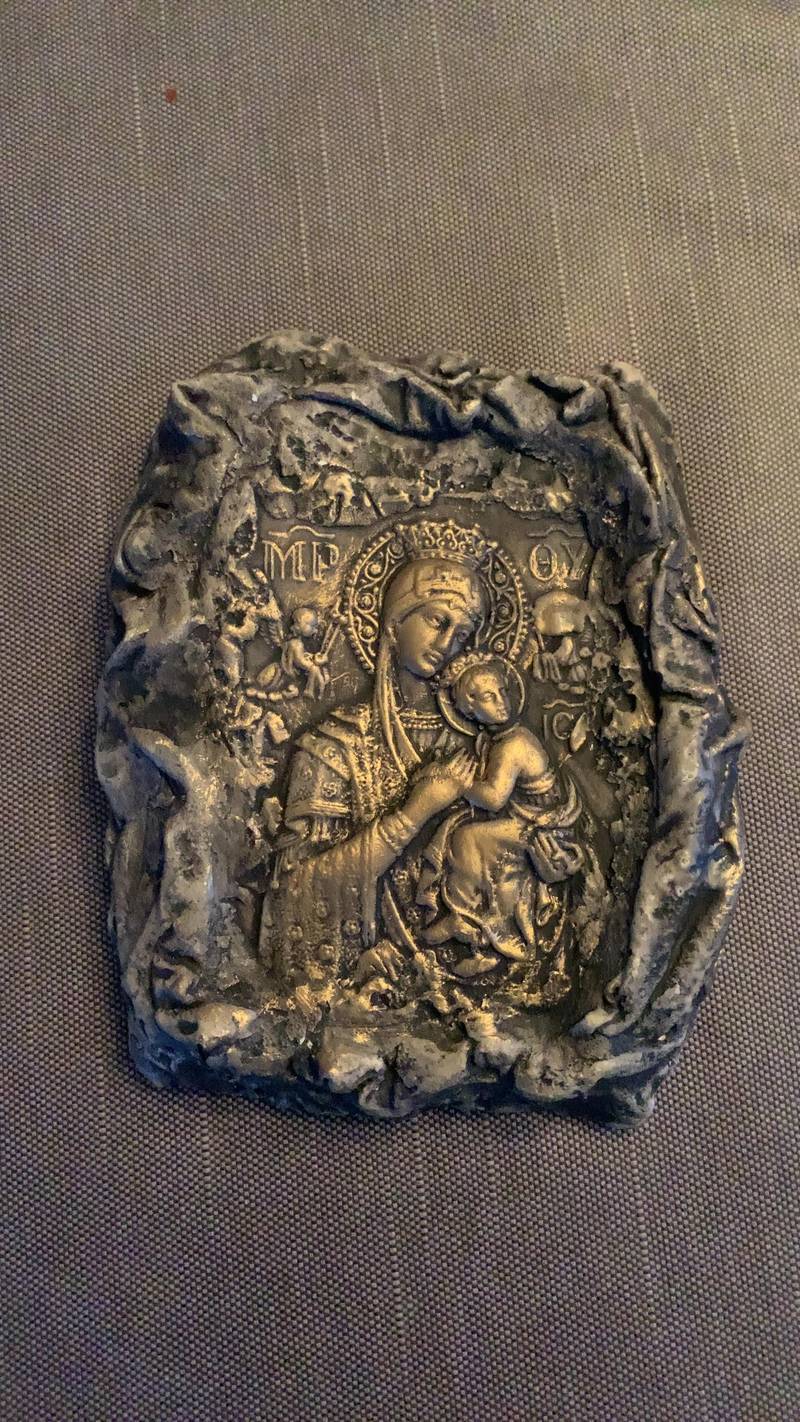
Orthodox Virgin Mary and Child Relief Plaque
Estimated value
$40 - $120Rarity
Average(4/10)Category
Religious & DevotionalEra
Late 19th - Mid 20th CenturyOrigin
InternationalAuthenticity
ORTHODOX VIRGIN MARY AND CHILD RELIEF PLAQUE: IDENTIFICATION
This appears to be a small, cast metal relief plaque depicting the Virgin Mary holding the Christ Child, rendered in a style reminiscent of Orthodox iconography. The composition features the traditional 'Mother of God of the Passion' or 'Our Lady of Perpetual Help' iconography, characterized by the presence of angels holding instruments of the Passion and the Greek monograms 'MP ΘY' (Mater Theou - Mother of God) and 'IC XC' (Iesous Christos - Jesus Christ) which are visible, albeit partially. The form is irregular, suggesting a cast piece with an intentional rustic or antique finish, designed to evoke the appearance of an early icon or a pilgrimage souvenir.
CROSS-CULTURAL PARALLELS
Where This Object Echoes
The iconography directly derives from the Byzantine tradition, particularly the 'Mother of God of the Passion' or 'Our Lady of Perpetual Help', which has been widely venerated and reproduced across Orthodox lands.
While distinctly Orthodox in style, the 'Our Lady of Perpetual Help' icon became extremely popular in the West, particularly after its entrustment to the Redemptorists by Pope Pius IX in 1866, leading to similar devotional objects.
Ritual & Ceremonial Use
- •Objects of personal prayer and veneration in Orthodox Christian homes.
- •Souvenirs acquired during pilgrimages to holy sites or monasteries.
- •Gifts commemorating religious milestones such as baptisms or confirmations.
Meaning Through Time
Icons were seen as 'windows to heaven,' sacred images through which the faithful could connect with the divine, not merely artworks.
With advancements in metal casting and printing, devotional objects like this plaque became more widely accessible, shifting from unique, hand-painted works to mass-produced items, yet retaining their spiritual significance for believers.
SCARCITY
Typical antique shop fare. Requires some searching but regularly available. This is where most genuine antiques fall.
Typical Characteristics
- Standard antique shop items
- Regularly available
- Moderate collector interest
Confidence Factors
- Relatively common devotional object type, not typically subject to high-level forgery.
- Wear and patination appear consistent with intended antique finish rather than deceptive aging.
- Absence of high-value materials that would incentivize sophisticated counterfeiting.
RELIGIOUS ART SCHOLAR'S TAKE
Sacred Art & Material Culture Specialist
Confidence is high due to the clear iconographic elements and visible monograms, allowing for secure identification of the subject and religious tradition. The material and style strongly suggest an era of mass-produced devotional objects, though precise dating and origin without maker's marks remain an estimate.
KEY EVIDENCE
- 1Iconography of the Virgin Mary and Christ Child consistent with 'Mother of God of the Passion' type.
- 2Visible Greek monograms ('MP ΘY', 'IC XC') are hallmarks of Eastern Orthodox iconography.
- 3The irregular, textured border and oxidized finish suggest a cast metal plaque mimicking older, revered forms.
- 4Style points to production in the late 19th or 20th century, catering to popular devotion.
UNCERTAINTIES
- •The exact metal composition is not verifiable from images, which can affect valuation for some collectors.
- •Lack of a clear maker mark or country of origin makes specific attribution challenging.
WHAT WOULD IMPROVE CERTAINTY
- →Examine the reverse side for any maker's marks, inscriptions, or hallmarks.
- →Perform a non-invasive metal test to confirm the alloy, if this is of concern for valuation.
- →Compare iconography with known examples of 'Mother of God of the Passion' icons to identify any specific school or prototype.
CONDITION & GRADE
Condition
The plaque appears to be in good overall condition, exhibiting intentional antiquing and patination rather than significant wear or damage. Some areas of higher relief show natural rubbing, exposing brighter metal beneath the darker patina, which is consistent with handling and age. No significant breaks or repairs are immediately visible.
SACRED ART VALUATION
Updated: Feb 27, 2026
- Market comparables from auctions & retail
- Condition, completeness & craftsmanship
- Current collector demand & trends
- Low = quick sale, high = patient seller
For informational purposes only, not a formal appraisal.
ABOUT RELIGIOUS & DEVOTIONAL
Icons, altar pieces, prayer items, and sacred objects from world religions.
Religious & Devotional value and rarity guideSHARE THIS CURIOSITY
Have your own curiosities to discover?
Scan Your Curiosity
COMMENTS