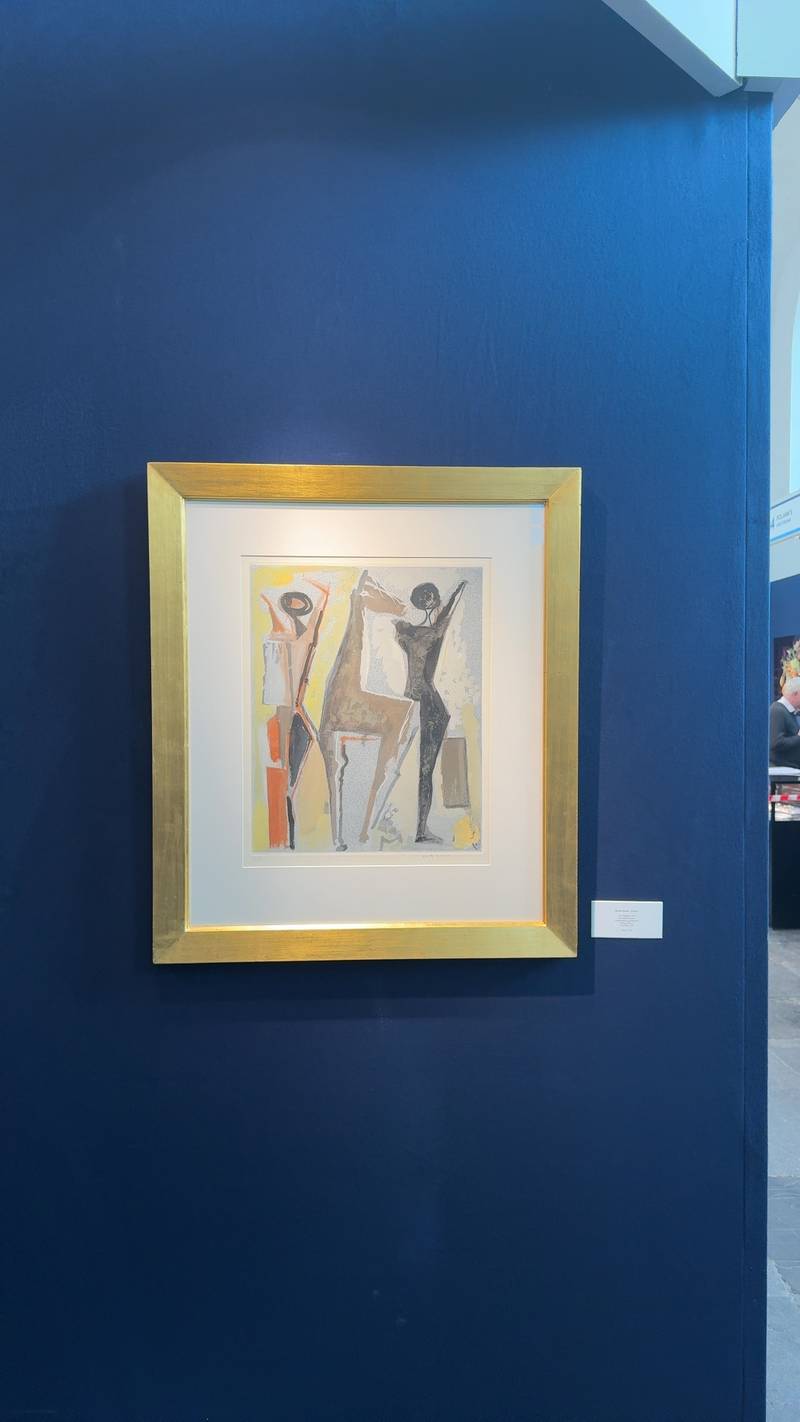
Marino Marini - "Il Greco" Aquatint Etching
Estimated value
$3,000 - $6,000Rarity
Uncommon(5/10)Type
Museum ObjectCategory
Prints & PostersBrand
Labyrinth FlorenceEra
1978Origin
ItalyArtist / Creator
Marino MariniAuthenticity
MARINO MARINI - "IL GRECO" AQUATINT ETCHING: IDENTIFICATION
This is an original etching and aquatint on woven paper, featuring a distinct, debossed plate mark measuring inward from the mat opening. The composition depicts two highly stylized, angular figures flanking an abstracted equestrian form, executed with flat, textured zones of gray, ochre, and pale yellow characteristic of the aquatint process. The lower margin bears pencil annotations: the edition number "61/100" at the lower left and the signature "MARINO" in block capitals at the lower right. The accompanying exhibition label identifies the work as "Il Greco," printed in 1978 by Il Labirinto in Florence, and correlates to the Guastalla catalogue raisonné reference A208.
PRINT LINEAGE
COLLECTOR NOTES
The Guastalla catalogue raisonné (Guastalla A208) documents Marini's complete graphic output, tracking over 400 distinct print editions created between 1914 and his death in 1980.
Marini originally adopted the horse and rider motif in 1936 after observing the panic of peasants fleeing aerial bombardments on horseback in Northern Italy.
SCARCITY
Genuine antiques with fewer examples on the market. Named makers, documented provenance, or early production examples.
Typical Characteristics
- Limited production
- Named makers
- Growing collector demand
Confidence Factors
- Visible plate mark confirms intaglio printing technique rather than a flat photomechanical reproduction.
- Pencil signature block aligns with Marini's established drafting style for graphic editions from the late 1970s.
- Accompanied by a gallery label citing the exact Guastalla catalogue raisonné volume reference (A208).
PRINT SPECIALIST'S TAKE
Museum-Trained Art Historian
The clear visibility of printmaking artifacts (plate indentation, granular ink topography) combined with a specific formal catalogue raisonné reference provides robust diagnostic evidence for authenticity.
KEY EVIDENCE
- 1Visible structural plate mark defining the intaglio image boundaries
- 2Pencil signature 'MARINO' aligned at the lower right margin
- 3Edition pencil numbering '61/100' at the lower left margin
- 4Gallery label identifying specific catalogue reference Guastalla A208
UNCERTAINTIES
- •Assessment restricted to areas visible through the frame's glazing; hinging techniques, sheet margins, and verso remain unexamined.
WHAT WOULD IMPROVE CERTAINTY
- →Examine the artwork unframed to check for acid burn lines from previous matting
- →Inspect the sheet under UV light to ensure no chemical fading or undocumented paper restoration exists
- →Verify the presence of a papermaker's watermark, often from Italian mills like Fabriano, in the margin
CONDITION & GRADE
Grading breakdown
Assessment is limited by the frame and glazing, but the visible paper shows no discoloration, the margins present a clean white tone, and the graphite annotations remain crisp with no smudging.
Condition
The visible image area appears free of foxing, pronounced mat burn, or planar distortion, with the ochre and yellow inks retaining their saturation beneath the framing glazing. The gilt step-profile frame displays minor surface wear and abrasions along the outer corners.
PRINT MARKET VALUATION
Updated: May 11, 2026
Auction houses like Christie's and Sotheby's frequently record Marini editions from the 1970s; similar 100-edition aquatints typically achieve $1,500 to $3,500 at auction, though retail fine art gallery markups routinely reach the €7,200 ($7,800 USD) level documented on this exhibition label.
Who buys this
Collectors of post-war European modernism and enthusiasts of mid-century Italian sculpture who seek documented graphic works by major institutional names.
What increases value
- •Documentation within the Guastalla catalogue raisonné
- •Richness and preservation of the aquatint textures
- •Absence of light fading or mat burn on the paper support
What lowers value
- •Hidden condition issues such as foxing or acid damage from non-archival prior framing materials
- •Fading of the delicate yellow and ochre tones due to prolonged UV light exposure
What makes top-tier examples
- •Examples exhibiting particularly crisp, deep plate marks and high-contrast ink separation
- •Sheets preserving full, untrimmed margins confirming the original publisher's paper format
Grade & condition
Evaluated primarily on paper structural integrity (lack of trimming or tears), the absence of biological foxing or chemical toning, and the preservation of ink saturation.
Rarity & demand
For informational purposes only, not a formal appraisal.
ABOUT PRINTS & POSTERS
Vintage prints, posters, advertising signs, and graphic art.
Prints & Posters value and rarity guideSHARE THIS CURIOSITY
Have your own curiosities to discover?
Scan Your Curiosity
COMMENTS