Zassenhaus - Ottoman Style Cylinder Coffee/Pepper Mill (c. 1920-1950)
Estimated value
$45 - $110Rarity
Ordinary(3/10)Category
Mechanical & IndustrialBrand
ZassenhausEra
Circa 1920-1950Origin
GermanyAuthenticity
ZASSENHAUS - OTTOMAN STYLE CYLINDER COFFEE/PEPPER MILL (C. 1920-1950): IDENTIFICATION
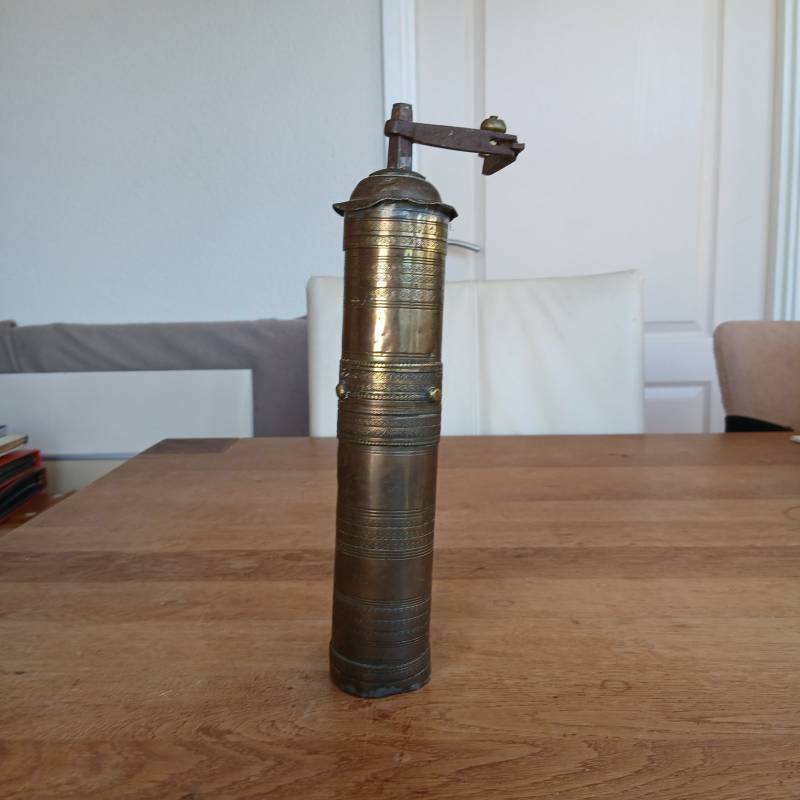
A cylindrical brass coffee or spice mill featuring a folding iron crank handle and a four-part assembly: a domed top cap, a ground-collecting base, and a central grinding body with an internal steel burr mechanism. The exterior is decorated with machine-rolled guilloché patterns, specifically repeating wave and beaded borders. The mid-section bears the 'GARANTI' stamp alongside the three-lion crest of Zassenhaus and another circular mark depicting a rampant lion, common on export models destined for Eastern European and Ottoman markets.
PRODUCTION PERIOD
SCARCITY
Standard antiques commonly found at estate sales and flea markets. Plentiful supply meets modest demand.
Typical Characteristics
- Moderate production runs
- Common at estate sales
- Entry-level collectibles
Confidence Factors
- Presence of authentic Zassenhaus three-lion and single-lion strike marks
- Machine-rolled guilloché precision consistent with mid-20th century German manufacturing
- Natural tiered patina levels across different sections of the brass tube
ENGINEERING APPRAISER'S TAKE
Vintage Technology Restorer & Historian
The hallmarks are exceptionally clear and provide a definitive attribution to Zassenhaus, while the manufacturing techniques visible on the body (guilloché and stamping) confirm the era and origin.
KEY EVIDENCE
- 1Hallmark identification: The three-lion coat of arms is the definitive mark for Zassenhaus.
- 2Hallmark identification: The 'GARANTI' stamp is diagnostic of high-end German export metals.
- 3Material logic: The folding iron crank with a square-bottom socket is characteristic of early 20th-century burr grinders.
- 4Wear pattern: The base deformation indicates heavy manual use over decades.
UNCERTAINTIES
- •Impact damage to the lower cup may prevent a tight friction fit during grinding.
- •Evidence of minor surface rust on the iron handle suggests improper storage in a humid environment.
WHAT WOULD IMPROVE CERTAINTY
- →Unscrew the top cap to inspect the condition of the internal steel teeth for dulling or rust.
- →Check the internal drive shaft for vertical play or wobble, which indicates bearing wear.
- →Clean the hallmarks with a soft cloth to confirm the specific variant of the lion crest for precise dating.
CONDITION & GRADE
Grading breakdown
Loss of structural symmetry at the base and significant brass oxidation lower the grade; however, the presence of clear hallmarks significantly preserves its value over unbranded versions.
Condition
Significant indentation and warping on the top bezel and bottom rim suggest repeated drops or forceful assembly. The iron handle shows oxidation and loss of original finish, though the folding hinge appears intact and functional.
INDUSTRIAL ARTIFACT VALUE
Updated: May 11, 2026
Similar hallmarked German mills sold on eBay and Etsy between 2023-2024 ranging from $50 to $90 depending on branding clarity.
Who buys this
Vintage coffee enthusiasts sought after for functional use and collectors of German Solingen-made metalware.
What increases value
- •Authenticity of Zassenhaus stamps
- •Functionality of the folding handle mechanism
- •Absence of 'zinc pest' or major corrosion in the internal mechanism
What lowers value
- •Dents in the brass body that affect the fit of the catch-cup
- •Seized or excessively rusted internal burrs
What makes top-tier examples
- •Mint brass finish with no dents
- •Presence of the original 'Zassenhaus' paper label (rare on these models)
- •Smooth mechanical operation with no grinding resistance when empty
Grade & condition
Fit of the friction-lock base, clarity of hallmark stamps, and sharpness of the internal steel burrs.
Rarity & demand
For informational purposes only, not a formal appraisal.
ABOUT MECHANICAL & INDUSTRIAL
Vintage machines, industrial objects, tools, and mechanical curiosities.
Mechanical & Industrial value and rarity guideSHARE THIS CURIOSITY
Have your own curiosities to discover?
Scan Your Curiosity
COMMENTS