Natural Amethyst Geode Cathedral - Brazilian Origin
Authenticity
NATURAL AMETHYST GEODE CATHEDRAL - BRAZILIAN ORIGIN: IDENTIFICATION
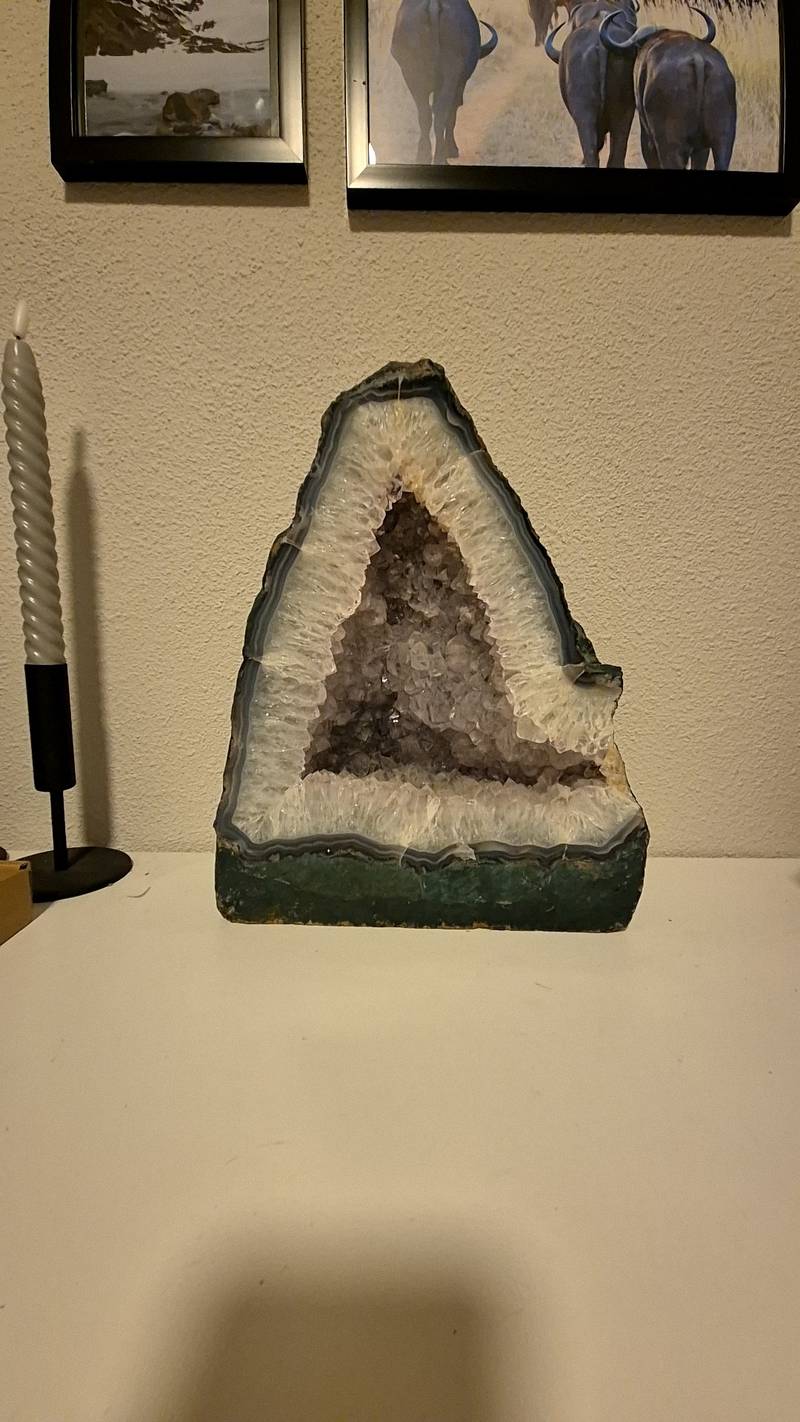
A vertical amethyst geode 'cathedral' section exhibiting a distinct tri-layer composition: a dark green celadonite-coated basaltic exterior, a thick band of microcrystalline banded agate, and an interior druzy cavity of macrocrystalline quartz. The crystals are characterized by a pyramidal termination habit and a pale-to-medium lavender saturation. The base has been cut flat and appears reinforced with a green-tinted cement or epoxy-basalt mixture to ensure stability for upright display.
SCARCITY
Standard antiques commonly found at estate sales and flea markets. Plentiful supply meets modest demand.
Typical Characteristics
- Moderate production runs
- Common at estate sales
- Entry-level collectibles
Confidence Factors
- Geologic structure is consistent with Rio Grande do Sul deposits
- Agate banding and crystal habit follow natural quartz growth patterns
GEMOLOGIST'S TAKE
Gemologist & Mineral Specialist
Identification of species (quartz variety amethyst) and origin (Brazil) is highly reliable based on the specific morphology and preparation style of the specimen.
KEY EVIDENCE
- 1Hexagonal crystal system evident in visible terminations
- 2Presence of banded agate 'rim' indicating sequential silica deposition
- 3Basaltic matrix coated in green-pigmented finish typical of Brazilian production
- 4Gradation of color from colorless quartz base to amethyst tips
UNCERTAINTIES
- •Color saturation appears low; potential for color fade if exposed to UV/sunlight over time
- •Exterior green coating likely masks structural repairs or epoxy reinforcement
WHAT WOULD IMPROVE CERTAINTY
- →Examine crystals under 10x magnification for 'tiger stripe' twinning or negative crystals
- →Check the base for a producer's export label or weight in kilograms
- →View under long-wave UV light to check for dyed resin repairs in the agate rim
CONDITION & GRADE
Grading breakdown
Crystal saturation is in the 'pale' to 'light' range, which is common for larger commercial-grade geodes; higher-grade specimens would show deep purple 'grape' hues.
Condition
Visible mechanical fracture or 'v-cut' on the right-hand side of the agate rim suggests a past impact or stress fracture during the extraction process. Termination points on the interior crystals appear largely intact without significant bruising.
Weight & feel
Estimated at 5.5 to 8.0 kg given its approximate 30 cm height and dense basaltic base.
GEMSTONE VALUATION
Updated: May 10, 2026
Who buys this
Interior decorators and mineral collectors looking for 'statement' bookshelf or tabletop pieces.
What increases value
- •Depth and saturation of the purple color
- •Completeness of the crystal terminations (no bruising)
- •Height and presence as a vertical display piece
What lowers value
- •Heat or sunlight exposure causing color loss
- •Structural cracks in the agate rim
- •Excessive artificial cement on the base increasing weight without adding value
What makes top-tier examples
- •Deep 'Siberian' purple color saturation
- •Presence of 'flower' formations or large calcite inclusions
- •Thin matrix wall relative to crystal volume
Grade & condition
Determined by color saturation (A to AAAA), crystal size, and matrix stability.
Rarity & demand
For informational purposes only, not a formal appraisal.
ABOUT GEMSTONES
Precious stones, semi-precious gems, minerals, crystals, and geological specimens.
Gemstones value and rarity guideSHARE THIS CURIOSITY
Have your own curiosities to discover?
Scan Your Curiosity
COMMENTS