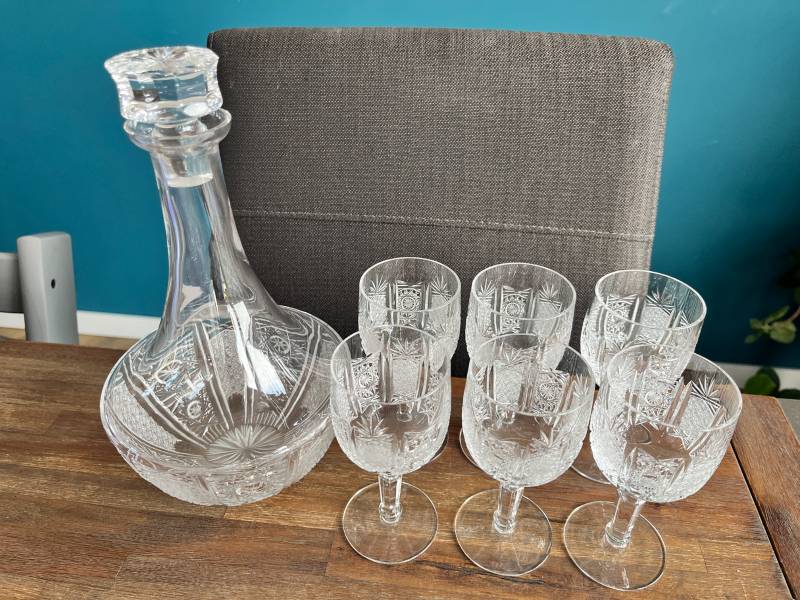
Mid-20th Century Lead Crystal Decanter and Stemware Set (7 Pieces)
Estimated value
$80 - $180Rarity
Ordinary(3/10)Category
Decorative ObjectsBrand
H&HEra
Circa 1960-1980Origin
InternationalAuthenticity
MID-20TH CENTURY LEAD CRYSTAL DECANTER AND STEMWARE SET (7 PIECES): IDENTIFICATION
This set comprises a wide-bodied ships-style decanter with a faceted octagonal stopper and six coordinating stemmed cordial glasses. The decorative program utilizes deep-cut geometric patterns including hobstar, fan, and cross-cut diamond motifs typical of European lead crystal production from the 1950s through the 1970s. The decanter displays vertical flute cuts on the neck and a substantial flared base for stability.
CROSS-CULTURAL PARALLELS
Where This Object Echoes
The 'Brilliant Period' (1876–1917) established the aesthetic for deep-cut geometric patterns seen in this mid-century set.
Ritual & Ceremonial Use
- •Formal dining etiquette involving the decanting of fortified wines like Sherry or Port to separate sediment and aerate the spirit.
Meaning Through Time
Utilitarian nautical design for safety at sea.
Symbol of domestic hospitality and middle-class status in the post-war era.
SCARCITY
Standard antiques commonly found at estate sales and flea markets. Plentiful supply meets modest demand.
Typical Characteristics
- Moderate production runs
- Common at estate sales
- Entry-level collectibles
Confidence Factors
- Material weight and refractive dispersion are consistent with vintage lead crystal
- Cutting patterns are standard for mid-century European glasshouses
- Condition and style suggest authentic 20th-century decorative ware rather than a modern reproduction
DECORATIVE ARTS EXPERT'S TAKE
Decorative Arts Specialist
Identification is based on clear visual evidence of glass-cutting techniques and lead-content properties, though the specific manufacturer remains unconfirmed without a hallmark.
KEY EVIDENCE
- 1Ships-style wide-base decanter profile
- 224% Pbo (lead oxide) refractive qualities visible in light dispersion
- 3Hobstar and fan mitre-cut patterns
- 4Octagonal faceted stopper with ground joint
- 5Vertical flute cuts on the neck consistent with mid-century production
UNCERTAINTIES
- •Lack of visible acid-etched maker's mark (e.g., Waterford or Baccarat), suggesting a high-quality but perhaps anonymous Continental factory like Nachtmann.
WHAT WOULD IMPROVE CERTAINTY
- →Inspect the base of each piece under magnification for a faint acid-etched signature
- →Perform a 'ring test' by gently tapping the glass to check for the long-sustained resonance unique to lead crystal
- →Examine the stopper and inner neck for matching etched numbers, which indicate a hand-fitted set
CONDITION & GRADE
Condition
The set appears well-preserved with no visible 'knicking' or flea bites on the sharp edges of the cuts. The stopper fits flush, and there is no evidence of 'sick glass' or internal mineral clouding from stagnant liquids.
Weight & feel
Solid lead crystal construction suggests the decanter alone weighs approximately 1.5 to 2.0 kg, providing a dense and stable handfeel.
DECORATIVE ARTS VALUATION
Updated: May 11, 2026
Similar unbranded lead crystal sets have sold on eBay and at regional estate auctions (e.g., Heritage or Morphy's) for $100-$150 USD in 2023-2024.
Who buys this
Vintage barware enthusiasts and collectors of European cut glass who prioritize functional mid-century sets for home entertaining.
What increases value
- •Completeness of the 7-piece set
- •Presence of the original stopper without damage
- •Clarity of the glass (absence of clouding)
What lowers value
- •Micro-chipping along the sharp facets of the cutting
- •Replacement of the stopper with a non-matching piece
- •Cracks at the stem-to-bowl junction of the glasses
What makes top-tier examples
- •Attribution to a prestige maker like Waterford or St. Louis
- •Hand-copper-wheel engraving instead of machine-cut mitres
Grade & condition
Visual clarity, edge sharpness of the cuts, and structural integrity of the stems.
Rarity & demand
For informational purposes only, not a formal appraisal.
ABOUT DECORATIVE OBJECTS
Silver, glassware, metalwork, enamelwork, and decorative arts.
Decorative Objects value and rarity guideSHARE THIS CURIOSITY
Have your own curiosities to discover?
Scan Your Curiosity
COMMENTS