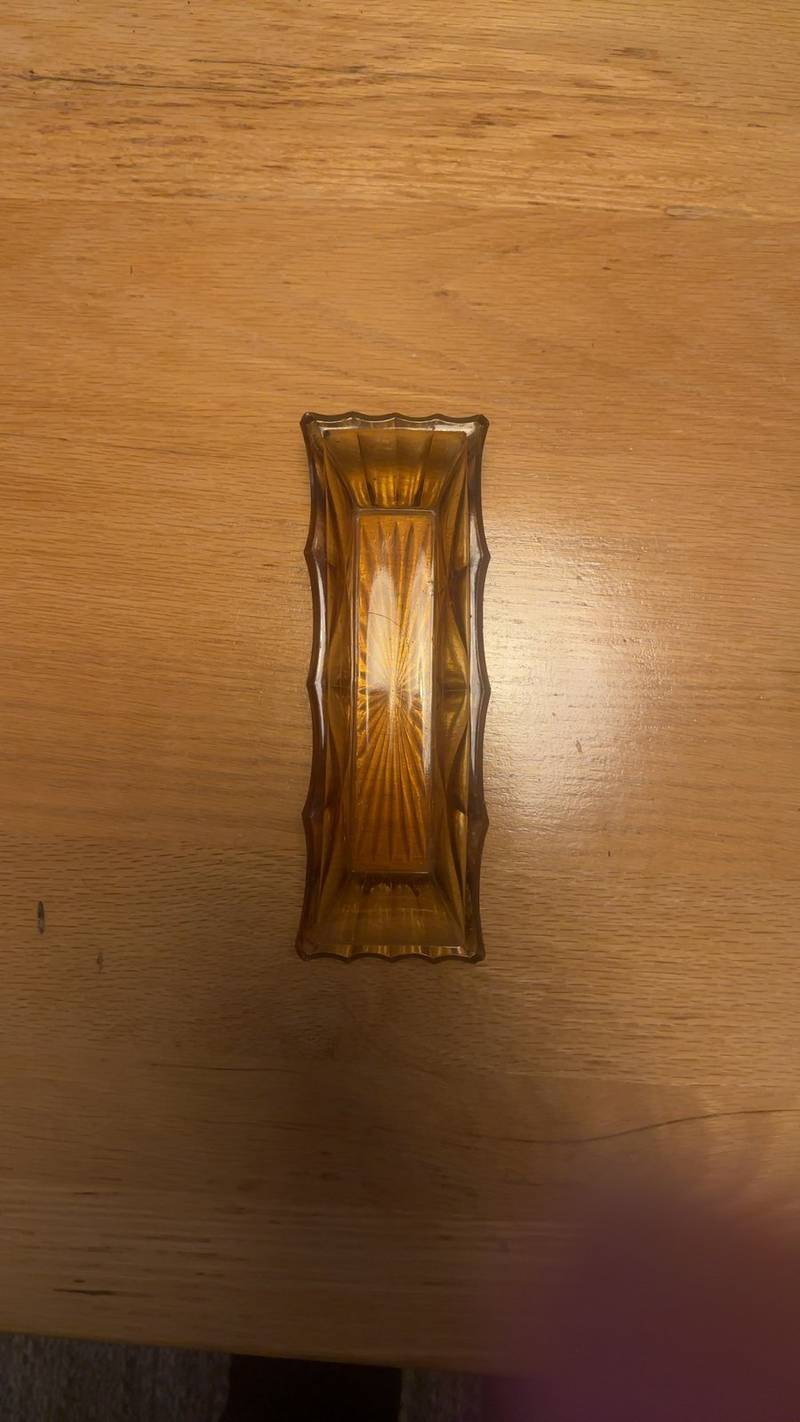
Amber Pressed Glass Tray - Starburst Pattern
Estimated value
$10 - $25Rarity
Ordinary(3/10)Category
Decorative ObjectsEra
circa 1965-1975Origin
United StatesAuthenticity
AMBER PRESSED GLASS TRAY - STARBURST PATTERN: IDENTIFICATION
A rectangular amber-colored pressed glass tray or trinket dish featuring a central starburst or sunburst motif on the interior floor. The side walls are molded with a geometric diamond and prism pattern, while the rim displays a scalloped or serrated edge typical of mid-20th century utility glassware.
PRODUCTION PERIOD
Production of amber-toned glassware peaked in the United States between 1960 and 1975, driven by companies like Tiara Exclusives, Indiana Glass, and Anchor Hocking. This specific geometric prism style aligns with the 'Modernist' or 'Early American Prescut' trends common in 1970s domestic serveware.
SCARCITY
Standard antiques commonly found at estate sales and flea markets. Plentiful supply meets modest demand.
Typical Characteristics
- Moderate production runs
- Common at estate sales
- Entry-level collectibles
Confidence Factors
- Common mass-produced item from the late mid-century period
- Material and color are consistent with 1970s soda-lime glass
DECORATIVE ARTS EXPERT'S TAKE
Decorative Arts Specialist
Identification is high due to the distinctive 1970s color palette and common geometric pressed patterns well-documented in glass catalogs.
KEY EVIDENCE
- 1Amber color achieved through carbon/sulfur additive
- 2Pressed glass molding marks visible on the side seams
- 3Starburst motif is a diagnostic 'EAPC' (Early American Prescut) style element
- 4Thickness of the rim suggests machine-pressed production rather than hand-blown
WHAT WOULD IMPROVE CERTAINTY
- →Check for a small 'Tiara' or 'I' (Indiana Glass) mark on the bottom center
- →Inspect rim for 'flea bites' or tactile chips
CONDITION & GRADE
Condition
The glass appears clear with no visible 'sick glass' clouding. Minor surface scratches are present on the flat interior consistent with table use.
DECORATIVE ARTS VALUATION
Updated: May 11, 2026
Similar Indiana Glass amber pickle dishes sell regularly on eBay and Etsy for $12-$18 USD.
Who buys this
Vintage kitchenware collectors and individuals seeking 1970s retro home decor.
What increases value
- •Clarity of the amber color
- •Absence of chips on the serrated scalloped edges
What lowers value
- •Commonality of the pattern
- •Dishwasher etching which can dull the surface permanently
What makes top-tier examples
- •Presence of original retail foil stickers
- •Part of a complete luncheon set
Grade & condition
Chips along the points of the scalloped rim and surface dulling/scratches.
Rarity & demand
For informational purposes only, not a formal appraisal.
ABOUT DECORATIVE OBJECTS
Silver, glassware, metalwork, enamelwork, and decorative arts.
Decorative Objects value and rarity guideSHARE THIS CURIOSITY
Have your own curiosities to discover?
Scan Your Curiosity
COMMENTS