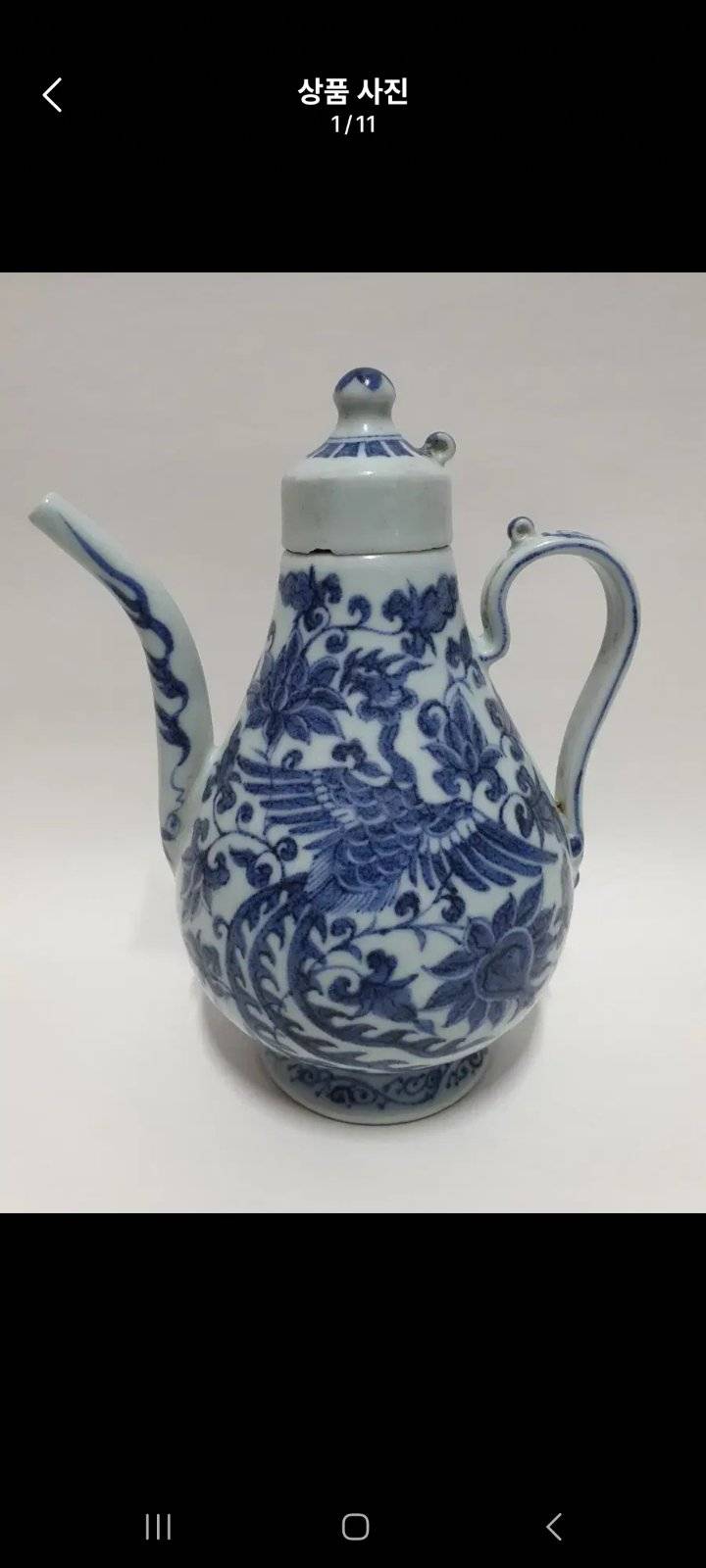
Blue and White Porcelain Phoenix Ewer
Estimated value
$150 - $450Rarity
Average(4/10)Category
Ceramics & PotteryEra
20th century in the style of the 14th centuryOrigin
ChinaAuthenticity
BLUE AND WHITE PORCELAIN PHOENIX EWER: IDENTIFICATION
A pear-shaped ceramic ewer featuring underglaze blue decoration of a phoenix (fenghuang) amidst scrolling lotus and peony motifs. The vessel displays a curved spout with flame-like cobalt accents, a looped handle with a small porcelain eyelet for a tether, and a domed lid with a globular finial. The footrim is unglazed, revealing a dense, buff-colored stoneware or proto-porcelain paste with visible iron spotting and kiln grit.
SCARCITY
Typical antique shop fare. Requires some searching but regularly available. This is where most genuine antiques fall.
Typical Characteristics
- Standard antique shop items
- Regularly available
- Moderate collector interest
Confidence Factors
- Artificial staining on the base lacks the natural depth of 600-year-old burial patina
- The 'heaping and piled' cobalt effect appears painted on rather than resulting from the high-iron manganese minerals used in the 14th century
- The glaze luster is unusually bright for a piece claiming Yuan/early Ming antiquity
Expert review recommended. Consider consulting a specialist before making purchasing decisions.
CERAMICIST'S ASSESSMENT
Ceramics Historian & Kiln Specialist
Identification of the style is certain, but the dating relies on visual indicators of aging that appear inconsistent with genuine Yuan Dynasty production, leading to a moderate-high risk score.
KEY EVIDENCE
- 1Pear-shaped 'Yuhuchun' silhouette consistent with 14th-century prototypes
- 2Unglazed footrim reveals a buff stoneware-like body rather than pure white kaolin porcelain
- 3Presence of 'eyelets' on handle and lid for tethering
- 4Underglaze blue motifs are stylistically correct for the period but executed with modern precision
UNCERTAINTIES
- •The 'distressed' appearance of the base appears to be a surface wash rather than genuine age-related accumulation
- •The spout angle and handle proportion are slightly more rigid than genuine 14th-century examples
- •Uniformity of the glaze thickness suggests modern kiln control
WHAT WOULD IMPROVE CERTAINTY
- →Close-up photo of the spout tip and handle joins under 10x magnification
- →UV light scan to check for overpainting or restoration on the lid and spout
- →Rub-test on the base staining to see if it is soluble
CONDITION & GRADE
Grading breakdown
Assessment based on structural integrity and absence of major cracks, though surface grit and 'kiln dirt' on the base are noted as production-related artifacts.
Condition
Significant kiln grit and iron spotting visible on the unglazed base. The lid shows a minor glaze flake at the rim, and there is a noticeable brown oxidation line where the handle joins the body, indicating possible firing stress or later repair.
CERAMICS MARKET VALUE
Updated: May 11, 2026
Modern high-quality Jingdezhen reproductions typically sell for $150–$300; genuine Yuan ewers are multi-million dollar auction items (Sotheby's 2021).
Who buys this
Collectors of Chinese 'reproduction' wares or interior designers seeking traditional Asian aesthetics for decor.
What increases value
- •Completeness of the lid and tether eyelets
- •Vibrancy of the cobalt blue decoration
- •Large, decorative phoenix motif
What lowers value
- •Confirmation as a 20th-century decorative copy rather than an antique
- •Visible glaze flaking on the lid rim
- •Poorly executed 'aged' base that deters serious antique collectors
What makes top-tier examples
- •Genuine 14th-century provenance (museum value)
- •Natural 'iron spots' from mineral impurities in original Su-ma-li cobalt
- •Naturally worn, velvet-textured footrim
Grade & condition
Integrity of the lid, clarity of the blue painting, and lack of hairline cracks in the spout.
Rarity & demand
For informational purposes only, not a formal appraisal.
ABOUT CERAMICS & POTTERY
Pottery, porcelain, stoneware, earthenware, and kiln-fired objects.
Ceramics & Pottery value and rarity guideSHARE THIS CURIOSITY
Have your own curiosities to discover?
Scan Your Curiosity
COMMENTS