Sancai-style Marbled Earthenware Equestrians
Estimated value
$150 - $450Rarity
Ordinary(3/10)Category
Ceramics & PotteryEra
Late 20th Century (circa 1980-1995)Origin
ChinaAuthenticity
SANCAI-STYLE MARBLED EARTHENWARE EQUESTRIANS: IDENTIFICATION
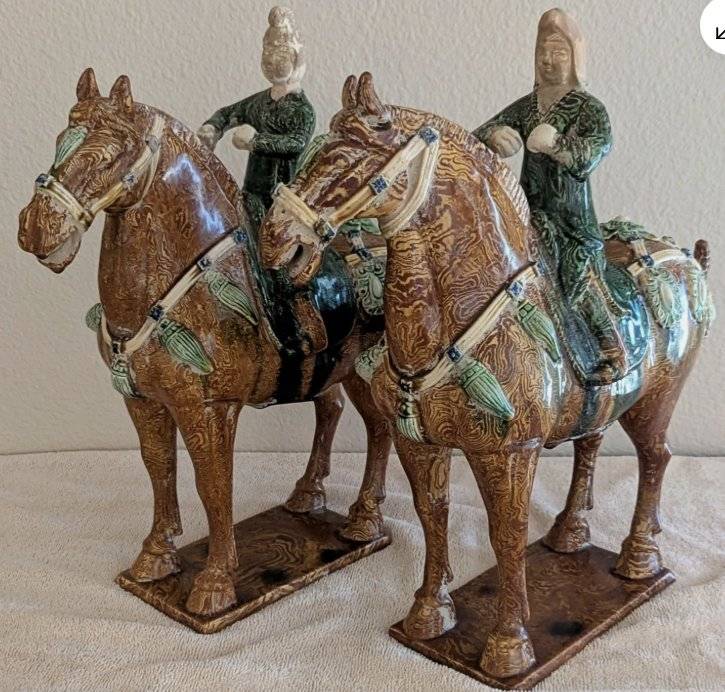
A pair of ceramic equestrian figures executed in the Tang Dynasty Sancai style, featuring riders on standing horses. The bodies exhibit a distinctive marbled or 'agate' surface created by mingling different colored clays (marmorated slip or 'jiao tai' technique). The riders wear green-glazed robes with molded detailing, while the horses are adorned with green and cream trappings, including tassels and harnesses. The underside reveals a hollow-molded construction with a visible firing aperture in the belly and a flat, unglazed rectangular base showing a light-buff earthenware paste.
CROSS-CULTURAL PARALLELS
Where This Object Echoes
The aesthetic mirrors the cosmopolitan 'Silk Road' influence where horses from Ferghana were highly prized status symbols.
Ritual & Ceremonial Use
- •Funerary offering (mingqi) intended to accompany high-ranking officials into the tomb to provide transportation and guard the spirit.
Meaning Through Time
Sacred protection and status for the deceased.
Decorative 'Chinoiserie' interior design element representing classical Chinese heritage.
SCARCITY
Standard antiques commonly found at estate sales and flea markets. Plentiful supply meets modest demand.
Typical Characteristics
- Moderate production runs
- Common at estate sales
- Entry-level collectibles
Confidence Factors
- Uniformly flat, clean base lacks the typical calcification or mineral encrustation found on 1,200-year-old excavated earthenware
- Internal mold lines visible through the belly aperture suggest modern industrial production
- Modern chemical glaze composition lacks the iridescent silvering or 'crawling' common in period Sancai wares
Expert review recommended. Consider consulting a specialist before making purchasing decisions.
CERAMICIST'S ASSESSMENT
Ceramics Historian & Kiln Specialist
High confidence in the identification as 20th-century decorative pieces because the construction techniques and base condition are inconsistent with ancient excavated ceramics.
KEY EVIDENCE
- 1Buff earthenware paste visible on the base lacks the degradation typical of burial burial environment
- 2Circular vent hole in the horse's belly is precision-cut and shows modern smooth interior walls
- 3Glaze color remains vibrant without the lead-corrosion 'silvery' patina found on genuine Tang artifacts
- 4Agate/marmorated slip decoration is atypical for large equestrian mingqi of the Tang period
UNCERTAINTIES
- •Lack of 'softness' in the clay edges on the underside
- •Uniformity between the two figures suggests factory-mold production
WHAT WOULD IMPROVE CERTAINTY
- →Perform a Thermoluminescence (TL) test to confirm the firing date if period origin is suspected
- →Inspect under UV light to detect modern synthetic binders or repairs on the rider's neck/head
CONDITION & GRADE
Condition
Minor surface abrasions and small chips are visible on the base edges and rider's head. The glaze exhibits wide-pattern crazing consistent with 20th-century fast-cooling firing cycles.
Weight & feel
Estimated at 3.5 to 5 kg per figure based on the hollow-molded earthenware walls and base thickness.
CERAMICS MARKET VALUE
Updated: May 11, 2026
Who buys this
Primarily sought by interior designers and home decorators seeking traditional motifs for high-end residential styling.
What increases value
- •Large scale (height) of the figures
- •Presence of a complete pair rather than a single figure
- •The 'jiao tai' marbled pattern which offers more visual complexity than standard Sancai glazes
What lowers value
- •Structural damage or repairs to fragile extremities like ears or hands
- •Excessive wear to the glaze surface which degrades the aesthetic appeal
What makes top-tier examples
- •Large scale over 50cm in height
- •Detailed hand-tooling of faces and hair after molding
Grade & condition
Integrity of the glaze, completeness of the riders, and absence of modern restoration.
Rarity & demand
For informational purposes only, not a formal appraisal.
ABOUT CERAMICS & POTTERY
Pottery, porcelain, stoneware, earthenware, and kiln-fired objects.
Ceramics & Pottery value and rarity guideSHARE THIS CURIOSITY
Have your own curiosities to discover?
Scan Your Curiosity
COMMENTS