
Modern Reproduction of a Chinese Export 'Hong' Punch Bowl
Estimated value
$50 - $150Rarity
Ordinary(3/10)Category
Ceramics & PotteryEra
Late 20th - Early 21st Century (Reproduction)Origin
ChinaVisual assessment
Photo analysis
Save to revisit in your watchlist. This does not add the object to your own collection.
Modern Reproduction of a Chinese Export 'Hong'
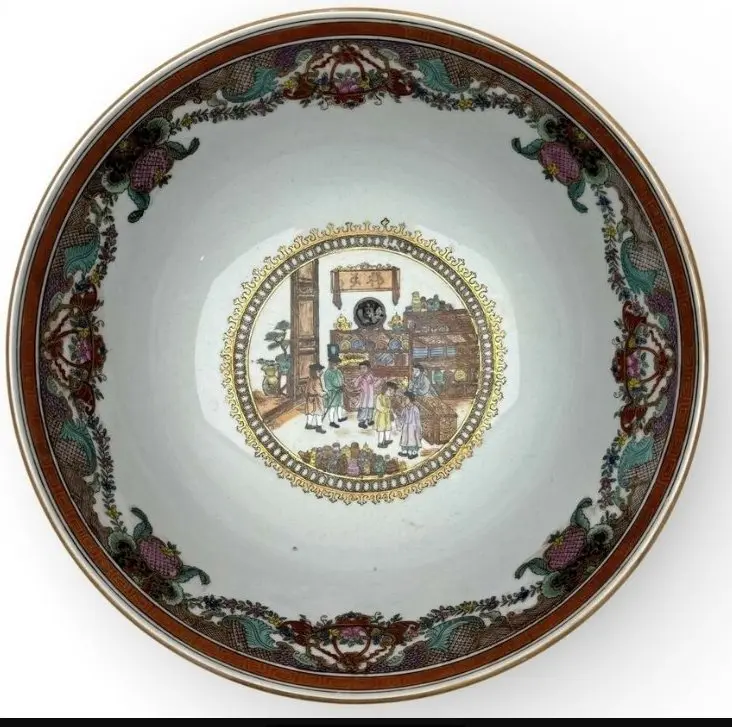
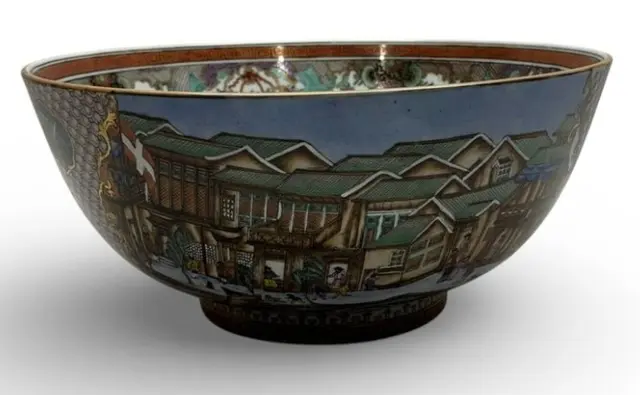
A modern porcelain reproduction of a late 18th-century Chinese Export 'Hong' punch bowl. The exterior features a continuous panorama of the Thirteen Factories at Canton, specifically showing the Danish trading house identified by the white-on-red Dannebrog flag. The interior displays a pseudo-famille rose palette, featuring a central medallion of a Chinese shop interior encircled by a gilt spearhead border. The inner rim is heavily ornamented with iron-red diaper patterns, floral swags, and scaled cartouches. The perfectly uniform white ground and flat enamel application indicate modern transfer-print or stencil-assisted production, lacking the distinct brushwork and nuanced shading of period pieces.
Related traditions
British East India Company
18th Century
The consumption of punch, derived from the Hindi word 'panch' (meaning five ingredients), drove the initial demand for these massive communal drinking vessels in 18th-century European society.
Use and ceremony
Late 20th Century
Transitioned from a unique, hand-painted status symbol of global maritime trade into a mass-produced staple of traditional Western interior design.
The trading houses of Canton
Genuine Hong bowls were commissioned in Canton between circa 1765 and 1800 by European and American supercargoes to commemorate their confined trading quarters along the Pearl River. Because foreign merchants were restricted from entering China proper under the Canton System rules established in 1757, these bowls served as accurate visual records of the Western trading presence prior to the devastating factory fire of 1822.
Further details
Historians date original Hong bowls by identifying the specific sequence of national flags, as factories frequently changed national ownership or burned down during the late 1700s.
The central interior scene of a porcelain shop is a meta-reference; these bowls were often purchased in the exact type of Canton retail establishments depicted in the medallion.
Attribution and evidence
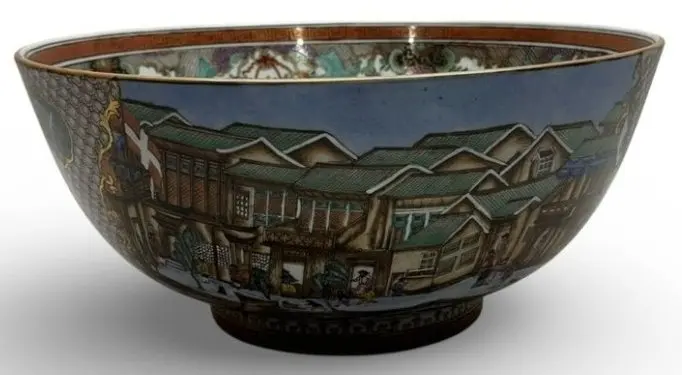
The combination of the user's explicit identification as a reproduction and the visually obvious modern manufacturing techniques (sterile glaze, flat enamels) provides absolute certainty regarding its status as a modern copy.
Identifying details
- 1Presence of Canton Thirteen Factories motif with Dannebrog flag (Hong bowl pattern)
- 2Flat, homogenous enamel coloration indicating modern decal/transfer usage
- 3Sterile white ground lacking 18th-century firing imperfections
- 4Stiff execution of the intricate famille rose floral swags on the inner rim
Open questions
- •The piece is a known, confirmed reproduction; any attempt to sell it as period Qianlong export ware would be fraudulent.
Photographs that would help
- Examine the unglazed foot rim to confirm the modern, bright white industrial porcelain paste.
- Inspect the enamel under a 10x jeweler's loupe to identify modern dot-matrix or stencil edges in the color application.
Terms in this record
- Hong
- The foreign trading factories (warehouses and offices) established outside the city walls of Canton where Western merchants were restricted to live and trade.
- Famille Rose
- A palette of overglaze porcelain enamels, introduced in China in the early 18th century, characterized by the presence of an opaque pink/rose color derived from colloidal gold.
- Export Porcelain
- Ceramics made in China explicitly for Western markets, often featuring Western shapes (like punch bowls) decorated with Chinese or specially commissioned Western motifs.
Wear and preservation
The bowl shows minor surface dirt and slight wear to the gilt rims, consistent with modern decorative handling. No visible chips, hairlines, or structural repairs are present in the provided angles.
Glaze and painted decoration
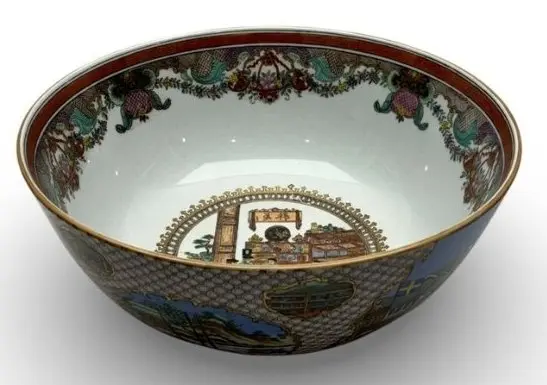
The surface is characterized by a stark, uniform glossy glaze that lacks the typical 'orange-peel' texture, pinholing, or minor kiln ash inclusions found on genuine 18th-century Qing Dynasty porcelain.
Recorded physical details
Substantial and heavily potted, typical for large punch bowls approaching 30-40 cm in diameter, though lacking the precise tapering weight-distribution rings of period thrown examples.
Scarcity and surviving examples
Ordinary · 3/10 estimated rarity
This is a qualitative collection score, not a measured survival count, market percentile or proof of authenticity.
What the photographs establish
Interpretation of the photographs and supplied context. This does not authenticate the object.
- Opaqueness and flat color application typical of modern transfer or decal techniques rather than 18th-century hand-painted enamels
- Gilding lacks the soft, rubbed patina of 200-year-old gold leaf
- The paste and clear glaze are entirely sterile, showing modern industrial kiln perfection
Value and its basis
Estimate recorded: May 16, 2026
How we estimate value
Estimate context (not a documented sale): While modern reproductions retail and resell in the $50-$150 range on eBay, Sotheby's and Christie's regularly record genuine 18th-century Qianlong Hong bowls selling between $30,000 and $80,000 depending on the specific flags shown.
Collectors and interest
Interior designers and homeowners seeking the traditional 'Grand Tour' aesthetic for display on sideboards or center tables without the high investment risk of genuine antiques.
What supports the estimate
- •Large physical dimensions (pieces exceeding 35cm command more as centerpieces)
- •Complexity and crispness of the applied decoration
- •Overall decorative impact and lack of modern damage
What could change it
- •Fading or scratching of the modern overglaze enamels
- •Chips to the rim, which severely impact decorative utility
Comparing quality
- •Older (mid-20th century) reproductions produced in Macau or early PRC export factories that utilized some actual hand-painting over printed outlines
The effect of condition
Completeness of the rim, integrity of the interior medallion, and lack of visible modern wear to the gilding.
Market interest
For informational purposes only, not a formal appraisal.
The collector’s account
Supporting details
- User stated 'Replica/Reproduction' - visual evidence definitively confirms this is a modern copy of an 18th-century export antique.
- User claimed 'Minor wear' - visible light surface dirt/rubbing aligns with gentle use of a modern decorative item.
- User noted 'China' origin - this aligns with both the original subject matter and the likely modern manufacturing origin.
Related objects
Chinese Export Porcelain 'Hong' Punch Bowl
Shared title details
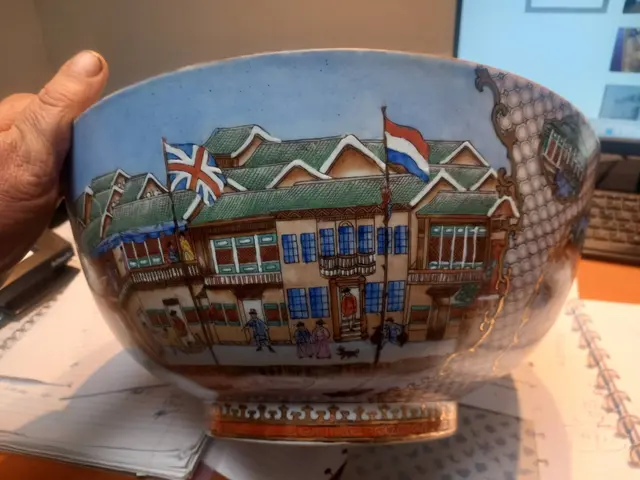
Chinese export-style 'hong' bowl with Canton trading-house scenes
Shared title details
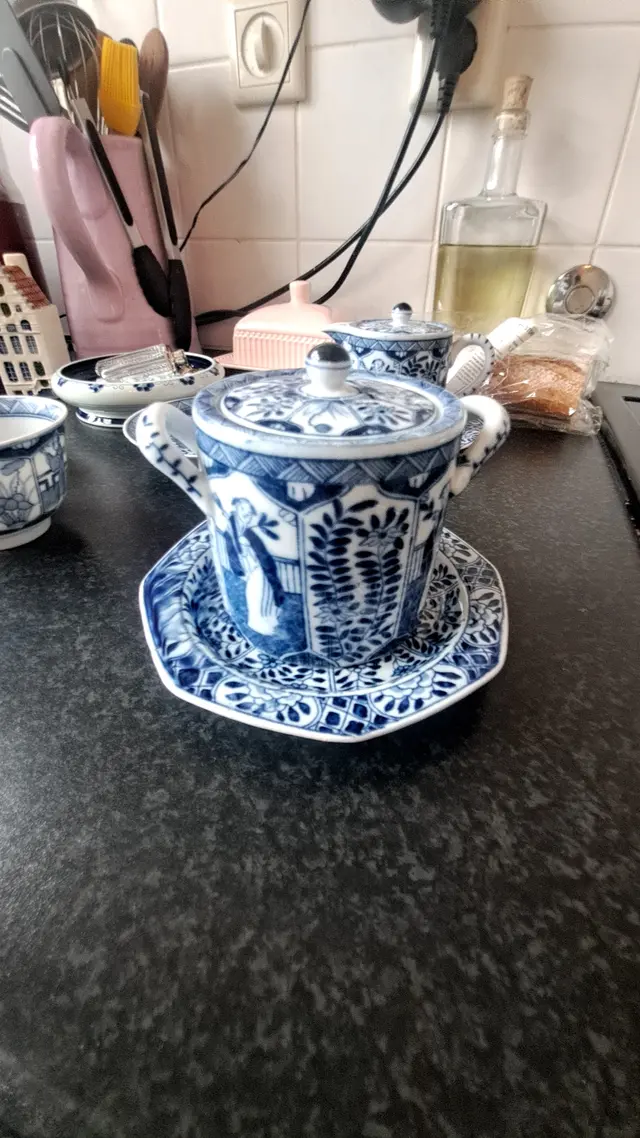
Chinese Blue & White Lidded Export Cup and Saucer, early 20th Century
Shared title details
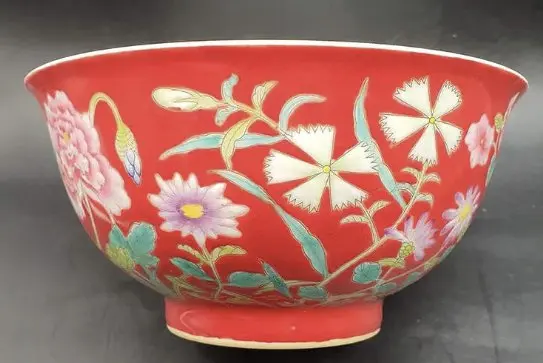
Chinese Falangcai Style Ruby-Ground Floral Bowl with Kangxi Yu Zhi Mark
Shared title details
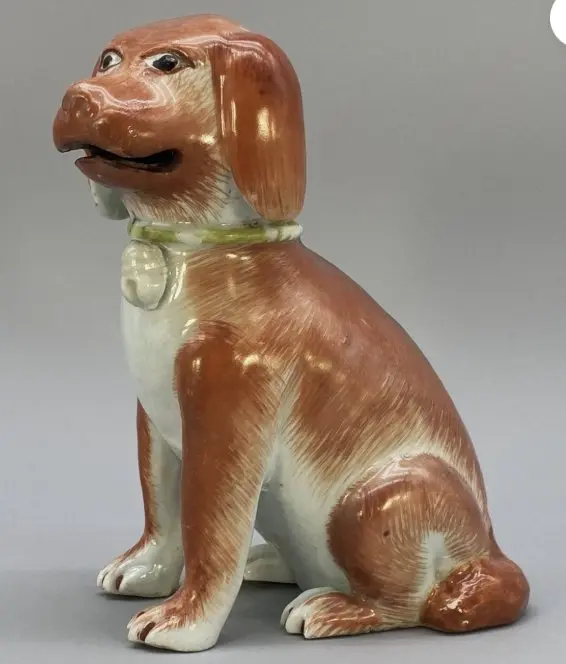
Chinese Export Porcelain Spaniel Figurine, Qing Dynasty, late 18th to mid-19th Century
Shared title details
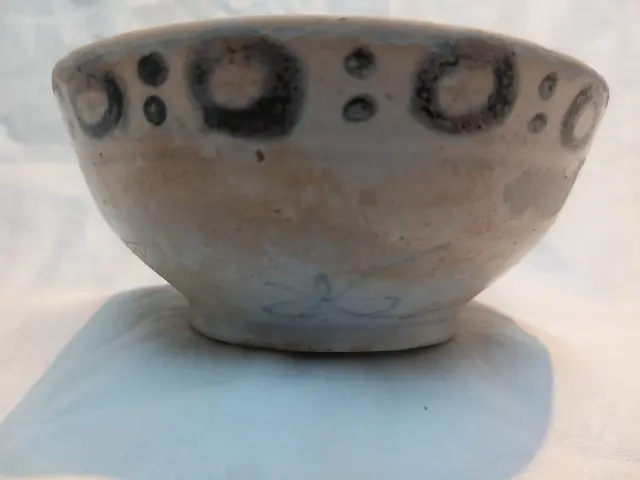
Chinese Blue and White 'Ring and Dot' Swatow Bowl, late Ming Dynasty (ca. 1570-1644)
Shared title details
Explore Ceramics & Pottery
Pottery, porcelain, stoneware, earthenware, and kiln-fired objects.
Ceramics & Pottery value and rarity guideShare this find
A place for your ceramics
Keep its photographs, maker’s marks and the story you know in one object record. Start with a photo.
Create an account for 10 free scans. No credit card needed.
Join the conversation
Recognise a detail or have a question? Add what you know and cite your source. Suggested corrections stay in the discussion for the owner or a moderator to review.
Sign in to leave a comment
Sign in