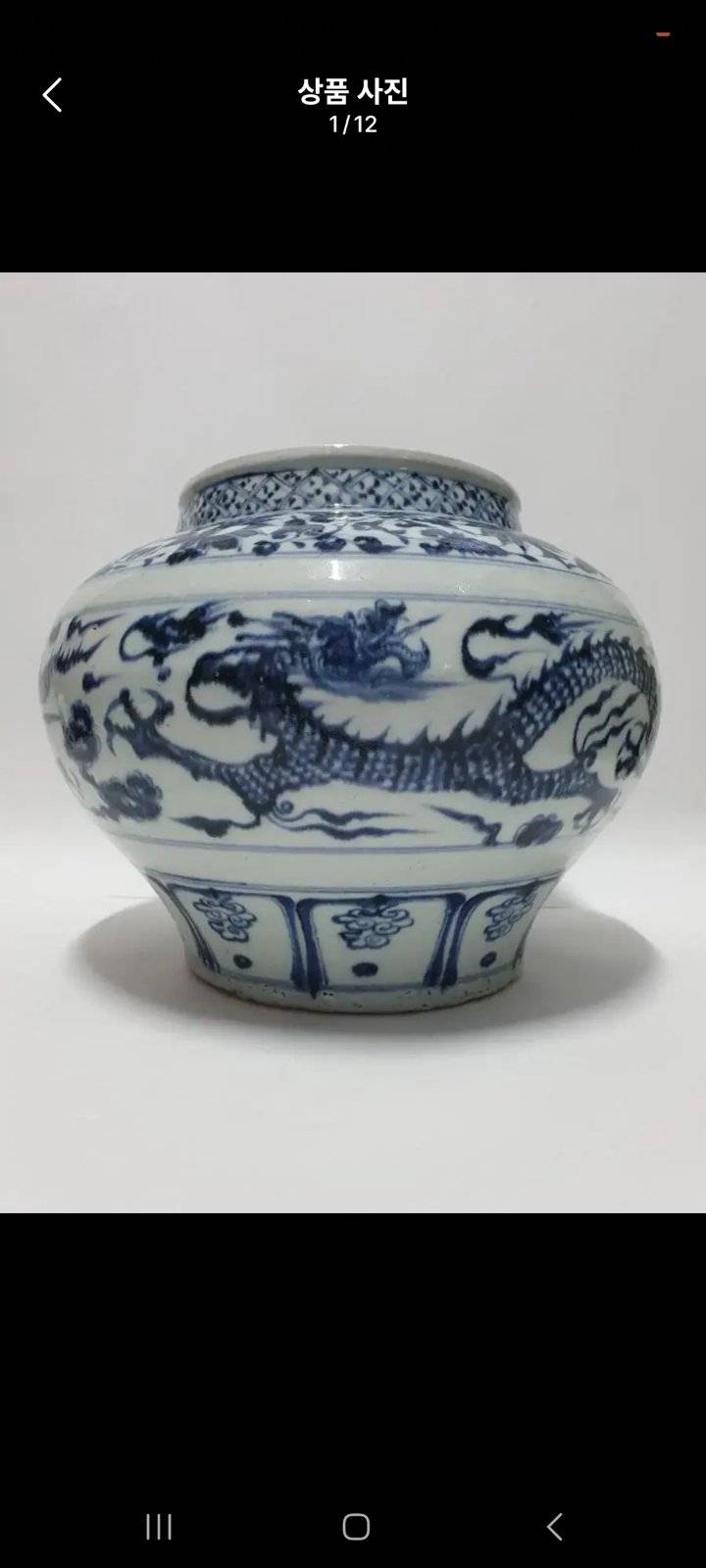
Blue and White Dragon Jar
Estimated value
$150 - $450Rarity
Average(4/10)Category
Ceramics & PotteryEra
Late 20th century in the style of the 14th-15th centuryOrigin
ChinaAuthenticity
BLUE AND WHITE DRAGON JAR: IDENTIFICATION
A globular blue and white porcelain jar featuring a central register with a four-clawed dragon amid stylized clouds. The neck is decorated with a diamond-hatch diaper border, while the shoulder displays a scrolling lotus vine. The base is finished with a series of upright lappet panels containing auspicious symbols. The underglaze cobalt shows characteristic 'heaping and piling' effects, especially on the dragon's scales and limbs.
CROSS-CULTURAL PARALLELS
Where This Object Echoes
The 'Dragon Jar' (Yongjun) served as a central ceremonial vessel for royal banquets, echoing the Chinese influence on status-bearing ceramics.
Ritual & Ceremonial Use
- •Placing in burials as food/liquid containers to sustain the soul in the afterlife.
- •Displaying in pairs in scholars' studios to symbolize cosmic power and wisdom.
Meaning Through Time
The dragon represented the 'Son of Heaven' and imperial authority over the weather and water.
Symbolizes cultural heritage and the global market demand for 'Chinoiserie' aesthetics.
SCARCITY
Typical antique shop fare. Requires some searching but regularly available. This is where most genuine antiques fall.
Typical Characteristics
- Standard antique shop items
- Regularly available
- Moderate collector interest
Confidence Factors
- The extreme coarseness and uniform 'dirty' appearance of the base are common indicators of modern artificial aging.
- The cobalt blue lacks the natural diffusion patterns seen in genuine 15th-century examples.
- The 'heaping and piling' appears deliberately applied rather than a natural result of the firing process.
Expert review recommended. Consider consulting a specialist before making purchasing decisions.
CERAMICIST'S ASSESSMENT
Ceramics Historian & Kiln Specialist
Identification as a high-quality decorative reproduction is based on the mismatch between the forced 'ancient' look of the base and the relatively modern execution of the brushwork.
KEY EVIDENCE
- 1The dragon's four-clawed design is consistent with Yuan/Ming iconography.
- 2The presence of upright lappets at the base follows traditional layout for Guan jars.
- 3The footrim shows significant iron-red oxidation where the paste meets the atmospheric oxygen.
- 4Heaping and piling effect is present in the cobalt decoration.
UNCERTAINTIES
- •The base paste is excessively gritty and uniform, which is often seen in 1980s-1990s reproductions.
- •The scrolling lotus on the shoulder is slightly stiff compared to the fluid movement of early 15th-century hand-painting.
- •A lack of credible 'wear' on the actual glaze surface despite the 'aged' look of the bottom.
WHAT WOULD IMPROVE CERTAINTY
- →Perform a UV light scan to check for modern resins or repairs masked by the busy pattern.
- →Obtain a close-up of the glaze 'bubbles' (longyan) to determine if they are uniform or varied in size.
- →Test the weight against known imperial-spec jars of these dimensions.
CONDITION & GRADE
Condition
Surface shows artificial aging on the unglazed footrim; however, the glazed body appears free of significant chips or hairline fractures. The interior shows consistent pitting and cooling contractions.
CERAMICS MARKET VALUE
Updated: May 11, 2026
Who buys this
Interior designers looking for traditional Asian accents and entry-level collectors of 'in the style of' Chinese porcelain.
What increases value
- •Visual scale and decorative impact
- •Completeness of the dragon motif
- •Execution of the diaper-patterned rim
What lowers value
- •High probability of being a modern 'imitation antique'
- •Coarse base may deter collectors seeking refined porcelain quality
- •Lack of reign mark
What makes top-tier examples
- •Natural cobalt diffusion into the glaze
- •Asymmetrical hand-painted details (not repetitive stamps)
- •Genuine translucency when held to light
Grade & condition
Glaze integrity, clarity of cobalt pigment, and absence of modern grinding marks on the base.
Rarity & demand
For informational purposes only, not a formal appraisal.
ABOUT CERAMICS & POTTERY
Pottery, porcelain, stoneware, earthenware, and kiln-fired objects.
Ceramics & Pottery value and rarity guideSHARE THIS CURIOSITY
Have your own curiosities to discover?
Scan Your Curiosity
COMMENTS