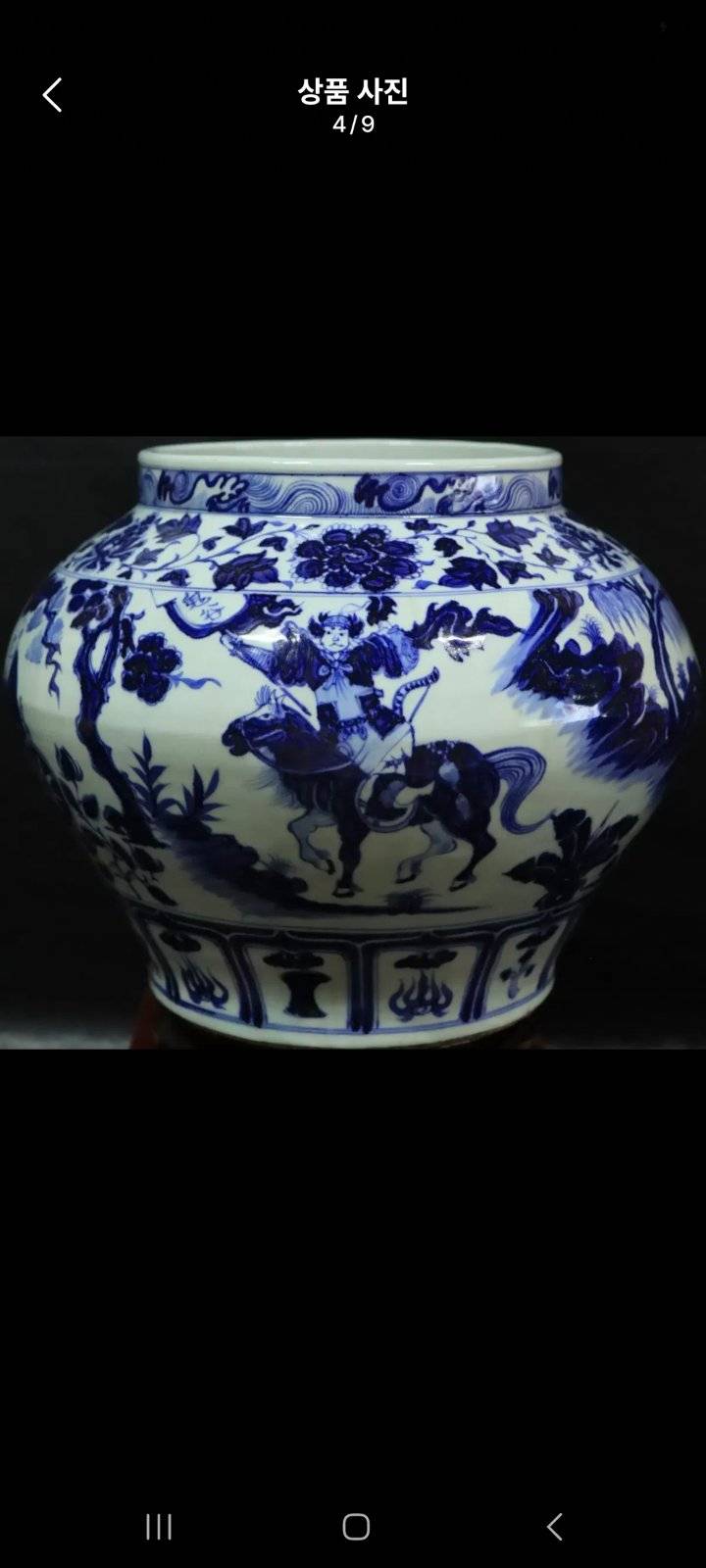
Blue and White Guan Jar with Figurative Decoration
Estimated value
$80 - $250Rarity
Common(2/10)Category
Ceramics & PotteryEra
Late 20th Century (post-1980)Origin
ChinaAuthenticity
BLUE AND WHITE GUAN JAR WITH FIGURATIVE DECORATION: IDENTIFICATION
A baluster-form porcelain jar featuring underglaze cobalt blue decoration of a mounted warrior in a landscape, flanked by floral scrolls on the shoulder and classic lotus lappets around the base. The central frieze depicts a figure on horseback with a bow, rendered in a style emulating the Yuan Dynasty (1271–1368) 'heaping and piling' cobalt effect. The base is unglazed, showing a grit-contaminated paste with a central spiral 'chatter mark' and a small inset rectangular blue seal mark.
COLLECTOR NOTES
Real Yuan jars of this 'Guan' shape are among the most expensive ceramics in the world, with a 'Gui Gu Zi Descending the Mountain' jar selling for over $27 million at Christie's in 2005.
SCARCITY
Older mass-produced items still widely available. Easy to find on eBay, antique malls, and estate sales in large quantities.
Typical Characteristics
- Mass produced historically
- High survival rate
- Readily available everywhere
Confidence Factors
- Synthetic 'chatter marks' on base are too uniform
- Seal mark on unglazed base is inconsistent with Yuan or Ming prototypes
- Cobalt blooming is chemically controlled rather than mineralogical
- The orange 'iron skin' inside the rim is likely an applied wash
Expert review recommended. Consider consulting a specialist before making purchasing decisions.
CERAMICIST'S ASSESSMENT
Ceramics Historian & Kiln Specialist
High confidence due to the presence of multiple diagnostic 'modern reproduction' indicators, particularly the base construction and the spurious seal mark.
KEY EVIDENCE
- 1The footrim shows mechanically perfect concentric turning marks, typical of modern lathe finishing.
- 2Small blue seal mark inset into an unglazed base is a 20th-century convention unknown in the Yuan period.
- 3The cobalt 'blooming' lacks the true depth and crystalline structural breakdown seen in native or Persian mineral cobalt.
- 4The paste on the base shows high-temperature vitrification inconsistent with 700-year-old burial or storage.
UNCERTAINTIES
- •Intentional surface staining on the base to mimic age
- •Anachronistic marking style
- •Overly bright, clean glaze color
WHAT WOULD IMPROVE CERTAINTY
- →Examine the interior for a horizontal join line (authentic Yuan jars were potted in sections)
- →Perform a UV light test to check if the 'iron spots' on the base fluoresce, indicating modern pigment
- →Check for translucency at the rim; Yuan jars are typically thick and opaque
CONDITION & GRADE
Grading breakdown
Not applicable to decorative contemporary ceramics.
Condition
Artificial aging evident on the base in the form of scattered dark spotting. Glaze appears pristine with no visible kiln debris or genuine 14th-century degradation.
Weight & feel
Estimated 2.5 to 3.5 kg, likely possessing a modern slip-cast uniform thickness rather than the base-heavy potting of early vessels.
CERAMICS MARKET VALUE
Updated: May 11, 2026
Who buys this
General decorators and novice collectors looking for a classic Chinese aesthetic without the investment of a period piece.
What increases value
- •Large physical scale for interior design impact
- •Clarity of the narrative 'warrior' scene
- •Absence of structural cracks or chips
What lowers value
- •Common nature as a modern workshop production
- •Lack of authentic provenance
- •Obvious simulated aging on base
What makes top-tier examples
- •Hand-painted narrative detail rather than transfer printing
- •Correct sectioned construction (horizontal join inside)
- •Genuine mineral cobalt with deep glaze penetration
Grade & condition
Visual appeal of the painting, glaze clarity, and structural integrity.
Rarity & demand
For informational purposes only, not a formal appraisal.
ABOUT CERAMICS & POTTERY
Pottery, porcelain, stoneware, earthenware, and kiln-fired objects.
Ceramics & Pottery value and rarity guideSHARE THIS CURIOSITY
Have your own curiosities to discover?
Scan Your Curiosity
COMMENTS