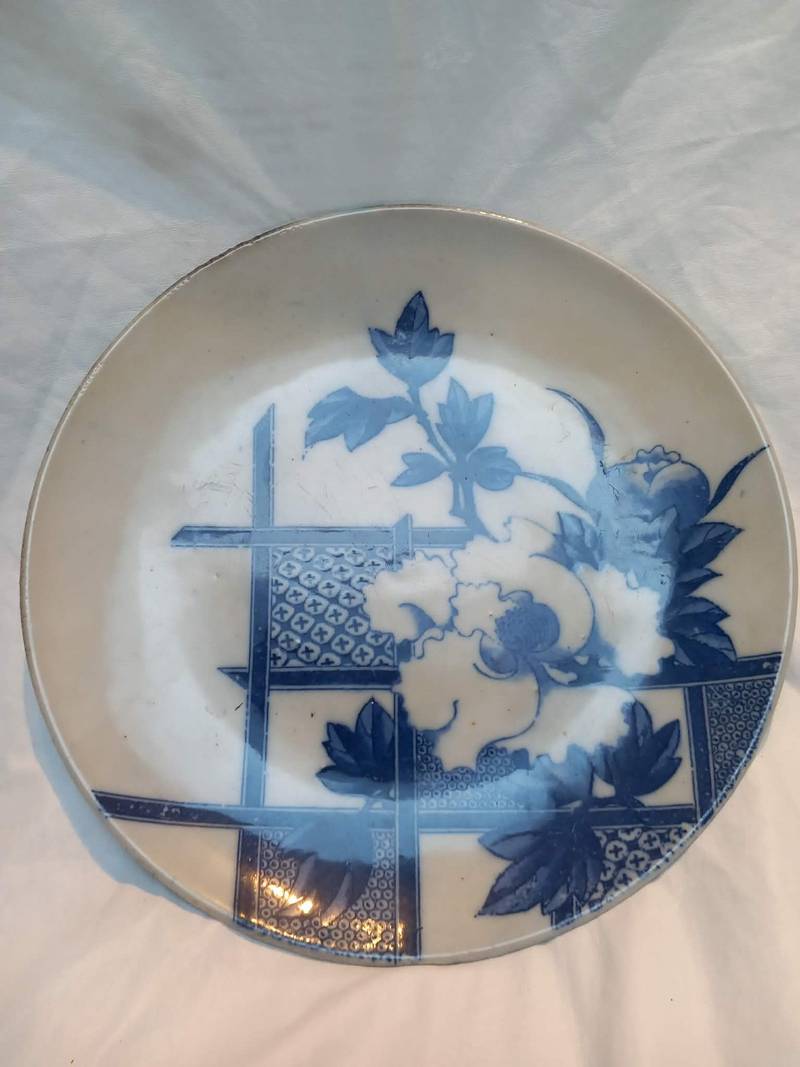
Chinese Blue and White Porcelain Plate with Peony and Bamboo Motif
Estimated value
$45 - $120Rarity
Ordinary(3/10)Category
Ceramics & PotteryEra
Late Qing Dynasty, circa 1880-1910Origin
ChinaAuthenticity
CHINESE BLUE AND WHITE PORCELAIN PLATE WITH PEONY AND BAMBOO MOTIF: IDENTIFICATION
A circular underglaze blue and white porcelain plate featuring an asymmetrical composition of a large peony blossom and bamboo trellis. The central design utilizes a distinct 'stencil-like' or transfer-printed appearance combined with hand-painted elements, characteristic of late 19th-century export or provincial wares. The reverse side is decorated with three scrolling floral sprays in a simplified cobalt wash. The footrim is unglazed and shows signs of iron-oxide burning and kiln grit.
PRODUCTION & FIRING
SCARCITY
Standard antiques commonly found at estate sales and flea markets. Plentiful supply meets modest demand.
Typical Characteristics
- Moderate production runs
- Common at estate sales
- Entry-level collectibles
Confidence Factors
- Construction and glaze wear are consistent with late 19th-century provincial production
- Presence of kiln grit and irregular footrim firing is typical for the era
- Low market value for this specific type makes modern forgery unlikely
CERAMICIST'S ASSESSMENT
Asian Art Specialist
The visual markers for late 19th-century provincial Chinese ware are clear, particularly in the footrim construction and cobalt application, though the specific kiln location (e.g., Jingdezhen vs. Swatow) is difficult to verify from photos.
KEY EVIDENCE
- 1Unglazed footrim shows characteristic 'oatmeal' texture and iron-oxide oxidation.
- 2The cobalt blue sits under a thick, slightly blue-tinted glaze consistent with late Qing provincial wares.
- 3Compositional style uses a 'broken border' layout common in export ceramics from 1870-1900.
UNCERTAINTIES
- •The absence of a reign mark is expected for this grade but makes pinpointing the exact kiln difficult.
- •Heavy scratching on the face indicates significant domestic use.
WHAT WOULD IMPROVE CERTAINTY
- →Clean the surface with a mild soap to distinguish between glaze staining and surface dirt.
- →Check for hairline cracks by gently tapping the rim to hear for a clear 'ring' or a dull 'thud'.
CONDITION & GRADE
Grading breakdown
Structural integrity remains, but multiple small chips (nibbles) on the outer rim and significant stacking wear in the center reduce the grade from 'Fine'.
Condition
Significant rim chipping and visible glaze abrasions are present. There is a noticeable 'mushiness' to the transfer quality and various kiln inclusions (tiny black specks) throughout the body.
CERAMICS MARKET VALUE
Updated: May 11, 2026
Who buys this
General antique collectors or those specializing in 'Kitchen Qing' or provincial Chinese export wares.
What increases value
- •Popularity of 'Blue and White' aesthetic for interior design
- •Authenticity of age (genuine late 19th-century piece)
What lowers value
- •Large rim chips significantly decrease value for serious porcelain collectors
- •Lack of a reign mark limits upside potential
What makes top-tier examples
- •Vibrant, deep sapphire cobalt tones
- •Absence of kiln defects and chips
- •Documented provenance to a specific known kiln
Grade & condition
Condition of the rim, clarity of the cobalt transfer, and absence of glaze surface pitting.
Rarity & demand
For informational purposes only, not a formal appraisal.
ABOUT CERAMICS & POTTERY
Pottery, porcelain, stoneware, earthenware, and kiln-fired objects.
Ceramics & Pottery value and rarity guideSHARE THIS CURIOSITY
Have your own curiosities to discover?
Scan Your Curiosity
COMMENTS