
Chinese Blue & White Lidded Export Cup and Saucer, early 20th Century
Estimated value
$85 - $220Rarity
Average(4/10)Category
Ceramics & PotteryBrand
Arita WareEra
circa 1890-1925Origin
ChinaVisual assessment
Photo analysis
Save to revisit in your watchlist. This does not add the object to your own collection.
Chinese Blue & White Lidded Export Cup
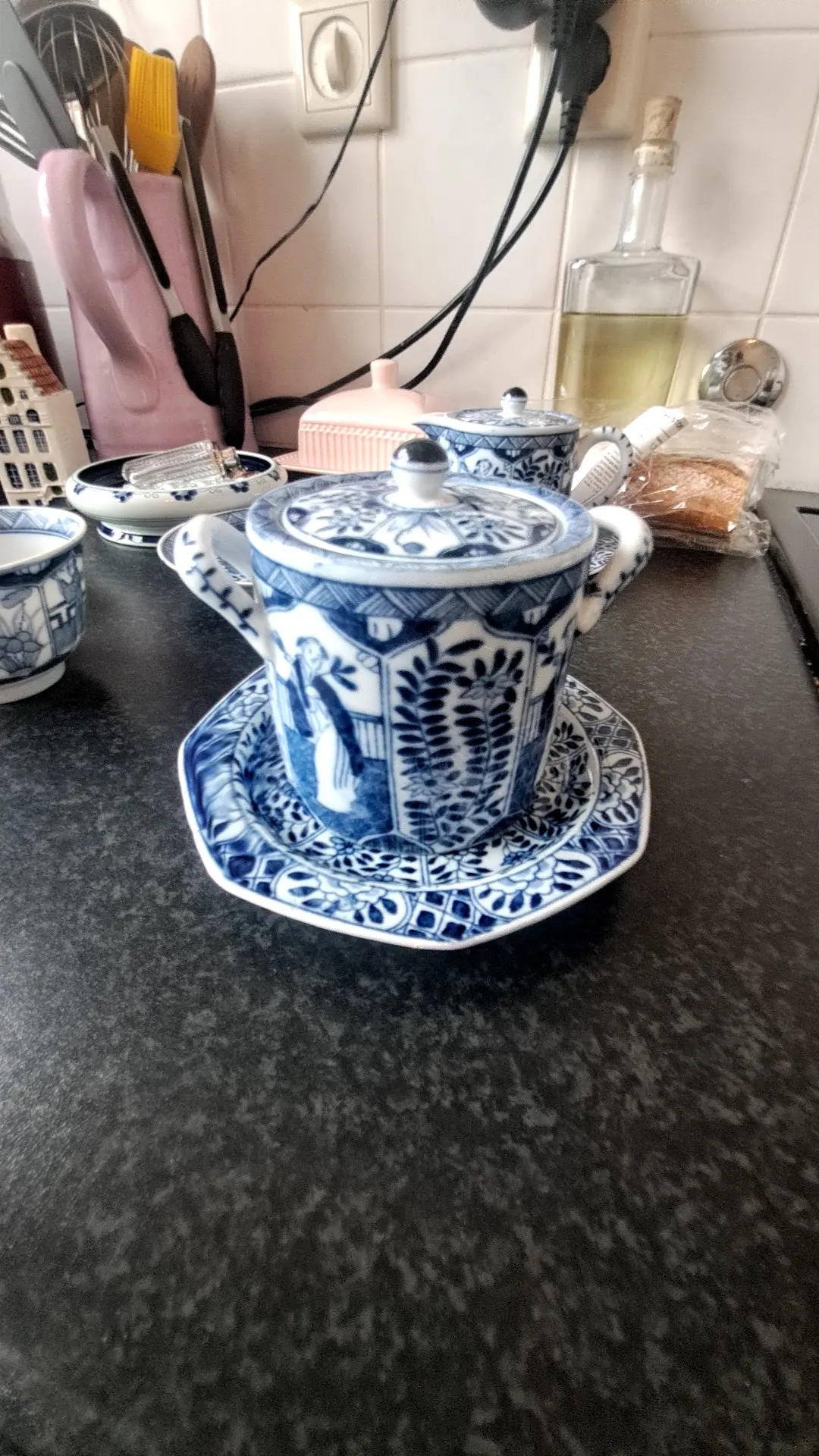
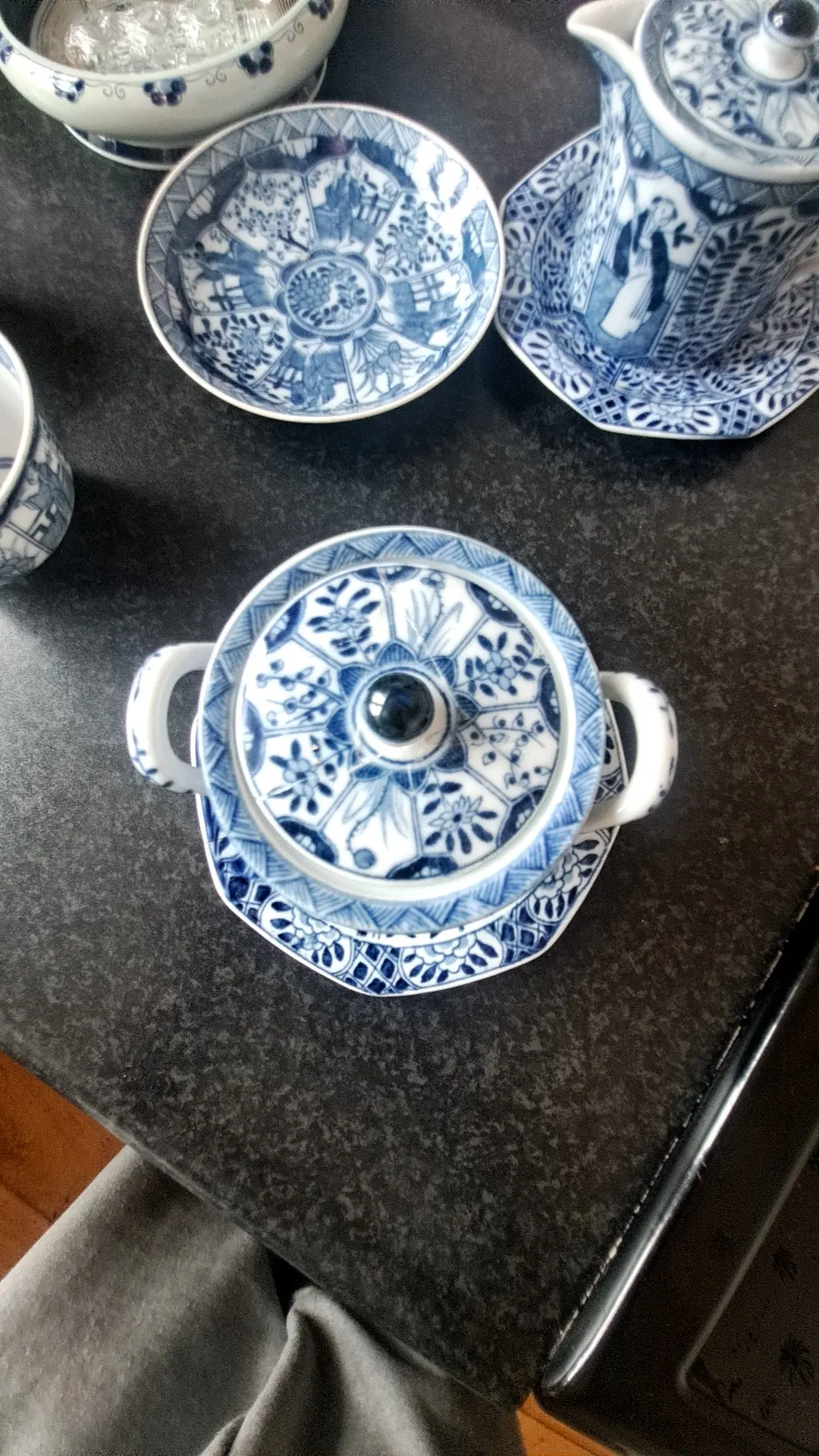
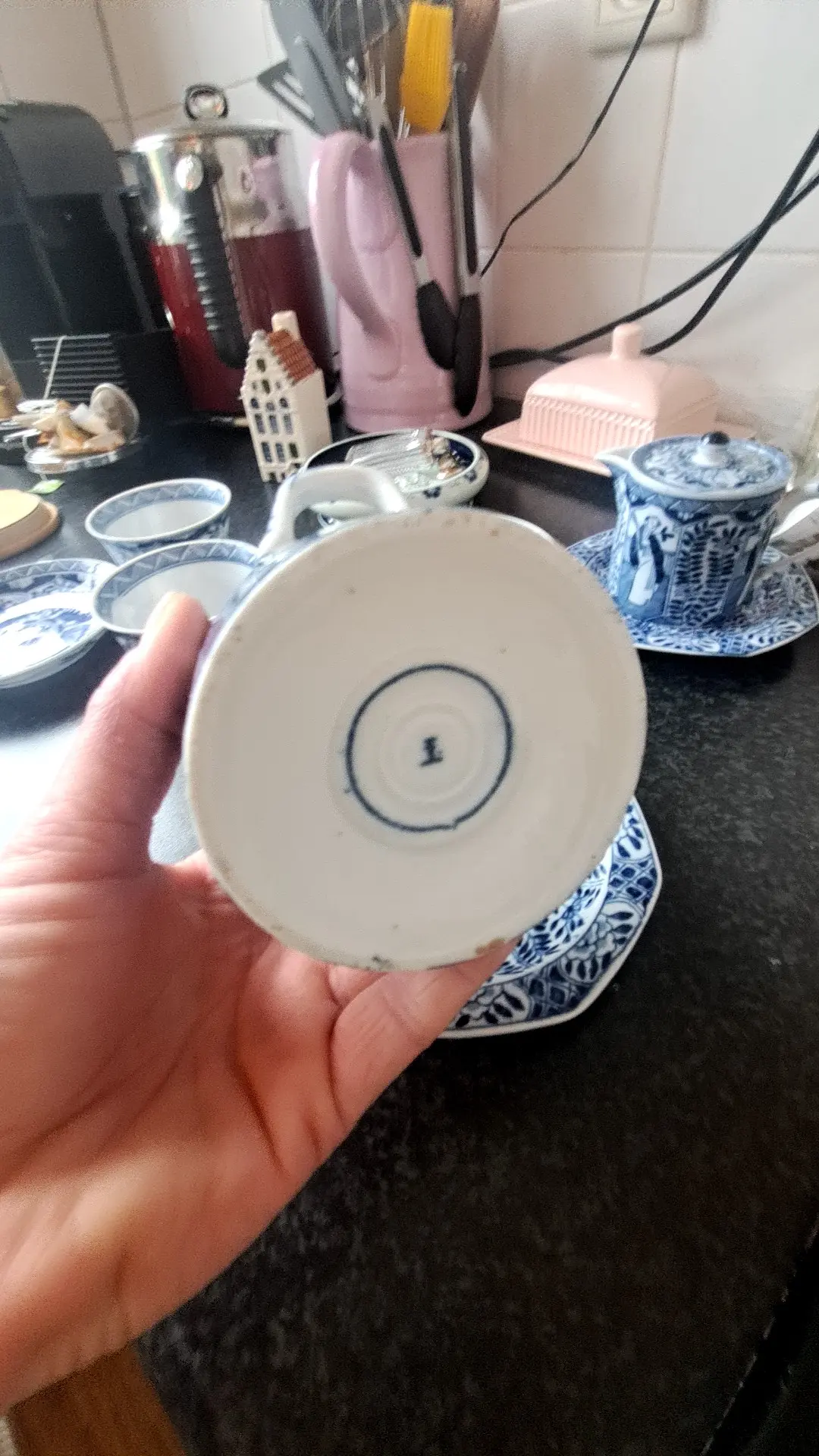
This is a blue and white porcelain lidded cup with double shell-form handles and a matching lobed saucer, featuring underglaze cobalt decoration. The central panels depict 'Long Eliza' figures (meiren) within an architectural landscape, bordered by alternating panels of floral sprays and geometric diaper patterns. The base reveals a single underglaze blue character, likely a potter's mark or shop mark, rather than an imperial reign mark.
Related traditions
Dutch Delftware
18th-19th Century
Lowlands potters closely imitated these 'Long Eliza' patterns in tin-glazed earthenware starting in the 1700s.
At the tea table
Kangxi Period
Female figures represented scholarly elegance and Daoist virtues.
Meiji/Victorian
These figures became primarily decorative 'Orientalist' motifs for Western interior design.
Origins and context
This set is executed in the Kangxi revival style, which became highly popular for the European export market between 1890 and 1920. While the motifs reference the 17th-century Kangxi period (1662-1722), the thicker potting and specific cobalt hue suggest the late Qing Dynasty to early Republic period. These sets were frequently produced in Jingdezhen to satisfy the Western 'Chinamania' demand for traditional Chinese motifs.
Further details
The 'Long Eliza' nickname was coined by 19th-century Dutch collectors as a translation of 'Lange Lijzen', used to describe the elegant, slender female figures depicted in Chinese porcelain.
The single blue character mark on the base, known as a 'hall mark' or workshop signifier, was often used in Jingdezhen during the 1900-1925 period to distinguish production batches for specific exporters.
Attribution and evidence
The visual evidence of construction and the specific execution of the panels provides a high probability of a late 19th to early 20th-century date.
Identifying details
- 1Underglaze cobalt indicates traditional Jingdezhen production methods.
- 2The lobed saucer and shell handles are diagnostic of late 19th-century export adaptations.
- 3The 'Lange Lijzen' (Long Eliza) motif is a classic feature of the Kangxi revival style.
- 4Character mark on the base is consistent with early 20th-century workshop practices.
Open questions
- •The blue character mark is simplified, suggesting high-volume production rather than artist-signed work.
- •Potting thickness at the footrim is greater than found on early Qing examples.
Photographs that would help
- Obtain a high-resolution close-up of the base mark for specific workshop identification.
- Check for translucent spots under a strong backlight to confirm porcelain quality.
Terms in this record
- Long Eliza
- A slender female figure motif popular in export porcelain.
- Fritting
- Small chips common on the edges of porcelain where the glaze meets the body.
- Diaper Pattern
- A repeating geometric background motif used to border central scenes.
Wear and preservation
Surface wear is consistent with domestic use; small firing flaws on the base are typical for this grade of export ware.
Small chips or 'fritting' are visible on the footrim and the edges of the lid; the blue pigment shows consistent saturation with no obvious modern digital transfer characteristics.
Glaze and painted decoration
The glaze shows a slightly blue-white tint (qingbai) typical of late 19th-century Jingdezhen, with minor pinholing and visible underglaze cobalt bleeding into the glaze at the panel borders.
Recorded physical details
Approximately 250-350 grams; the potting is noticeably denser and heavier than authentic 17th-century eggshell porcelain, suggesting a later manufacturing date.
Scarcity and surviving examples
Average · 4/10 estimated rarity
This is a qualitative collection score, not a measured survival count, market percentile or proof of authenticity.
What the photographs establish
Interpretation of the photographs and supplied context. This does not authenticate the object.
- Style is a deliberate revival of 17th-century Kangxi motifs
- Potted weight is characteristic of late 19th/early 20th century production
- Mark on base is a workshop signifier rather than a dated reign mark
Value and its basis
Estimate recorded: May 10, 2026
How we estimate value
Estimate context (not a documented sale): Similar early 20th-century export gaiwans often appear in regional auctions such as Chiswick or Bonhams with estimates between $100-$300.
Collectors and interest
Collectors of Chinese export ware and interior decorators seeking classic Chinoiserie aesthetics.
What supports the estimate
- •Completeness of the set (lid, cup, and saucer included)
- •Lack of vertical hairline cracks in the body
- •Clarity of the cobalt blue decoration
What could change it
- •Chips to the lid finial or rim
- •Substantial kiln grit on the interior
- •Fading or 'scuffing' of the glaze
Comparing quality
- •Authentic 17th-century Kangxi mark and weight
- •Uniform deep sapphire blue without gray undertones
The effect of condition
Completeness of components and integrity of the edge glaze.
Market interest
For informational purposes only, not a formal appraisal.
Related objects
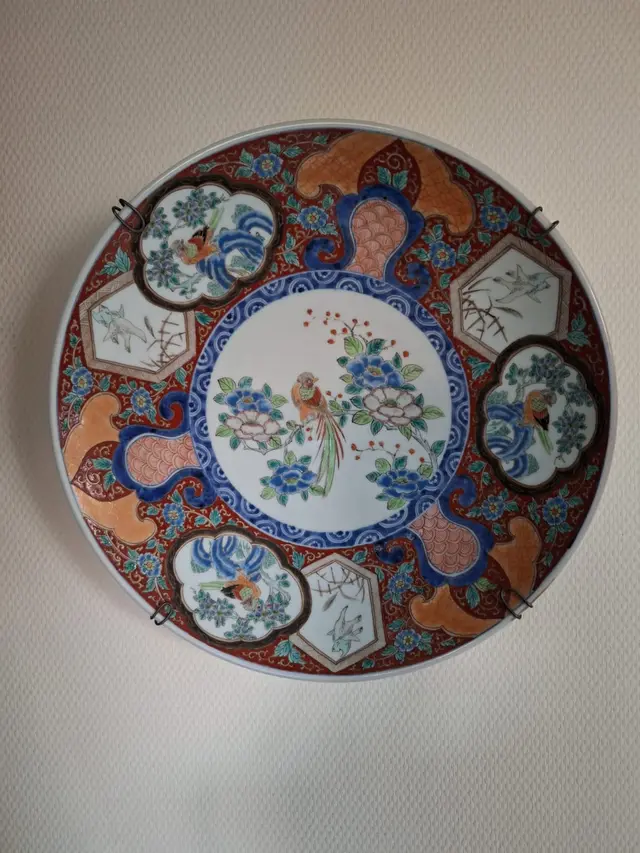
Chinese Porcelain 'Hundred Birds' Charger with Floral and Medallion Motifs
Same brand: Arita Ware
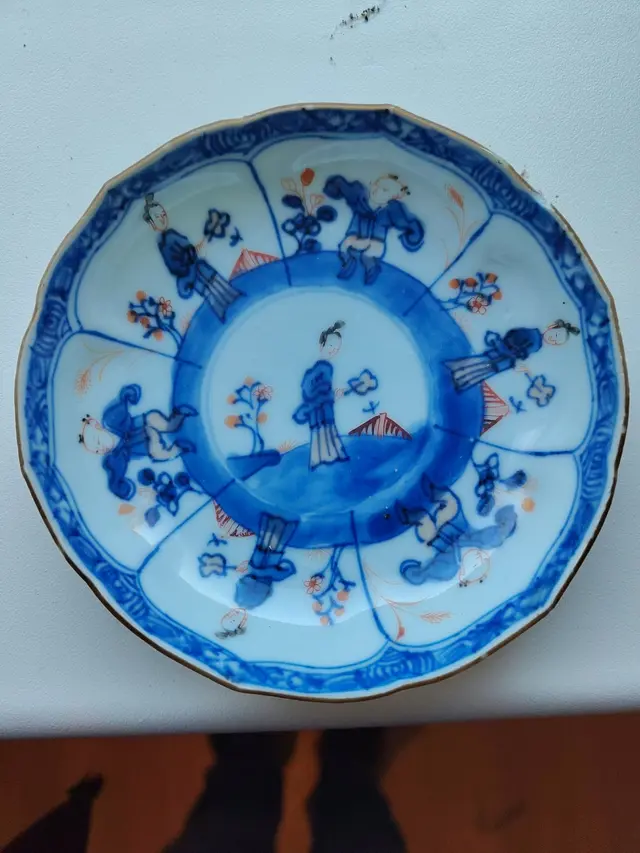
Chinese Blue and White and Iron-Red Scalloped Saucer, Kangxi Period (1662-1722)
Shared title details
Chinese Blue and White Porcelain 'Dragon and Phoenix' Charger
Shared title details
Chinese Famille Rose 'Dragon' Vase with Islamic Inscriptions, 20th Century
Shared title details
Chinese Blue and White 'Three Friends of Winter' Stem Cup, Ming Style
Shared title details
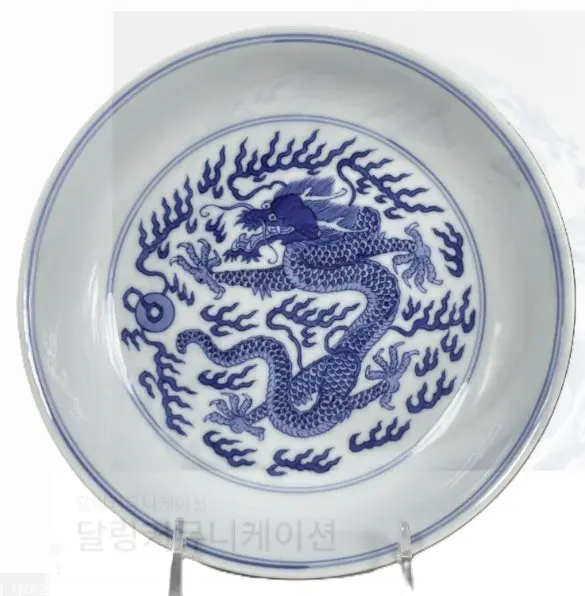
Chinese Blue and White 'Dragon' Dish
Shared title details
Explore Ceramics & Pottery
Pottery, porcelain, stoneware, earthenware, and kiln-fired objects.
Ceramics & Pottery value and rarity guideShare this find
A place for your ceramics
Keep its photographs, maker’s marks and the story you know in one object record. Start with a photo.
Create an account for 10 free scans. No credit card needed.
Join the conversation
Recognise a detail or have a question? Add what you know and cite your source. Suggested corrections stay in the discussion for the owner or a moderator to review.
Sign in to leave a comment
Sign in