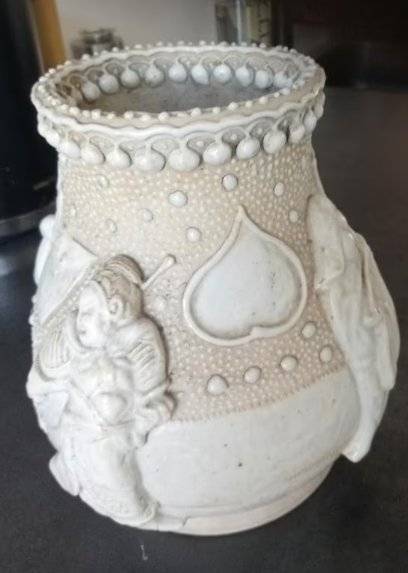
Chinese Shiwan Ware Figural Vase with Molded Luohan Relief, Late 19th Century
Estimated value
$150 - $450Rarity
Average(4/10)Category
Ceramics & PotteryEra
Late 19th to early 20th century (circa 1880-1920)Origin
ChinaAuthenticity
CHINESE SHIWAN WARE FIGURAL VASE WITH MOLDED LUOHAN RELIEF, LATE 19TH CENTURY: IDENTIFICATION
A robust stoneware vase featuring high-relief molded figures of Luohan (immortals) against a granulated background. The vessel displays a thick, creamy 'eggshell' glaze over a buff-colored body, with a characteristic beaded or 'pearl' border at the flared rim. The central field is decorated with a spade-shaped cartouche and a distinctive stippled texture achieved through slip-trailing or molding, typical of the Shiwan kilns in Guangdong province.
CROSS-CULTURAL PARALLELS
Where This Object Echoes
Hirado ware often utilized similar high-relief figural molding on white porcelain during the Meiji period.
Ritual & Ceremonial Use
- •The Luohan figures depicted represent Buddhist disciples who achieved enlightenment, frequently placed in domestic shrines for protection and wisdom.
Meaning Through Time
Essentially a high-end decorative export for European parlors during the 'Chinoiserie' revival.
PRODUCTION & FIRING
SCARCITY
Typical antique shop fare. Requires some searching but regularly available. This is where most genuine antiques fall.
Typical Characteristics
- Standard antique shop items
- Regularly available
- Moderate collector interest
Confidence Factors
- Square seal mark is consistent with late 19th-century export marks but lacks clarity
- Style is heavily reproduced in the mid-20th century (1950s-70s) using similar stoneware
- Wear on the footrim appears consistent with a 100-year age profile
CERAMICIST'S ASSESSMENT
Asian Art Specialist
Identification as Shiwan export ware is high based on the specific glaze/texture combination, though the blurred mark prevents a definitive kiln attribution.
KEY EVIDENCE
- 1Granulated background texture is a hallmark of Shiwan export stoneware.
- 2Form of the molded figures (costume and facial features) aligns with late Qing iconography.
- 3Beaded rim motif is typical of the 1880-1910 production window for the Canton region.
- 4The buff-colored unglazed footrim is diagnostic of Guangdong stoneware clays.
UNCERTAINTIES
- •Lower body hairline crack suggests structural fragility.
- •Recessed square mark is common on later 20th-century reproductions; requires rubbing for full identification.
WHAT WOULD IMPROVE CERTAINTY
- →Obtain a clear, high-resolution macro photograph of the base mark using side-lighting.
- →Perform a 'ring test' by gently tapping the rim to determine the depth and resonance of the base crack.
- →Examine the interior for glaze flow patterns to confirm hand-poured vs. industrial dipping.
CONDITION & GRADE
Grading breakdown
The primary value detractor is the visible fissure at the base; however, the relief figures remain intact with no significant chipping to the high points of the molding.
Condition
Significant vertical hairline crack visible near the base extending upward. The unglazed footrim shows expected oxidation and shelf wear, while the recessed square seal mark is partially obscured by glaze pooling.
Weight & feel
Estimated weight of 1.5 to 2.2 kg, suggesting the dense, thick-walled stoneware construction common to the Foshan kilns.
CERAMICS MARKET VALUE
Updated: May 10, 2026
Who buys this
Private collectors of late Qing export ceramics and interior decorators seeking textured Asian antiques.
What increases value
- •Integrity of the high-relief molding
- •Clarity of the basal mark
- •Size (larger examples command a exponential premium)
What lowers value
- •The large vertical crack greatly reduces auction appeal
- •Obscured mark makes specific workshop attribution difficult
What makes top-tier examples
- •Hand-modeled figures rather than molded ones
- •Bi-color or polychrome glazes
- •Documented workshop marks such as 'Chen Yuehua'
Grade & condition
Glaze integrity, presence of cracks or chips in reliefs, and visibility of the reign/workshop mark.
Rarity & demand
For informational purposes only, not a formal appraisal.
ABOUT CERAMICS & POTTERY
Pottery, porcelain, stoneware, earthenware, and kiln-fired objects.
Ceramics & Pottery value and rarity guideSHARE THIS CURIOSITY
Have your own curiosities to discover?
Scan Your Curiosity
COMMENTS