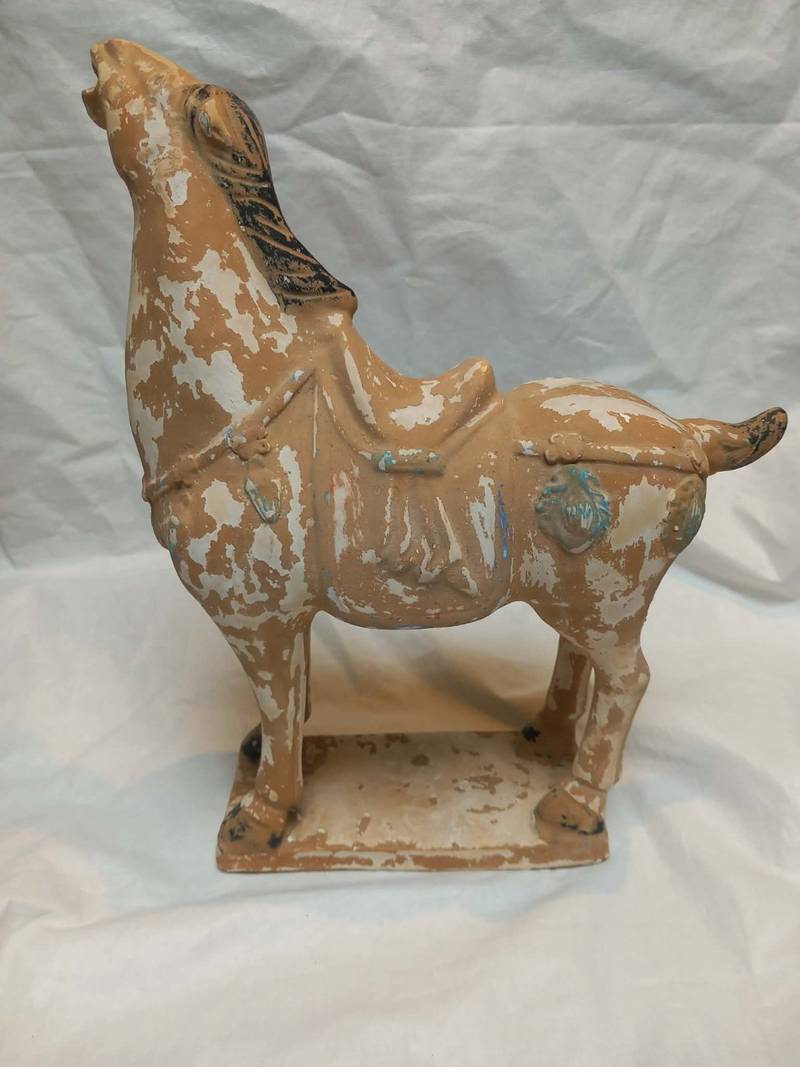
Chinese Tang-Style Sancai Pottery Horse
Estimated value
$150 - $450Rarity
Ordinary(3/10)Category
Ceramics & PotteryEra
Mid-to-late 20th centuryOrigin
ChinaAuthenticity
CHINESE TANG-STYLE SANCAI POTTERY HORSE: IDENTIFICATION
Earthenware figure of a caparisoned horse standing on a rectangular plinth, modeled in the classic Tang Dynasty sculptural tradition with a neighing expression and docked tail. The piece exhibits stylized 'cold-painted' or partially glazed surface decoration with traces of cobalt blue and ochre pigments. The modeling includes a draped saddle, floral-medallion trappings (phalerae), and a distinctively cropped mane.
PRODUCTION & FIRING
SCARCITY
Standard antiques commonly found at estate sales and flea markets. Plentiful supply meets modest demand.
Typical Characteristics
- Moderate production runs
- Common at estate sales
- Entry-level collectibles
Confidence Factors
- Uniformity of surface 'wear' suggests mechanical distressing rather than natural burial degradation
- Underbelly ventilation hole shows sharp, modern edges inconsistent with ancient hand-coring
- The blue pigment appears to be a cold-painted wash rather than a fired lead glaze typical of 8th-century originals
Expert review recommended. Consider consulting a specialist before making purchasing decisions.
CERAMICIST'S ASSESSMENT
Asian Art Specialist
The identification of the style is certain, but assigning a precise manufacture date between 1920 and 1980 is difficult without physical handling of the clay slip and TL testing.
KEY EVIDENCE
- 1Modeling follows the 'Fat Horse' aesthetic popularized during the reign of Emperor Xuanzong.
- 2Base construction is a flat, uniform rectangular plinth typical of mid-century replicas.
- 3Surface 'encrustation' is localized and lacks the crystalline structure found on genuine excavated low-fired earthenware.
UNCERTAINTIES
- •The placement and cleanliness of the firing hole in the belly are indicative of modern mold-production.
- •Pigment flaking reveals a very clean, uniform ceramic body underneath.
WHAT WOULD IMPROVE CERTAINTY
- →Thermoluminescence (TL) testing to determine the last firing date.
- →Examination of the interior clay through the vent hole for signs of modern tool marks.
- →Ultraviolet (UV) light check to see if pigments fluoresce, indicating modern synthetic binders.
CONDITION & GRADE
Condition
Intentional surface abrasion present to mimic centuries of burial; no visible structural fractures or modern repairs, though the pigment loss is extensive throughout the flanks.
Weight & feel
Estimated 2.5 to 3.5 kg; likely slip-cast or hollow-molded as evidenced by the ventilation hole in the underbelly.
CERAMICS MARKET VALUE
Updated: May 10, 2026
Who buys this
Interior decorators and entry-level Asian art collectors looking for the Tang aesthetic without the five-figure price tag of authenticated originals.
What increases value
- •Larger scale (height over 12 inches) significantly increases decorative value
- •Presence of cobalt blue pigments, which are more desirable than simple ochre/green
What lowers value
- •Major structural repairs or replacement of ears/tail which are prone to snapping
- •Oversaturation of the market with 1980s-era Chinese export versions
What makes top-tier examples
- •Genuine 8th-century examples possess an Oxford TL certificate and provenance from established collections like Eskenazi or J.J. Lally
- •Authentic pieces show earthy 'root marks' and dendritic mineral deposits on the surface
Grade & condition
Integrity of the decorative pigments and lack of structural fractures.
Rarity & demand
For informational purposes only, not a formal appraisal.
ABOUT CERAMICS & POTTERY
Pottery, porcelain, stoneware, earthenware, and kiln-fired objects.
Ceramics & Pottery value and rarity guideSHARE THIS CURIOSITY
Have your own curiosities to discover?
Scan Your Curiosity
COMMENTS