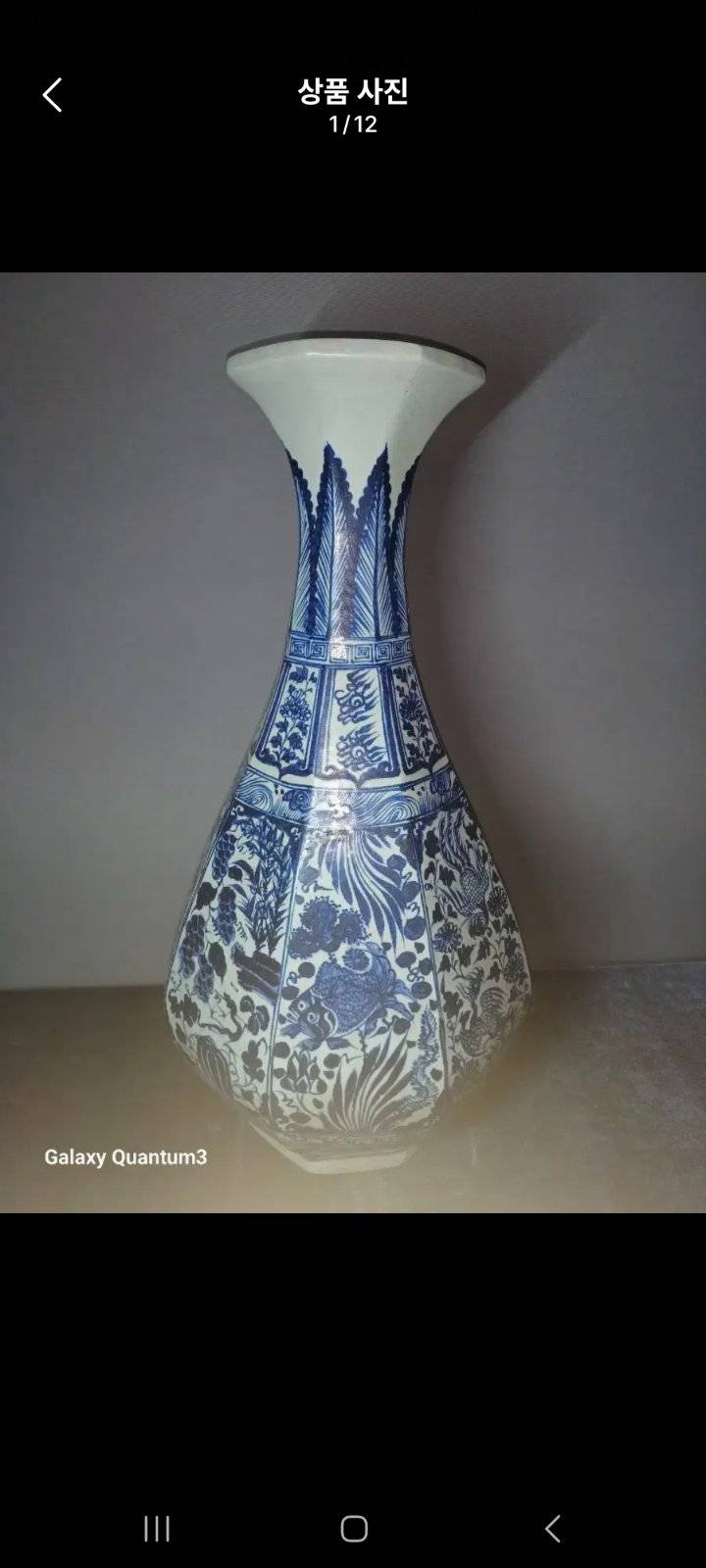
Octagonal Blue and White Yuhuchunping Vase
Estimated value
$50 - $150Rarity
Common(2/10)Category
Ceramics & PotteryEra
Late 20th century to contemporaryOrigin
ChinaAuthenticity
OCTAGONAL BLUE AND WHITE YUHUCHUNPING VASE: IDENTIFICATION
An octagonal pear-shaped vase, or yuhuchunping, featuring underglaze blue decoration on a heavy stoneware or porcelain body. The form consists of eight vertical facets decorated with repeating panels of aquatic motifs, including fish among water weeds, interspersed with floral sprays. The neck is elongated with a flared rim, decorated with stiff plantain leaves above a Greek key fret border. The cobalt pigment appears inconsistently applied, with visible 'heaping and piling' effects meant to simulate 14th-century Yuan dynasty characteristics.
CROSS-CULTURAL PARALLELS
Where This Object Echoes
The introduction of cobalt blue from Persia revolutionized ceramic aesthetics in the 14th century.
Ritual & Ceremonial Use
- •Originally used as wine carafes in Mongol court banquets during the Yuan period.
Meaning Through Time
A high-status luxury export item for Middle Eastern and Southeast Asian markets.
A mass-produced decorative object celebrating Chinese heritage and traditional motifs.
SCARCITY
Older mass-produced items still widely available. Easy to find on eBay, antique malls, and estate sales in large quantities.
Typical Characteristics
- Mass produced historically
- High survival rate
- Readily available everywhere
Confidence Factors
- The iron-red staining on the base is uniform and appears painted on rather than occurring naturally from the paste's mineral content.
- The cobalt drawing lacks the fluidity and brushwork depth found in period Yuan dynasty examples.
- Artificial distressing on the footrim is inconsistent with natural 600-year-old wear patterns.
Expert review recommended. Consider consulting a specialist before making purchasing decisions.
CERAMICIST'S ASSESSMENT
Ceramics Historian & Kiln Specialist
The visual evidence of the base treatment and the stiff application of the cobalt pigment clearly identifies this as a modern decorative reproduction of a Yuan-style piece.
KEY EVIDENCE
- 1The base staining is too vibrant and lacks the 'haloing' effect of genuine aged iron-rich paste.
- 2Brushwork in the fish scales is repetitive and lacks the calligraphic variation of hand-painted antiques.
- 3Construction joints inside the octagonal facets show signs of modern slip-molding rather than slab-building.
- 4Glaze depth is shallow and lacks the micro-bubble 'congealed' appearance of antique Jingdezhen glazes.
UNCERTAINTIES
- •The extreme contrast of the orange base is a classic indicator of 'faker's red' used in modern reproduction workshops.
- •Lack of authentic surface 'patina' or legitimate signs of burial/use.
WHAT WOULD IMPROVE CERTAINTY
- →Examine the interior neck with a flashlight to look for mold seams.
- →Perform a 'tap test' with a fingernail; a high-pitched ring indicates modern high-fired porcelain rather than period stoneware.
- →Apply a solvent to a small area of the orange base to see if the pigment is surface-applied.
CONDITION & GRADE
Condition
The footrim shows deliberate mechanical abrasion to simulate shelf wear. No structural cracks or chips are visible, suggesting it is a decorative item of recent manufacture.
Weight & feel
Estimated weight of 1.8 to 2.5 kg; the thickness of the faceted walls suggests a heavy, slip-cast construction rather than a hand-potted form.
CERAMICS MARKET VALUE
Updated: May 11, 2026
Who buys this
Mainly sought by interior decorators and casual collectors looking for a classic Chinese aesthetic at a low price point.
What increases value
- •Large physical size for home display
- •Presence of popular motifs like the 'Wealth and Prosperity' fish
What lowers value
- •High prevalence in the market as a mass-produced item
- •Obvious artificial aging decreases value for serious collectors
What makes top-tier examples
- •Genuine 14th-century examples have distinctively 'soft' glaze and uneven cobalt tones
- •Hand-painted period pieces show unique artistic 'flare' in animal motifs
Grade & condition
Uniformity of glaze and lack of modern firing defects like pinholes.
Rarity & demand
For informational purposes only, not a formal appraisal.
ABOUT CERAMICS & POTTERY
Pottery, porcelain, stoneware, earthenware, and kiln-fired objects.
Ceramics & Pottery value and rarity guideSHARE THIS CURIOSITY
Have your own curiosities to discover?
Scan Your Curiosity
COMMENTS