Chinese Blue and White Porcelain Ginger Jar, Qing Dynasty Style
Estimated value
$80 - $250Rarity
Ordinary(3/10)Category
Ceramics & PotteryEra
Late 19th to early 20th CenturyOrigin
ChinaAuthenticity
CHINESE BLUE AND WHITE PORCELAIN GINGER JAR, QING DYNASTY STYLE: IDENTIFICATION
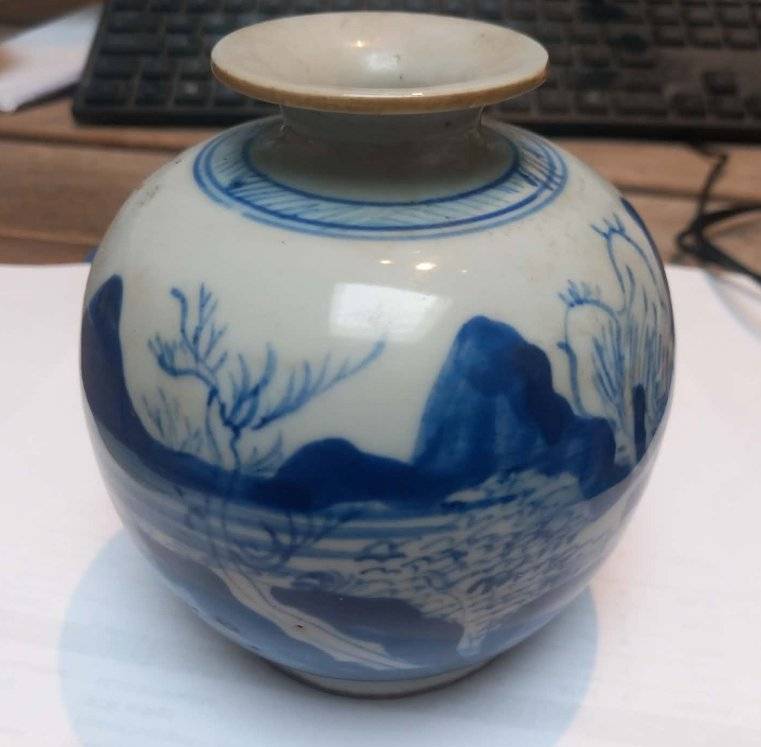
A globular blue and white porcelain vessel, likely a small ginger jar or water pot, featuring an underglaze cobalt landscape decoration. The central motif depicts a 'Shan Shui' (mountain-water) scene with stylized pine trees and mountainous terrain rendered in a gradient of blue tones. The vessel has a short neck terminating in a wide, flattened rim with a visible unglazed brown-dressed edge along the lip, a characteristic common in provincial or export wares produced for the Southeast Asian market.
PRODUCTION & FIRING
SCARCITY
Standard antiques commonly found at estate sales and flea markets. Plentiful supply meets modest demand.
Typical Characteristics
- Moderate production runs
- Common at estate sales
- Entry-level collectibles
Confidence Factors
- High volume of modern reproductions in this specific landscape style
- Surface grime appears superficial and could be artificially applied
- Lack of base image prevents verification of footrim construction and potential marks
CERAMICIST'S ASSESSMENT
Asian Art Specialist
The form and decoration are highly consistent with late-period Chinese domestic wares, but the high prevalence of modern copies in this category necessitates a cautious stance without seeing the footrim.
KEY EVIDENCE
- 1Cobalt blue landscape decoration in underglaze style typical of 19th-century Minyao.
- 2Globular 'ginger jar' form with a characteristic short neck.
- 3Presence of brown-dressed rim (cafe-au-lait) commonly seen on export-market wares.
- 4Glaze characteristics including 'pepper spots' and moderate 'orange peel' texture.
UNCERTAINTIES
- •Potential for 20th-century 'antique-style' reproduction; the brushwork is somewhat hasty.
- •Absence of base/footrim photos makes definitive dating difficult.
WHAT WOULD IMPROVE CERTAINTY
- →Photograph the base and footrim to check for wear patterns and marks.
- →Examine the interior for glaze consistency and potential repair marks.
- →Inspect the rim under 10x magnification for signs of artificial age staining.
CONDITION & GRADE
Grading breakdown
The appraisal is based on the lack of visible hairlines or major chips, though the presence of kiln grit and pepper spots indicates a standard commercial production grade rather than a fine art grade.
Condition
The rim shows minor firing flaws and surface grime. No major cracks are visible in the provided angles, but there is noticeable wear to the base and several dark kiln spots (pepper spots) on the shoulder.
CERAMICS MARKET VALUE
Updated: May 11, 2026
Who buys this
General antique collectors, interior decorators seeking Chinoiserie accents, and entry-level Asian ceramic enthusiasts.
What increases value
- •Completeness (presence of a matching lid would significantly increase value)
- •Clarity of the landscape painting
- •Authenticity of the 19th-century date
What lowers value
- •Hairline cracks (especially at the neck or base) often hidden by grime
- •Evidence of being a modern 'faked' antique
What makes top-tier examples
- •Finely detailed brushwork with clear depth levels in the landscape
- •Bright, 'sapphire' blue cobalt of the Kangxi revival period
Grade & condition
Condition of the glaze, presence of chips/cracks, and quality of the cobalt painting.
Rarity & demand
For informational purposes only, not a formal appraisal.
ABOUT CERAMICS & POTTERY
Pottery, porcelain, stoneware, earthenware, and kiln-fired objects.
Ceramics & Pottery value and rarity guideSHARE THIS CURIOSITY
Have your own curiosities to discover?
Scan Your Curiosity
COMMENTS