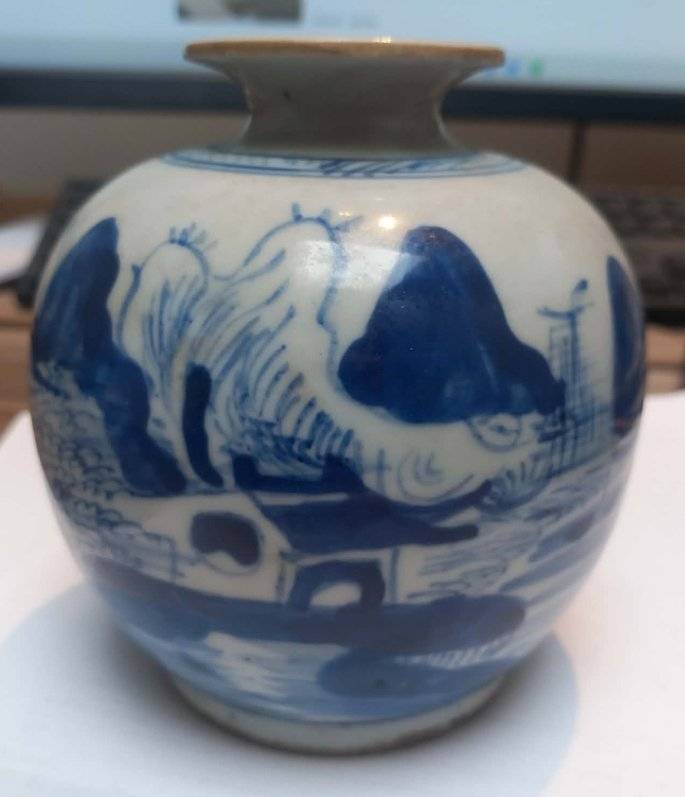
Chinese Blue & White 'Ginger Jar' Vase, Style of Kangxi Period
Estimated value
$80 - $250Rarity
Ordinary(3/10)Category
Ceramics & PotteryEra
Circa 1880-1940Origin
ChinaAuthenticity
CHINESE BLUE & WHITE 'GINGER JAR' VASE, STYLE OF KANGXI PERIOD: IDENTIFICATION
A small ovoid porcelain vessel featuring underglaze cobalt blue decoration of a mountain landscape with a scholar's pavilion. The composition utilizes the 'shanshui' (mountain-water) motif, characterized by bold mountain silhouettes and rapid brushwork execution. The paste is a dense white porcelain, visible at the unglazed footrim, which shows a characteristic iron-red oxidation line at the glaze junction.
PRODUCTION & FIRING
COLLECTOR NOTES
The unglazed footrim reveals the quality of the 'kaolin' clay, which becomes vitrified at temperatures exceeding 1,200 degrees Celsius in the kiln.
SCARCITY
Standard antiques commonly found at estate sales and flea markets. Plentiful supply meets modest demand.
Typical Characteristics
- Moderate production runs
- Common at estate sales
- Entry-level collectibles
Confidence Factors
- Brushwork is simplified compared to 17th-century imperial examples
- Presence of modern production methods cannot be fully ruled out without high-res base inspection
- Small ginger jars are some of the most frequently reproduced objects in the 20th century
CERAMICIST'S ASSESSMENT
Asian Art Specialist
The object presents clear diagnostic indicators of Late Qing/Early Republic manufacturing techniques, though the absence of a mark and medium image resolution prevents a definitive 19th-century attribution over a high-quality mid-20th-century copy.
KEY EVIDENCE
- 1Unglazed footrim shows typical Late Qing/Republic orange-toned oxidation.
- 2The landscape layout follows traditional Shanshui perspective with receding mountain tiers.
- 3Cobalt blue tone is vibrant but lacks the 'sapphire' depth of early Kangxi wares.
- 4Ovoid body shape is consistent with late 19th-century domestic pottery.
UNCERTAINTIES
- •Uniformity of the glaze at the neck suggests more modern firing consistency.
- •Iron spots on the base are common in both antiques and deliberate 'aging' of 1990s fakes.
WHAT WOULD IMPROVE CERTAINTY
- →Take a macro photo of the footrim to check for 'chatter marks' from the potter's wheel.
- →Conduct a water-immersion test to check for hidden hairlines or repairs at the neck.
- →Examine under a UV light to identify any modern resin restorations.
CONDITION & GRADE
Grading breakdown
Condition is evaluated based on the absence of 'crazing' or structural cracks which are common in export wares of this age.
Condition
Small firing defects including iron spots (black specks) in the base glaze; minor surface abrasions consistent with 100+ years of handling; the rim appears intact without visible hairlines.
CERAMICS MARKET VALUE
Updated: May 10, 2026
Who buys this
General antique collectors and interior designers looking for authentic Qing-style blue and white ceramics.
What increases value
- •Clarity of the landscape painting
- •Intact rim and foot without chips
- •Presence of 'iron spots' which suggest older kiln conditions
What lowers value
- •Cracks (hairlines) hidden under the glaze
- •Evidence of modern mold-seams (though unlikely here)
- •Oversupply of similar export wares on the market
What makes top-tier examples
- •Authentic Kangxi-period seal marks
- •Thin, transluscent porcelain body
- •Masterful brushwork with nuanced shading
Grade & condition
Visual appeal of the painting, integrity of the glaze, and absence of structural damage.
Rarity & demand
For informational purposes only, not a formal appraisal.
ABOUT CERAMICS & POTTERY
Pottery, porcelain, stoneware, earthenware, and kiln-fired objects.
Ceramics & Pottery value and rarity guideSHARE THIS CURIOSITY
Have your own curiosities to discover?
Scan Your Curiosity
COMMENTS