Curiosa
Sign InTry a scan

Chinese Famille Rose 'Hundred Antiques' Plate

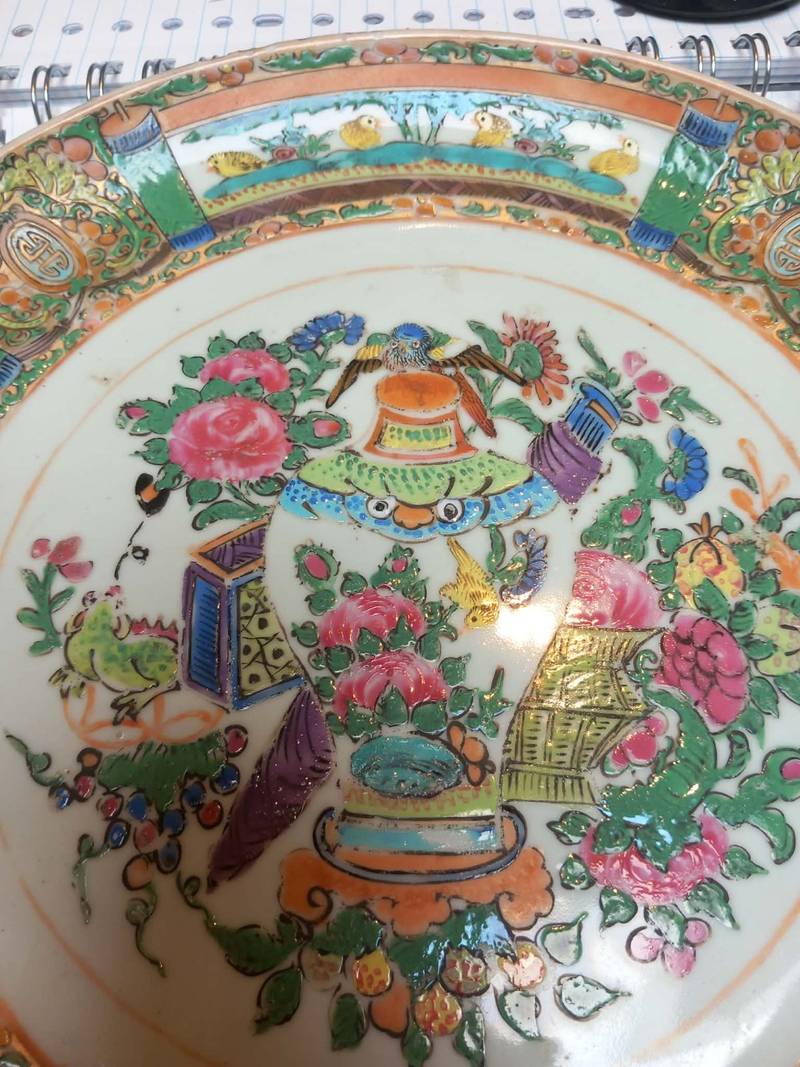
Chinese Famille Rose porcelain plate with dense floral and antiquities motif, unglazed base showing kiln firing marks - view 1
1/3

Estimated value

$150 - $250

Rarity

Average(4/10)

Era

Late Qing Dynasty (c. 1850-1900)

Origin

πŸ‡¨πŸ‡³ China

Authenticity

Very High(85%)
8

KILN TO COLLECTION: CHINESE FAMILLE ROSE 'HUNDRED ANTIQUES' PLATE

A vibrantly enameled Chinese porcelain plate executing the 'Hundred Antiques' (Po Gu) motif in the robust Fencai (Famille Rose) palette. The central medallion features a highly stylized, almost anthropomorphic archaic-style vessel overflowing with peony blossoms, flanked by a bird, a rectangular scholar's box, and assorted auspicious symbols. The enamels sit proud of the glaze, creating a tactile topography, particularly the opaque rose-pink and turquoise. The complex border is divided into intricately patterned cartouches containing birds and floral sprays against geometric brocade grounds. The reverse reveals an unglazed, wide foot rim displaying significant kiln-grit adhesion and the characteristic burnt-orange iron oxidation (iron spots) typical of 19th-century provincial or export kilns.

CLAY ACROSS CULTURES

Where This Object Echoes

Japanese Edo Period18th-19th Century

Imari wares similarly utilized densely packed, brightly colored brocade borders and cartouches to appeal to both domestic and export markets.

European Chinoiserie18th-19th Century

European factories like Meissen and Spode fiercely copied these specific rich enamel palettes and complex border designs to satisfy Western craving for 'the Orient'.

Ritual & Ceremonial Use

  • β€’Displayed in reception rooms during the Lunar New Year and major festivals, as the objects depicted (vases, peonies) act as visual puns (rebuses) for peace, wealth, and high social rank.

Meaning Through Time

18th Century to 19th Century

Fencai shifted from an incredibly delicate, restrained medium for imperial poetry and painting to a bold, highly commercialized aesthetic designed for maximum visual impact across busy dining rooms.

FROM KILN TO COLLECTOR

The Fencai enamel technique, incorporating opaque colors mixed with glass powder, revolutionized Chinese porcelain in the 1720s. By the mid-to-late 19th century, earlier refined imperial styles had given way to these bolder, densely packed compositions catering both to wealthy domestic merchants ...
The Fencai enamel technique, incorporating opaque colors mixed with glass powder, revolutionized Chinese porcelain in the 1720s. By the mid-to-late 19th century, earlier refined imperial styles had given way to these bolder, densely packed compositions catering both to wealthy domestic merchants and the voracious Western export market. The 'Hundred Antiques' motif, traditionally a signifiers of scholarly erudition and refined taste, is rendered here with a charmingly naive, provincial exuberance that prioritizes color and impact over traditional literati restraint.

KILN-SIDE SECRETS

1

The distinctive opaque pink color in Famille Rose is actually achieved using colloidal gold (gold chloride) introduced to China by European Jesuits in the late 17th century.

2

The central arrangement of the vase and lid in this specific plate has a distinct pareidolia effect, resembling a face wearing a green and orange hatβ€”a quirky result of a provincial painter heavily stylizing traditional archaic bronze shapes.

HOW SCARCE IS IT?

Average55-70%
CommonLegendary

Typical antique shop fare. Requires some searching but regularly available. This is where most genuine antiques fall.

Typical Characteristics

  • Standard antique shop items
  • Regularly available
  • Moderate collector interest

Confidence Factors

  • The paste characteristic and iron oxidation on the unglazed foot rim are natural outcomes of wood-fired kilns and are exceedingly difficult to fake convincingly.
  • The specific topography, minor pitting, and wear patterns of the lead-based Fencai enamels align perfectly with 19th-century applications.
  • Absence of an apocryphal reign mark is a positive indicator, as modern forgers often unnecessarily append them to domestic wares.
How does authenticity detection work?

CERAMICIST'S ASSESSMENT

Asian Art Specialist

East Asian Art Expert

High confidence based on the clear, unimpeded view of the foot rim (which is the most critical indicator of age in Chinese ceramics) combined with the unmistakable impasto texture of genuine Qing Dynasty famille rose enamels.

KEY EVIDENCE

  • 1Thick, opaque 'Fencai' enamels sitting prominently on the glaze surface.
  • 2Wide, flat, unglazed foot rim showing grit adhesion from the kiln floor.
  • 3Burnt-orange iron oxidation (iron spots) on the exposed paste.
  • 4Natural pattern of rub-wear on the overglaze gilding.
  • 5Stylistic execution of the 'Hundred Antiques' motif consistent with late Qing production.

UNCERTAINTIES

  • β€’Cannot fully rule out faint hairline cracks extending from the rim without physical handling or 'ringing' the plate (tapping to hear the resonance).

WHAT WOULD IMPROVE CERTAINTY

  • β†’Examine under an ultraviolet (UV) blacklight to reveal any modern touch-ups or overpainting in the pink/green enamels.
  • β†’Gently tap the rim with a wooden pencil to listen for a clear 'ring'β€”a dull thud would indicate a hidden structural hairline crack.
  • β†’Magnified inspection of the enamel edges to confirm natural aging/minor pitting vs modern synthetic smoothness.

CONDITION & GRADE

Condition

Displays honest wear commensurate with 19th-century age. Notable rubbing to the gilding on the rim and inner border, and slight stacking wear on the highest points of the central enamels. The unglazed foot rim is soiled and exhibits typical firing imperfections and kiln dirt.

Surface

The overglaze enamels are thickly applied (impasto), bearing a matte-to-satin finish that sits palpably upon the clear, faintly blue-tinted glaze. The gilding demonstrates natural rubbing on the high points of the enamel and along the rim, consistent with manual handling.

Weight & feel

Substantially potted and heavy in the hand, lacking the eggshell delicacy of earlier imperial wares, reflecting its purposeful nature for the provincial or export trade.

CERAMICS MARKET VALUE

$150 - $250

Updated: Apr 2, 2026

Who buys this

Collectors of Chinese export porcelain, interior decorators focused on maximalist or traditional aesthetics, and buyers seeking authentic 19th-century Asian ceramics for display cabinetry.

What increases value

  • β€’The brightness and integrity of the delicate pink and turquoise enamels
  • β€’The complexity and density of the multi-cartouche brocade border
  • β€’Complete absence of chips, 'frits' (glaze flakes), or restorations

What lowers value

  • β€’Hidden hairline cracks which destroy acoustic resonance and lower value by 50-70%
  • β€’Aggressive cleaning by previous owners that may have stripped away more of the fragile gilt lines

What makes top-tier examples

  • β€’Crisp, highly detailed painting in the miniature cartouches
  • β€’Thick, flawless application of the Fencai pink without firing bubbles

Grade & condition

In this category, value heavily relies on the survival of the overglaze enamels (which scratch easily) and the integrity of the rim, which is prone to chipping in these heavy provincial wares.

Rarity & demand

AverageModerate demandModerate liquidity
Browse similar ceramics objects

For informational purposes only, not a formal appraisal.

CONTEXT ANALYSIS

How your provided context compares with Curiosa.com scanner findings.

What Aligned

  • User stated 'Origin: China' - The paste, enamel palette, and stylistic execution absolutely confirm Chinese origin.
  • User stated 'Original/Authentic' - Firing spots and foot-rim characteristics strongly validate this as a period 19th-century antique.
  • User stated 'Minor wear' - Supported by the natural, age-appropriate rubbing visible on the gilding and high-point enamels.

FROM THE CABINET OF

BR

bruinsma

The Connoisseurβ€’55 items

COMMENTS

No comments yet. Be the first to share your thoughts!

Sign in to leave a comment

ABOUT CERAMICS & POTTERY

Pottery, porcelain, stoneware, earthenware, and kiln-fired objects.

Ceramics & Pottery value and rarity guide

SHARE THIS CURIOSITY

Have your own curiosities to discover?

Scan Your Curiosity