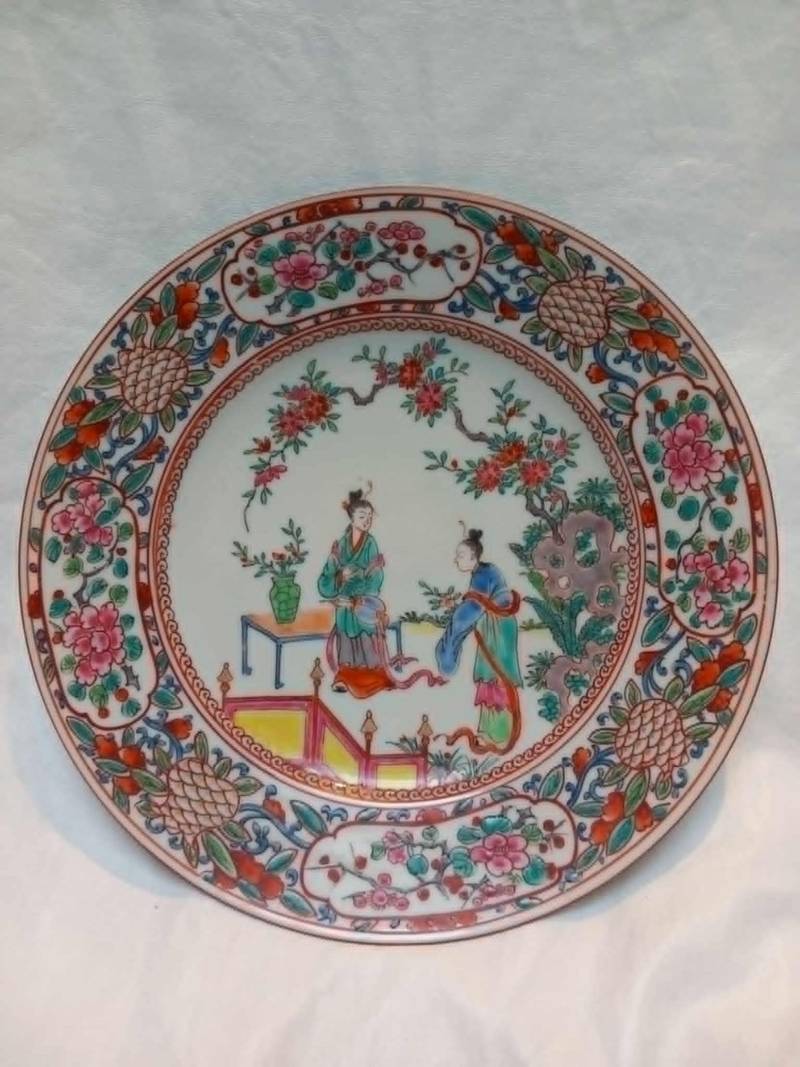
Chinese Famille Rose (Fencai) Decorative Plate
Estimated value
$35 - $85Rarity
Ordinary(3/10)Category
Ceramics & PotteryEra
Mid-to-Late 20th Century (circa 1950-1980)Origin
ChinaAuthenticity
CHINESE FAMILLE ROSE (FENCAI) DECORATIVE PLATE: IDENTIFICATION
A circular porcelain plate decorated in overglaze fencai (Famille Rose) enamels. The central medallion features two female figures in flowing robes standing near a table and planter, framed by a structural balustrade. The wide rim border contains continuous floral scrolls and prominent peony blossoms set against a white ground. The reverse exhibits a clear, highly reflective glaze with an unmarked, unglazed foot rim showing a slight iron firing coloration.
COLLECTOR NOTES
The structural zigzag fence motif seen in the foreground became a requisite design anchor for European export porcelain orders between 1750 and 1790.
SCARCITY
Standard antiques commonly found at estate sales and flea markets. Plentiful supply meets modest demand.
Typical Characteristics
- Moderate production runs
- Common at estate sales
- Entry-level collectibles
Confidence Factors
- Lack of a reign mark prevents misattribution to earlier high-value imperial periods.
- The clear, glassy reverse glaze and opaque enamel saturation are entirely consistent with documented mid-20th-century production methods.
CERAMICIST'S ASSESSMENT
Asian Art Specialist
The visual indicators of enamel texture, paste cleanliness, and glaze reflection on the reverse confidently place this within mid-to-late 20th-century production, though exact dating within that century requires hands-on paste analysis.
KEY EVIDENCE
- 1Opaque, slightly raised fencai enamels including bright synthetic pinks and yellows.
- 2Glassy, highly reflective clear glaze on the reverse.
- 3Unmarked base with an evenly cut foot rim and slight iron firing wash.
UNCERTAINTIES
- •The stiffness in the figural painting details and lack of subtle shading separate this from higher quality 18th-century or fine Republic period examples.
WHAT WOULD IMPROVE CERTAINTY
- →Examine the surface under a blacklight (UV) to confirm the absence of modern enamel touch-ups.
- →Inspect the central unglazed foot rim under 10x magnification to evaluate firing grit and exact paste density.
CONDITION & GRADE
Condition
The overglaze enamels remain continuous with no visible flaking or rubbing, and the rim shows no evidence of fritting, chips, or hairline cracks under standard light.
CERAMICS MARKET VALUE
Updated: May 20, 2026
Who buys this
Interior decorators and casual collectors of Chinoiserie seeking colorful display items rather than early antiquities.
What increases value
- •Bright, unrubbed enamel condition
- •Detailed figural narrative subjects over purely floral motifs
What lowers value
- •Lack of an imperial reign mark or maker's studio mark
- •Later 20th-century mass production limits the ceiling value
What makes top-tier examples
- •In 20th-century wares, examples featuring artist signatures or documented studio marks from Jingdezhen command higher premiums.
Grade & condition
Absence of enamel scratching, rim fritting, and hairline cracks directly determines secondary market saleability.
Rarity & demand
For informational purposes only, not a formal appraisal.
YOUR INPUT VS. SCAN
How your provided context compares with Curiosa.com scanner findings.
What Aligned
- The user description of 'Mint' condition is supported by the lack of visible enamel flaking, rim fritting, or hairline cracks in the provided images.
What Conflicted
- If 'Original' implies 18th-century period execution, the bright, synthetic-looking enamels and highly reflective modern glaze on the reverse indicate a later mid-20th-century production date.
ABOUT CERAMICS & POTTERY
Pottery, porcelain, stoneware, earthenware, and kiln-fired objects.
Ceramics & Pottery value and rarity guideSHARE THIS CURIOSITY
Have your own curiosities to discover?
Scan Your Curiosity
COMMENTS