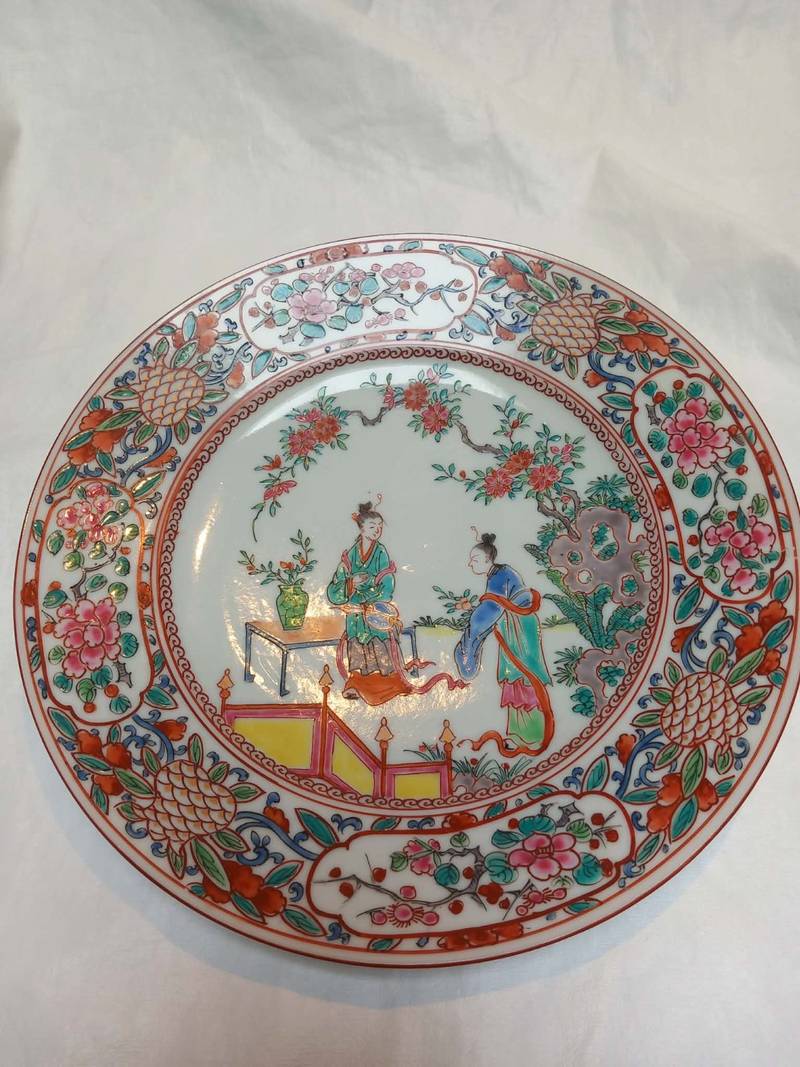
Chinese Export Famille Rose Porcelain Plate
Estimated value
$80 - $250Rarity
Ordinary(3/10)Category
Ceramics & PotteryEra
Late 19th to early 20th centuryOrigin
ChinaAuthenticity
CHINESE EXPORT FAMILLE ROSE PORCELAIN PLATE: IDENTIFICATION
A porcelain plate featuring overglaze polychrome enamels in the Famille Rose palette. The central medallion depicts a domestic scene with two figures in traditional Qing-style robes near a scholar's rock and flowering prunus branch. The wide rim is decorated with four cartouches containing floral sprays, separated by stylized peony blossoms and dense foliate scrolls in iron-red and blue. The reverse shows a shallow, unglazed footrim revealing a fine, white, high-fired kaolin paste.
CROSS-CULTURAL PARALLELS
Where This Object Echoes
18th-century Delft potters extensively copied these Famille Rose 'oriental' motifs to satisfy European demand for chinoiserie.
Ritual & Ceremonial Use
- •Display in European 'China Cabinets' or wall mounting as decorative interior art rather than functional tableware.
Meaning Through Time
The figures and garden represented elite scholarly leisure and moral refinement.
Interpreted primarily as a decorative antique and a marker of 19th-century global trade.
PRODUCTION & FIRING
SCARCITY
Standard antiques commonly found at estate sales and flea markets. Plentiful supply meets modest demand.
Typical Characteristics
- Moderate production runs
- Common at estate sales
- Entry-level collectibles
Confidence Factors
- Style is consistent with late 19th-century export production
- Evidence of kiln pinholes and iron spots on the reverse supports period firing
- Enamel wear patterns align with expected age
CERAMICIST'S ASSESSMENT
Ceramics Historian & Kiln Specialist
The visual characteristics (enamel palette, paste color, and border design) are highly consistent with late 19th-century Jingdezhen export ware, but the lack of a mark prevents absolute dating.
KEY EVIDENCE
- 1Presence of 'Rose' palette (colloidal gold enamel) indicates post-1720 technology.
- 2Bifurcated foliage scrolls on rim are characteristic of Guangxu era export wares.
- 3Unglazed footrim shows a clean, white paste without the gritty texture of earlier provincial kilns.
- 4Lack of a maker's mark is standard for late 19th-century mass-produced export pieces.
UNCERTAINTIES
- •The hairline crack on the right rim significantly impacts structural integrity and value.
- •Bright, unworn enamels suggest it may have been used solely for display.
WHAT WOULD IMPROVE CERTAINTY
- →Perform a 'ring test' by tapping the edge; a dull thud would confirm internal cracks not visible in photos.
- →Examine the rim under UV light to check for professional overpainting or restored chips.
CONDITION & GRADE
Condition
A visible hairline fracture or deep scratch is located on the right side of the rim near the 3 o'clock position. The footrim shows minor shelf wear and localized iron spots from firing.
CERAMICS MARKET VALUE
Updated: May 11, 2026
Who buys this
Collectors of Chinese export porcelain and interior designers looking for late 19th-century aesthetic accents.
What increases value
- •Vibrancy of the pink and turquoise enamels
- •Complexity of the central figural scene versus simpler floral patterns
- •Size (plates larger than 10 inches command higher premiums)
What lowers value
- •The visible hairline fracture on the rim reduces market value by 40-60%
- •Lack of a reign mark limits appeal to high-end scholars
What makes top-tier examples
- •Presence of a six-character Guangxu mark
- •Use of 'famille noire' or 'famille jaune' borders
- •Thinner, translucent 'eggshell' porcelain body
Grade & condition
Condition is the primary value driver; chips, hairlines, and enamel rubbing are the main detractors.
Rarity & demand
For informational purposes only, not a formal appraisal.
ABOUT CERAMICS & POTTERY
Pottery, porcelain, stoneware, earthenware, and kiln-fired objects.
Ceramics & Pottery value and rarity guideSHARE THIS CURIOSITY
Have your own curiosities to discover?
Scan Your Curiosity
COMMENTS