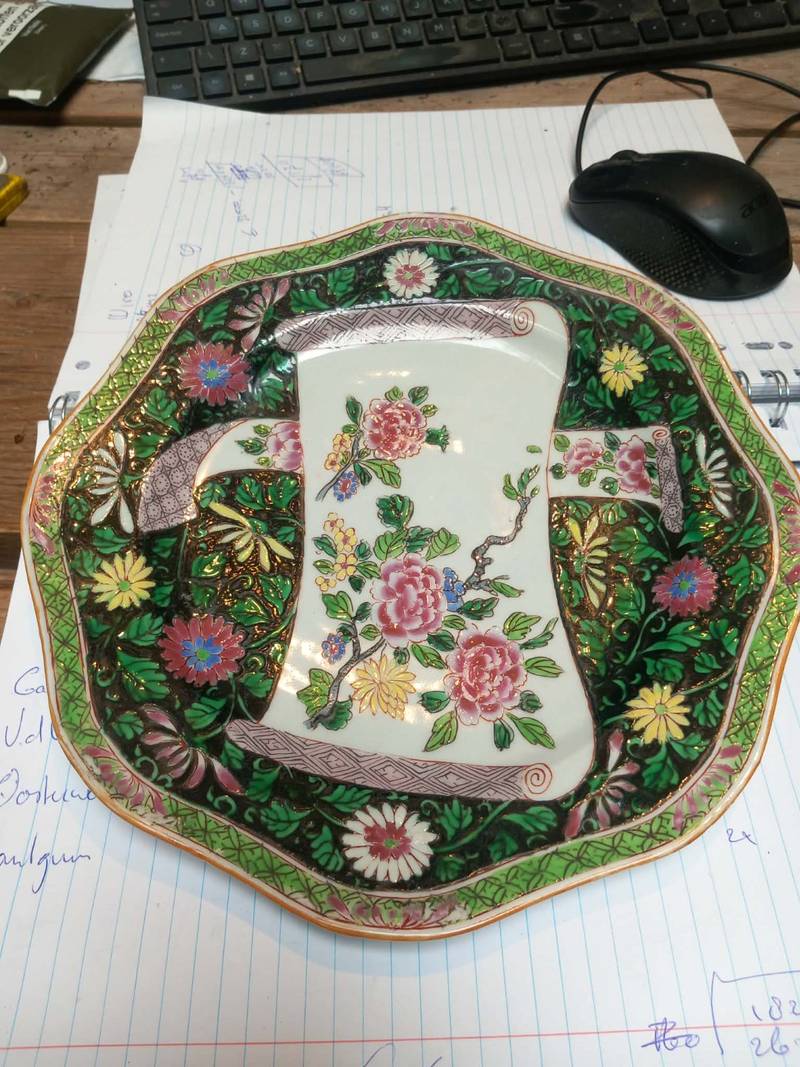
Chinese Famille Noire 'Scroll' Plate, Late Qing to Republic Period (1880-1920)
Estimated value
$150 - $350Rarity
Average(4/10)Category
Ceramics & PotteryEra
Circa 1880-1920Origin
ChinaAuthenticity
CHINESE FAMILLE NOIRE 'SCROLL' PLATE, LATE QING TO REPUBLIC PERIOD (1880-1920): IDENTIFICATION
A lobed porcelain plate featuring a central 'scroll' cartouche decorated with flowering peonies and chrysanthemums in famille rose enamels. The surrounding border is executed in the famille noire style, consisting of a rich black overglaze background meticulously hand-painted with green foliage, floral blossoms, and a lime-green 'cracked ice' or 'cell' pattern rim. The underside displays three simple floral sprays in iron-red enamel and three distinct spur marks in the center of the base.
CROSS-CULTURAL PARALLELS
Where This Object Echoes
The lobed shape and floral border echo the Kakiemon and Imari traditions that influenced and were influenced by Chinese export porcelain.
Ritual & Ceremonial Use
- •Scholar's Studio display: The use of the scroll motif signifies the owner's appreciation for calligraphy and painting, central to the Confucian literati lifestyle.
Meaning Through Time
Highly expensive and rare imperial-adjacent palate using lead-based copper-green washes.
The ultimate symbol of prestige for Gilded Age collectors in New York and London.
PRODUCTION & FIRING
SCARCITY
Typical antique shop fare. Requires some searching but regularly available. This is where most genuine antiques fall.
Typical Characteristics
- Standard antique shop items
- Regularly available
- Moderate collector interest
Confidence Factors
- The absence of a reign mark is common for the period but requires reliance on material analysis
- High volume of 20th-century reproductions in the famille noire style
- Surface wear appears consistent with an age of approximately 100-140 years
CERAMICIST'S ASSESSMENT
Asian Art Specialist
The identification of the 'famille noire' palette and late Qing stylistic markers is clear, but the lack of a mark and the proliferation of quality 20th-century reproductions necessitate a moderate confidence level.
KEY EVIDENCE
- 1Lobed 'mallow' shape typical of late 19th-century aesthetic trends.
- 2Presence of iron-red floral sprays on the reverse, a frequent feature of Guangxu period (1875-1908) wares.
- 3Well-defined spur marks on the base indicate traditional kiln firing techniques.
- 4Opaque, slightly gritty black enamel consistent with late Qing chemistries rather than modern chemical pigments.
UNCERTAINTIES
- •Modern copies often struggle to replicate the specific iridescent 'oil-slick' patina of the black enamel.
- •The painting on the scroll is somewhat standardized, suggesting a workshop production rather than a single artist's hand.
WHAT WOULD IMPROVE CERTAINTY
- →Examine the black enamel under a 10x jeweler's loupe to check for 'halo' effects around the colors.
- →Inspect the rim specifically for any professional restorations or concealed chips.
- →Compare the floral iron-red marks on the back to documented Guangxu export examples.
CONDITION & GRADE
Grading breakdown
Not applicable; however, the lack of significant chips or hairline cracks places this in 'Good to Very Good' antique condition based on visual inspection.
Condition
The enamel remains largely vibrant, though minor surface scratches and kiln grit inclusions are visible. The gilding along the rim shows moderate rubbing, and the footrim exhibits natural firing discoloration consistent with age.
CERAMICS MARKET VALUE
Updated: May 11, 2026
Who buys this
Specialist Chinese porcelain collectors and interior designers seeking high-end late Qing decorative arts.
What increases value
- •Integrity of the black enamel ground
- •Clarity and detail of the central flower painting
- •Lack of structural damage (cracks or chips)
What lowers value
- •Extensive gilding loss on the rim
- •Identification as a mid-20th century reproduction rather than late 19th century
What makes top-tier examples
- •Presence of a genuine Kangxi or Guangxu reign mark
- •Superior 'wash' quality in the green and yellow enamels
Grade & condition
Completeness of the black enamel, rubbing of the gold rim, and kiln defects.
Rarity & demand
For informational purposes only, not a formal appraisal.
ABOUT CERAMICS & POTTERY
Pottery, porcelain, stoneware, earthenware, and kiln-fired objects.
Ceramics & Pottery value and rarity guideSHARE THIS CURIOSITY
Have your own curiosities to discover?
Scan Your Curiosity
COMMENTS