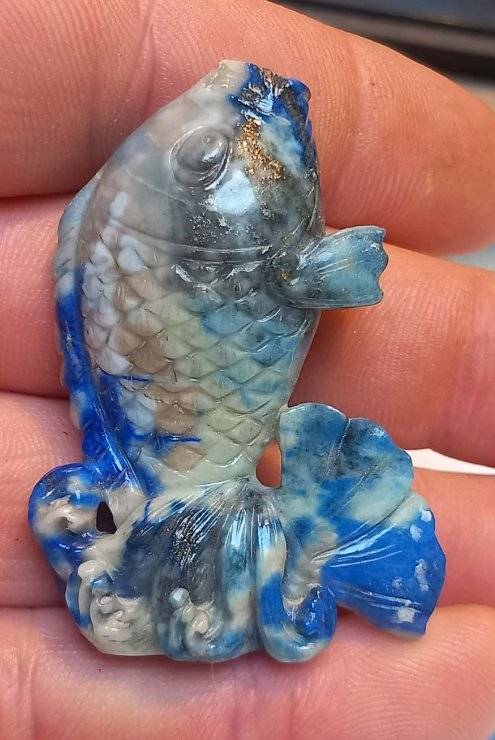
Chinese Lapis Lazuli and Calcite 'Carp' Snuff Bottle, Late 20th Century
Estimated value
$45 - $120Rarity
Ordinary(3/10)Category
Ceramics & PotteryEra
Circa 1970-1990Origin
ChinaAuthenticity
CHINESE LAPIS LAZULI AND CALCITE 'CARP' SNUFF BOTTLE, LATE 20TH CENTURY: IDENTIFICATION
A small decorative vessel carved in the form of a leaping carp. The material is a mottled blue and white stone, primarily lapis lazuli combined with significant white calcite and occasional metallic pyrite inclusions visible near the mouth. The fish is rendered with stylized scales and a fan-like tail, featuring a bored cylindrical orifice at the mouth designed to receive a spoon and stopper. The carving style is functional but lacks the micro-detail of high-period Qing lapidary work.
PRODUCTION & FIRING
SCARCITY
Standard antiques commonly found at estate sales and flea markets. Plentiful supply meets modest demand.
Typical Characteristics
- Moderate production runs
- Common at estate sales
- Entry-level collectibles
Confidence Factors
- Visible pyrite inclusions confirm natural lapis lazuli rather than glass or plastic imitation
- Carving style is consistent with 20th-century mass-market lapidary production
CERAMICIST'S ASSESSMENT
Asian Art Specialist
Identification of material is near-certain due to pyrite inclusions; period attribution is supported by the specific carving style and stone quality common in the 1970s-80s export market.
KEY EVIDENCE
- 1Orifice bored into the mouth persists the form of a 'snuff bottle' even if used decoratively.
- 2Mottled blue-white distribution indicates high calcite content lapis lazuli.
- 3Stylized, rounded scale carving avoids the sharp undercutting seen in 18th-century jade and hardstone works.
- 4Pyrite flecks (metallic gold color) are clearly visible in the dark blue sections near the head.
UNCERTAINTIES
- •The mouth rim is jagged and broken, significantly impacting its value as a functional snuff bottle.
WHAT WOULD IMPROVE CERTAINTY
- →Check for a ground-down base to see if it stands independently.
- →Verify the interior of the bore-hole for modern drill marks indicative of 20th-century manufacture.
CONDITION & GRADE
Condition
Significant loss at the mouth rim where the stone has fractured; missing the original stopper and spoon assembly. Surface shows minor abrasions consistent with late-century handling.
CERAMICS MARKET VALUE
Updated: May 10, 2026
Who buys this
General Asian art enthusiasts and snuff bottle collectors looking for representative motifs at an entry-level price point.
What increases value
- •Natural stone material with visible pyrite
- •Traditional 'Carp' motif demand
- •Vibrant blue saturation in the tail section
What lowers value
- •Missing stopper and spoon
- •Damage to the mouth rim significantly reduces collectible grade
- •High calcite-to-lapis ratio (white vs blue balance)
What makes top-tier examples
- •Deep 'Ultramarine' blue with minimal white calcite
- •Intricate undercutting in the tail and fins
- •Intact original jade or coral stopper
Grade & condition
Completeness (presence of stopper), lack of fractures, and intensity of the blue pigmentation.
Rarity & demand
For informational purposes only, not a formal appraisal.
ABOUT CERAMICS & POTTERY
Pottery, porcelain, stoneware, earthenware, and kiln-fired objects.
Ceramics & Pottery value and rarity guideSHARE THIS CURIOSITY
Have your own curiosities to discover?
Scan Your Curiosity
COMMENTS