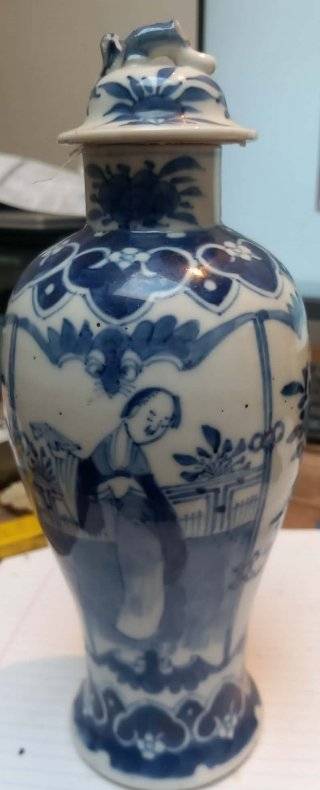
Chinese Blue and White Ginger Jar, Late Qing to Republic Period Style
Estimated value
$80 - $250Rarity
Ordinary(3/10)Category
Ceramics & PotteryEra
Late 19th to early 20th century (circa 1890-1940)Origin
ChinaAuthenticity
CHINESE BLUE AND WHITE GINGER JAR, LATE QING TO REPUBLIC PERIOD STYLE: IDENTIFICATION
A porcelain baluster-form jar with a domed lid featuring a Buddhist lion (shishi) finial. The body is decorated in underglaze blue with four lobed panels containing figures and floral motifs, separated by vertical lines and topped with bat (fu) designs. The base bears a four-character underglaze blue reign mark in kaishu script.
CROSS-CULTURAL PARALLELS
Where This Object Echoes
17th-century European potters mimicked these exact blue and white Chinese designs to meet high domestic demand.
Ritual & Ceremonial Use
- •Historically used in domestic scholars' studios for storing ginger, tea, or spices.
Meaning Through Time
Transitioned from strictly functional storage to highly decorative objects collected for their symbolic motifs.
PRODUCTION & FIRING
SCARCITY
Standard antiques commonly found at estate sales and flea markets. Plentiful supply meets modest demand.
Typical Characteristics
- Moderate production runs
- Common at estate sales
- Entry-level collectibles
Confidence Factors
- The mark is apocryphal, representing a later production date than the 17th-century reign it cites.
- Simplified brushwork in the facial features of the figures is typical of late Qing/Republic export production.
- Recent mass-produced reproductions of this specific style are common in the current market.
Expert review recommended. Consider consulting a specialist before making purchasing decisions.
CERAMICIST'S ASSESSMENT
Asian Art Specialist
Identification of the era and mark status is straightforward based on visible calligraphy and motifs, though modern reproduction cannot be 100% ruled out without examining the clay body in person.
KEY EVIDENCE
- 1Underglaze blue cobalt shows characteristic 'heaping and piling' mimics found in later 19th-century wares.
- 2Four-character kaishu mark 'Kangxi Nian Zhi' is written in a hurried style inconsistent with 17th-century imperial workshops.
- 3The finial construction and specific 'bat' border motifs are diagnostic of late-period Jingdezhen export porcelain.
- 4Pitting and iron spots in the glaze indicate a traditional wood-fired kiln but lack the extreme refinement of early Qing porcelain.
UNCERTAINTIES
- •Damage to the lid reduces the value significantly for serious porcelain collectors.
- •The mark is definitely apocryphal; the object is approximately 100-130 years old, not 300.
- •The drawing of the figures is somewhat crude compared to mid-Qing standards.
WHAT WOULD IMPROVE CERTAINTY
- →Provide a high-resolution close-up of the unglazed footrim to check clay texture and orange oxidation.
- →Take a photo of the interior of the jar to examine potting rings and glaze thickness.
- →Measure the exact height in centimeters to compare with standard archival sizes for ginger jars.
CONDITION & GRADE
Condition
Significant chips are visible on the edge of the lid. The footrim shows surface dirt and expected shelf wear for a piece of this age. Some losses to the finish of the finial are evident.
Weight & feel
The potting appears moderately thick, suggesting a weight of approximately 400-600 grams for a jar of this size range (estimated 15-20 cm).
CERAMICS MARKET VALUE
Updated: May 11, 2026
Who buys this
General antique collectors and those interested in late-dynastic Chinese export ceramics.
What increases value
- •The presence of the original lid increases value despite the damage.
- •Clear, legible reign mark and classic blue-and-white color palette.
What lowers value
- •Visible chips on the lid rim significantly impact the high-end secondary market value.
- •Generic motif lacking specific narrative or 'Master of the Rocks' style refinement.
What makes top-tier examples
- •Vibrant 'sapphire' blue cobalt.
- •Six-character mark instead of four.
- •Flawless condition of the finial and lid rim.
Grade & condition
Condition of the lid, clarity of the mark, and absence of hairline cracks in the body.
Rarity & demand
For informational purposes only, not a formal appraisal.
ABOUT CERAMICS & POTTERY
Pottery, porcelain, stoneware, earthenware, and kiln-fired objects.
Ceramics & Pottery value and rarity guideSHARE THIS CURIOSITY
Have your own curiosities to discover?
Scan Your Curiosity
COMMENTS