Dutch Interior Scene with Woman Sewing
QUICK FACTS
Categories
Era
Late 19th Century to Early 20th Century (1880-1920)
Origin
🇳🇱 Netherlands
Artist/Maker
Jacob Kever
Rarity
Uncommon (5/10)
Discovered
Feb 3, 2026
3 weeks ago
DESCRIPTION
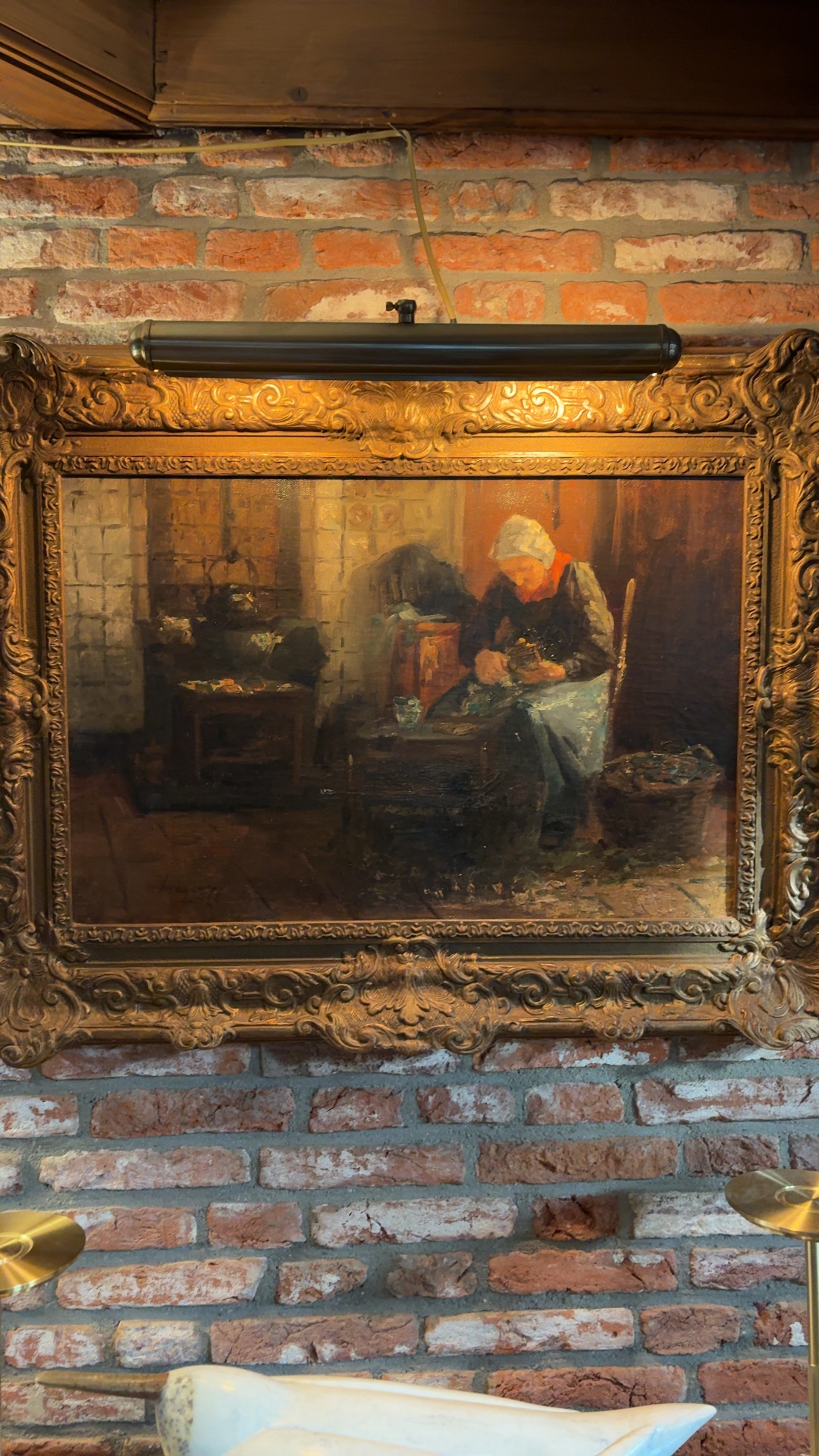
This appears to be an oil painting depicting an interior genre scene, likely of Dutch or Flemish origin, featuring a woman engaged in domestic work, possibly sewing or mending. The composition, characterized by soft, warm light emanating from an unseen source, suggests a late 19th or early 20th-century period. The use of rich, earthy tones and visible brushwork is typical of academic realism or the Hague School influence. The painting is housed within a heavily ornate, possibly gilded, frame that is consistent with the stylistic preferences of the era.
CULTURAL ECHOES
Where This Object Echoes
The tradition of intimate genre scenes, particularly figures engaged in domestic tasks, can be traced back to 17th-century artists like Jan Vermeer and Pieter de Hooch.
This painting shares stylistic similarities, such as muted tones, focus on light, and rendering of everyday life, with works by artists like Jozef Israëls or Anton Mauve.
Ritual & Ceremonial Use
- •The depiction of a woman sewing or working by hand reflects the domestic rituals and traditional roles of women in European society during the 19th century.
- •The act of observing and collecting such genre scenes became a ritual for a burgeoning middle class, who appreciated art that reflected their own values and aspirational lifestyles.
Meaning Through Time
While seemingly straightforward, domestic scenes often held moralistic or allegorical meanings, quietly commenting on diligence, virtue, or the fleeting nature of life.
These scenes shifted to emphasize realism and an empathetic portrayal of the working class or rural life, valuing authenticity and atmosphere over overt moralizing.
HISTORICAL STORY
DID YOU KNOW?
The Hague School, active in the Netherlands during the late 19th century, often depicted similar genre scenes with a focus on light and atmosphere, earning them the moniker 'Dutch Impressionists'.
Genre painting, while capturing everyday life, was also popular for its potential to convey moral messages or allegories through its nuanced depictions of human activity.
MATERIAL & CONDITION
Surface
The paint surface appears to be oil on canvas, exhibiting a noticeable impasto in certain areas, particularly visible in the closer details of the fabric and background. There is a fine network of craquelure across the surface, characteristic of aged oil paint. The varnish layer appears somewhat darkened and may have some surface grime, contributing to the overall subdued tonality.
Weight & Feel
Given the size and the substantial, ornate frame, the painting would likely feel moderately heavy, suggesting solid construction typical of pieces from this period.
Condition
The painting shows signs of age consistent with a work from its estimated period, including some darkening of the varnish and likely surface grime. No significant tears or major paint losses are immediately apparent from the provided images, though a small area of potential loss or abrasion is noted in the lower right quadrant in the closer detail shot. The frame appears to be in good, aged condition with possible minor losses to the gilding or gesso, which is expected.
RARITY ANALYSIS
Genuine antiques with fewer examples on the market. Named makers, documented provenance, or early production examples.
Typical Characteristics
- Limited production
- Named makers
- Growing collector demand
EXPERT ANALYSIS
Museum-Trained Art Historian
Confidence is good based on strong visual cues regarding period and style, material characteristics, and framing. However, the lack of an identifiable signature or clear provenance prevents a higher level of certainty regarding attribution.
KEY EVIDENCE
- 1Oil on canvas medium with visible brushwork and impasto.
- 2Composition and thematic elements (domestic genre scene, intimate lighting) are consistent with late 19th/early 20th-century European art, especially Dutch/Flemish traditions.
- 3The ornate frame aligns with styles prevalent in the late 19th century, indicating period appropriateness.
- 4Presence of craquelure suggests age and natural drying of oil paint.
UNCERTAINTIES
- •No discernible signature or artist's mark provides concrete attribution.
- •The lighting conditions in the photographs make it difficult to ascertain fine details of brushwork and potential subtle restorations.
WHAT WOULD IMPROVE CERTAINTY
- →High-resolution photographs of the entire painting and close-ups, especially around the lower corners and along the bottom edge, to search for a signature.
- →Photographs of the reverse of the canvas, stretcher, and frame to look for gallery labels, exhibition stickers, or inventory numbers.
- →Examination under UV light to reveal any significant overpainting or repairs, which could impact value and attribution.
- →A professional condition report to assess the integrity of the canvas and paint layers.
ESTIMATED VALUE
Updated: Feb 27, 2026
- Market comparables from auctions & retail
- Condition, completeness & craftsmanship
- Current collector demand & trends
- Low = quick sale, high = patient seller
For informational purposes only, not a formal appraisal.
SHARE THIS CURIOSITY
Have your own curiosities to discover?
Scan Your Curiosity
COMMENTS (1)
Wow what a setting on the painting. Amazing how times have changed.
Sign in to leave a comment