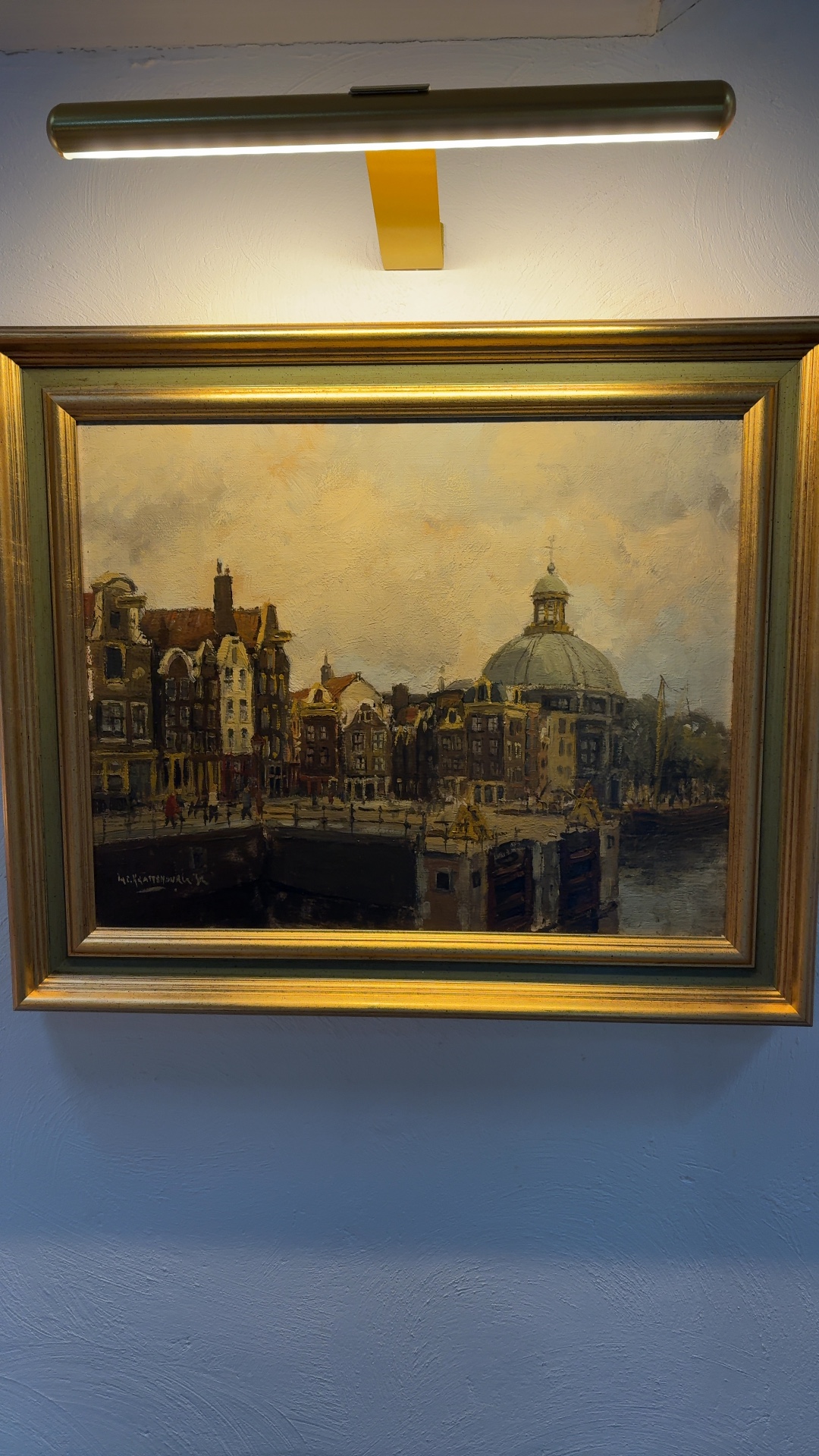
Amsterdam Canal View with Koepelkerk, Oil on Canvas
QUICK FACTS
Categories
Era
c. 1900-1940
Origin
🇳🇱 Netherlands
Artist/Maker
M.C. Krattenburg
Rarity
Uncommon (5/10)
Discovered
Feb 3, 2026
3 weeks ago
DESCRIPTION
This appears to be an oil painting depicting a cityscape, a common subject matter, particularly of European urban centers. The scene features historic buildings lining a canal, with a prominent domed structure reminiscent of Amsterdam's Koepelkerk (round Lutheran Church). The brushwork is impressionistic, suggesting an outdoor study (plein air) or a studio work deeply informed by such observation. The signature 'M.C. KRATTENBURG' is visible in the lower left, which is a crucial identifier for attribution.
CULTURAL ECHOES
Where This Object Echoes
The tradition of depicting everyday life, including cityscapes and genre scenes, which has a long and rich history in Dutch art.
The emphasis on capturing transient light, atmospheric effects, and visible brushstrokes, though often with a more controlled palette than French Impressionism.
Meaning Through Time
Cityscapes transitioned from purely topographical records to subjective artistic interpretations, focusing on mood and the artist's experience of place.
HISTORICAL STORY
DID YOU KNOW?
The domed building prominently featured in the painting is very likely the Koepelkerk (literally 'Dome Church'), also known as the Lutheran Church or Round Lutheran Church, in Amsterdam, an iconic architectural landmark completed in 1671.
Dutch artists like M.C. Krattenburg frequently depicted cityscapes, capturing the unique light and atmosphere of the Low Countries, carrying forward a tradition from masters like Johannes Vermeer and Jan van der Heyden.
MATERIAL & CONDITION
Surface
The painting exhibits a varied surface, characterized by evident impasto in areas, particularly in the rendering of the buildings and possibly the sky, creating textural interest. The brushstrokes appear deliberate yet loose, typical of early 20th-century landscape and cityscape painting. Some craquelure, fine cracks in the paint layer, is likely present, consistent with the age of an oil painting on canvas.
Weight & Feel
Based on the visible frame and the assumed canvas support, the painting would present with a moderate weight, consistent with a framed oil painting of its likely dimensions.
Condition
The overall visible condition appears good, with no obvious major damage from the images. The surface may show expected craquelure, and some toning of the varnish layer could be present, contributing to the warm, aged appearance. The frame, a gilded example, seems to be in good condition with minor wear typical of its age.
RARITY ANALYSIS
Genuine antiques with fewer examples on the market. Named makers, documented provenance, or early production examples.
Typical Characteristics
- Limited production
- Named makers
- Growing collector demand
EXPERT ANALYSIS
Museum-Trained Art Historian
Confidence is high due to the clear visibility of the artist's signature, the recognizable subject matter, and a painting style that is consistent with the artist's known oeuvre and the art historical period.
KEY EVIDENCE
- 1Visible signature 'M.C. KRATTENBURG' in the lower left corner.
- 2Impressionistic brushwork and color palette suggest an early 20th-century style.
- 3Subject matter—a prominent Amsterdam canal scene with the Koepelkerk—is a well-known motif in Dutch art.
- 4The painting is housed in a period-appropriate gilded frame.
UNCERTAINTIES
- •Image quality limits close inspection of surface details and potential craquelure.
- •No visible verso examination, which could reveal stretcher marks, labels, or inscriptions.
WHAT WOULD IMPROVE CERTAINTY
- →Examine the reverse of the canvas and stretcher for any labels, inscriptions, or gallery stamps.
- →Photographs under UV light to check for restorations or inpainting.
- →High-resolution close-ups of the signature for detailed comparison with authenticated examples of M.C. Krattenburg's work.
- →Measure the exact dimensions of the canvas (sight size).
ESTIMATED VALUE
Updated: Feb 27, 2026
- Market comparables from auctions & retail
- Condition, completeness & craftsmanship
- Current collector demand & trends
- Low = quick sale, high = patient seller
For informational purposes only, not a formal appraisal.

SHARE THIS CURIOSITY
Have your own curiosities to discover?
Scan Your Curiosity
COMMENTS
No comments yet. Be the first to share your thoughts!
Sign in to leave a comment