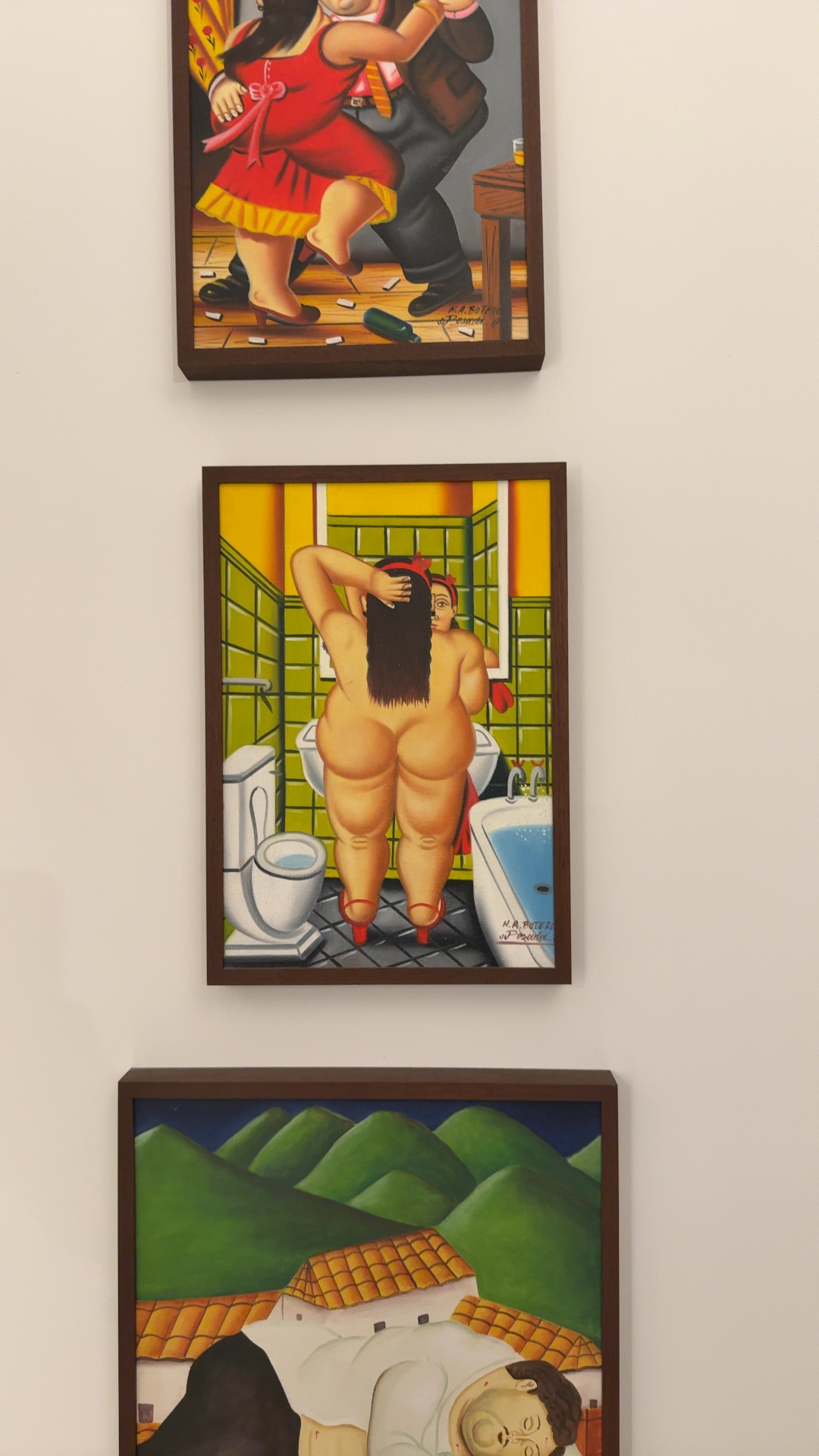
Nude Woman in Bathroom, attributed to H.A. Botero
QUICK FACTS
Categories
Era
Mid-Late 20th Century
Origin
🌍 International
Artist/Maker
H.A. Botero / J. Posada
Rarity
Uncommon (5/10)
Discovered
Jan 22, 2026
1 months ago
DESCRIPTION
This is an oil painting depicting a nude woman from behind, standing in a bathroom and looking into a mirror. The style is characteristic of 'Boterismo,' featuring exaggerated, voluminous figures, albeit rendered by an artist whose signature is 'H.A. Botero' and 'J. Posada.' The palette is vibrant, with stark contrasts, typical of Latin American folk or naive art influenced by the famed Colombian artist Fernando Botero. The subject matter of the bath and mundane domestic scenes aligns with themes explored by many twentieth-century artists.
CULTURAL ECHOES
Where This Object Echoes
The 'Boterismo' style, characterized by voluminous figures, became highly influential globally, often used by other artists to depict local scenes or critique social issues.
The simplified forms, bold outlines, and strong colors often resonate with sensibilities found in folk and naive art traditions, where direct expression and storytelling are prioritized over academic realism.
Ritual & Ceremonial Use
- •The depiction of everyday life and domestic intimacy, such as a woman preparing herself in a bathroom, serves as a ritualistic exploration of humanity and vulnerability in art.
- •The act of collecting such paintings can be seen as a ritual of appreciation for specific aesthetic movements and cultural narratives within a home setting.
Meaning Through Time
The nude in art often symbolized classical beauty, mythological narratives, or academic study of the human form.
With artists like Botero, the exaggerated or 'fat' nude began to challenge conventional beauty standards, inviting viewers to reconsider aesthetic norms and find beauty in unconventional forms, sometimes with political or satirical undertones.
HISTORICAL STORY
DID YOU KNOW?
The distinctive artistic style seen in this painting, 'Boterismo,' is characterized by the artist's unique technique of portraying figures and objects in large, exaggerated volumes, a stylistic choice that ironically underscores their presence and sensuality rather than detracting from it.
Boterismo, while originating from Fernando Botero's work in Colombia, has become an internationally recognized aesthetic, influencing artists and finding appreciation across various cultural contexts for its engaging and often humorous portrayal of human nature.
MATERIAL & CONDITION
Surface
The painting appears to be executed in oil on canvas, exhibiting a smooth, almost enamel-like finish typical of the Botero-esque style where brushstrokes are often minimized. The colors are bold and flat, giving the figures a sculptural, almost plastic quality.
Weight & Feel
Due to the presumed canvas and frame construction, the piece would likely be moderate in weight, easily manageable, reflecting its typical scale as a decorative rather than monumental work.
Condition
Visually, the painting appears to be in good condition with no overt signs of damage, tears, or significant paint loss. The colors retain their vibrancy. The frames are simple and seem well-preserved.
RARITY ANALYSIS
Genuine antiques with fewer examples on the market. Named makers, documented provenance, or early production examples.
Typical Characteristics
- Limited production
- Named makers
- Growing collector demand
EXPERT ANALYSIS
Museum-Trained Art Historian
Confidence is good regarding the stylistic influence and material, however, the specific artist attribution and market positioning for 'H.A. Botero / J. Posada' remain less certain without further research into this particular signature.
KEY EVIDENCE
- 1The painting exhibits clear stylistic characteristics of 'Boterismo,' notably the exaggerated, voluminous figures.
- 2The signature prominently displays 'H.A. Botero' and 'J. Posada,' clearly indicating the artist(s) responsible for this particular work.
- 3The use of oil on canvas, combined with the vibrant palette, is consistent with the general material techniques for this style and era.
- 4The subject matter of a private, domestic scene aligns with narrative themes commonly explored in modern figurative painting.
UNCERTAINTIES
- •The attribution to 'H.A. Botero' is not immediately recognizable as a widely documented name of the stature of Fernando Botero, leading to questions regarding the identity and market standing of this specific artist.
- •'J. Posada' appearing on the signature could indicate a collaboration or another aspect of the artist's professional identity, which requires further clarification.
- •Without specific context or provenance, differentiating between a 'follower of' work, an homage, or a potentially less-known artist within the Botero school is critical for valuation.
WHAT WOULD IMPROVE CERTAINTY
- →A high-resolution photograph of the signature for detailed analysis of script and potential other marks.
- →Examination of the reverse of the canvas and stretcher for any labels, inventory numbers, or exhibition stamps that could provide provenance.
- →A blacklight examination to detect any restorations, inpainting, or past damages.
- →Research into 'H.A. Botero' and 'J. Posada' in Latin American art archives and auction records to establish a market presence, if any.
ESTIMATED VALUE
Updated: Feb 27, 2026
- Market comparables from auctions & retail
- Condition, completeness & craftsmanship
- Current collector demand & trends
- Low = quick sale, high = patient seller
For informational purposes only, not a formal appraisal.

SHARE THIS CURIOSITY
Have your own curiosities to discover?
Scan Your Curiosity
COMMENTS
No comments yet. Be the first to share your thoughts!
Sign in to leave a comment