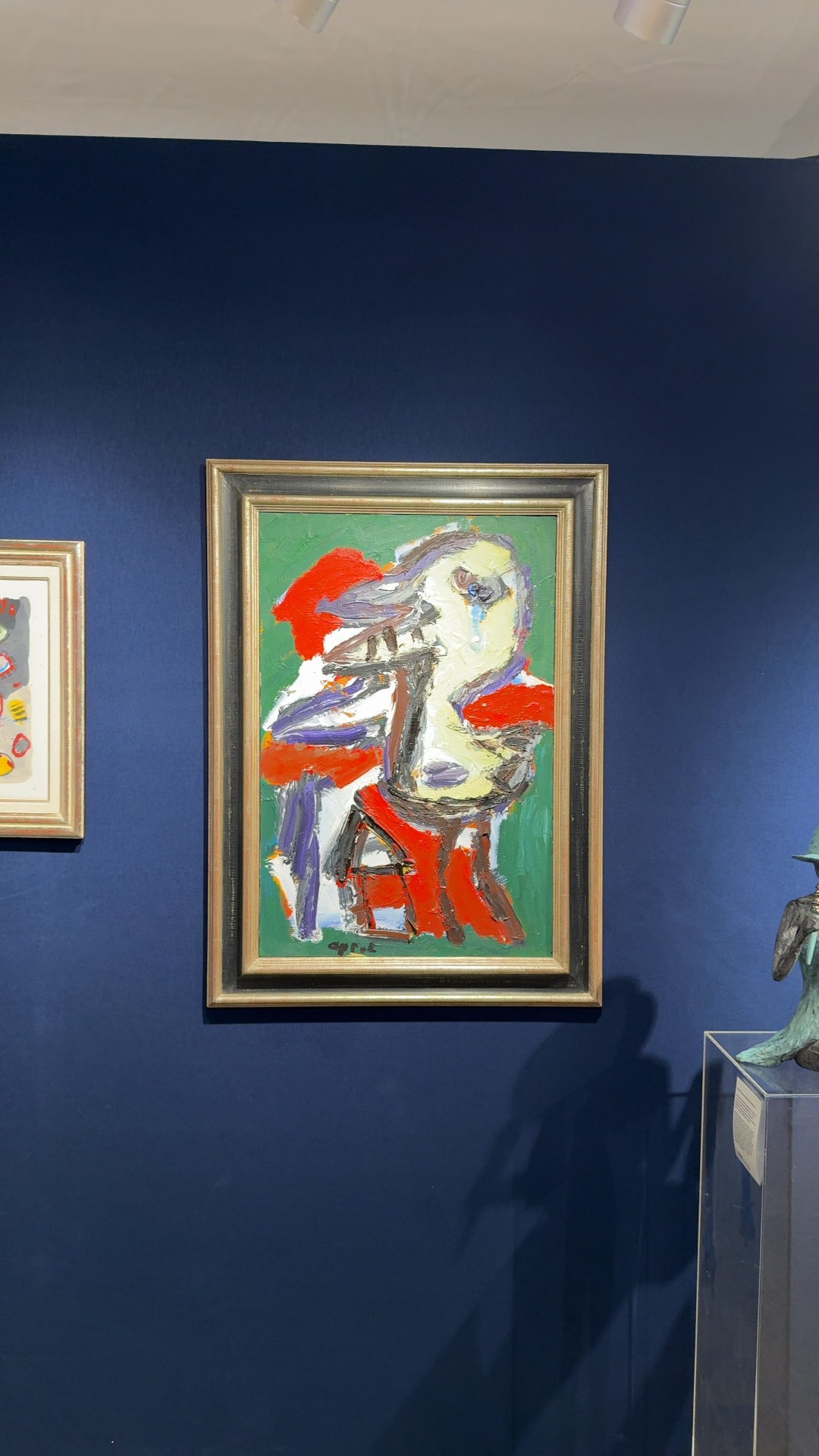
Abstract Expressionist Portrait or Figure
QUICK FACTS
Categories
Era
Mid-20th Century (1940s-1970s)
Origin
🌍 International
Artist/Maker
Karel AppelRarity
Average (4/10)
Discovered
Jan 25, 2026
1 months ago
DESCRIPTION
This appears to be an oil painting, executed in a bold, expressionistic style. The use of thick impasto creates a highly textured surface, suggesting emotional intensity and a dynamic hand from the artist. The composition features abstract forms that coalesce into what might be interpreted as a stylized portrait or figure set against a vibrant green background. The palette is striking, with strong primary and secondary colors—red, yellow, blue, and green—contrasted by areas of white, black, and visible canvas/ground.
CULTURAL ECHOES
Where This Object Echoes
The raw, childlike, and expressive figuration combined with vibrant colors strongly recalls the Post-War European CoBrA group (Copenhagen, Brussels, Amsterdam), active from 1948-1951, exemplified by artists like Karel Appel and Asger Jorn.
The deliberately unpolished and 'primitivist' aesthetic shares sensibilities with 'Art Brut' as championed by Jean Dubuffet, which valued art created outside the conventional art world.
Ritual & Ceremonial Use
- •The ritual of artistic self-expression as a form of psychological release or social commentary, particularly prevalent in post-war art seeking new modes of communication beyond traditional representation.
- •The exhibition and collection of art that challenges conventional beauty, encouraging viewers to engage with raw emotion and subjective interpretation.
Meaning Through Time
Abstraction in art was often seen as radical and challenging to established norms, a rebellion against academic realism.
Abstract Expressionism became a dominant force, particularly in the West, seen by some as reflecting individual freedom and existential angst in the post-war world.
The legacy of Abstract Expressionism influenced subsequent movements, with its focus on process, materiality, and emotional content continuing to resonate and be reinterpreted.
HISTORICAL STORY
DID YOU KNOW?
Impasto, the technique of applying paint thickly, became a hallmark of many Expressionist and Abstract Expressionist painters, allowing the physicality of the paint itself to convey meaning.
The use of bold, non-naturalistic colors in expressionistic art often aims to communicate inner emotion and subjective experience rather than objective reality.
MATERIAL & CONDITION
Surface
The surface is characterized by very heavy impasto, with visible peaks and valleys of oil paint throughout. The brushstrokes are broad and energetic, leaving distinct marks in the pigment. The paint appears to be dry, showing minor surface cracks typical of oil paint applied in thick layers over decades.
Weight & Feel
Given the substantial application of oil paint on what appears to be a canvas or panel, the work would feel quite solid and possess a moderate weight for its size. The framing would add further to its overall heft.
Condition
Visually, the painting appears to be in good overall condition for its age, though the extent of any craquelure or minute paint losses would require closer inspection. The frame also seems well-preserved with only minor signs of wear visible at a distance.
RARITY ANALYSIS
Typical antique shop fare. Requires some searching but regularly available. This is where most genuine antiques fall.
Typical Characteristics
- Standard antique shop items
- Regularly available
- Moderate collector interest
EXPERT ANALYSIS
Museum-Trained Art Historian
Confidence is good regarding the general style and estimated era, based on the strong visual cues of impasto and expressionistic figuration. However, specific artist attribution remains unknown without clearer signature identification or provenance, hence the moderate confidence in a definitive identification.
KEY EVIDENCE
- 1Heavy impasto application characteristic of mid-20th century expressionistic painting.
- 2Bold, non-naturalistic color palette and gestural brushwork align with Abstract Expressionist and European post-war movements like CoBrA.
- 3Abstracted figurative elements are consistent with a move away from strict representational art.
- 4The visible signature, while not immediately identifiable, indicates an artist-signed work.
UNCERTAINTIES
- •The signature is difficult to decipher and does not immediately point to a well-known master.
- •Without more significant identifying marks on the verso or documented provenance, attributing this to a specific, widely collected artist would be highly speculative.
- •Image quality limits detailed examination of craquelure patterns and paint aging, which can sometimes reveal inconsistencies in age.
WHAT WOULD IMPROVE CERTAINTY
- →A clear, high-resolution photograph of the signature for potential identification.
- →Images of the reverse side of the canvas/panel to check for any labels, stencils, or inscriptions from galleries, exhibitions, or previous owners.
- →Detailed close-up photographs of the paint surface to assess the nature of craquelure and any signs of restoration.
- →UV light examination to detect any overpainting or previous repairs that are not visible to the naked eye.
ESTIMATED VALUE
Updated: Feb 27, 2026
- Market comparables from auctions & retail
- Condition, completeness & craftsmanship
- Current collector demand & trends
- Low = quick sale, high = patient seller
For informational purposes only, not a formal appraisal.



SHARE THIS CURIOSITY
Have your own curiosities to discover?
Scan Your Curiosity
COMMENTS
No comments yet. Be the first to share your thoughts!
Sign in to leave a comment