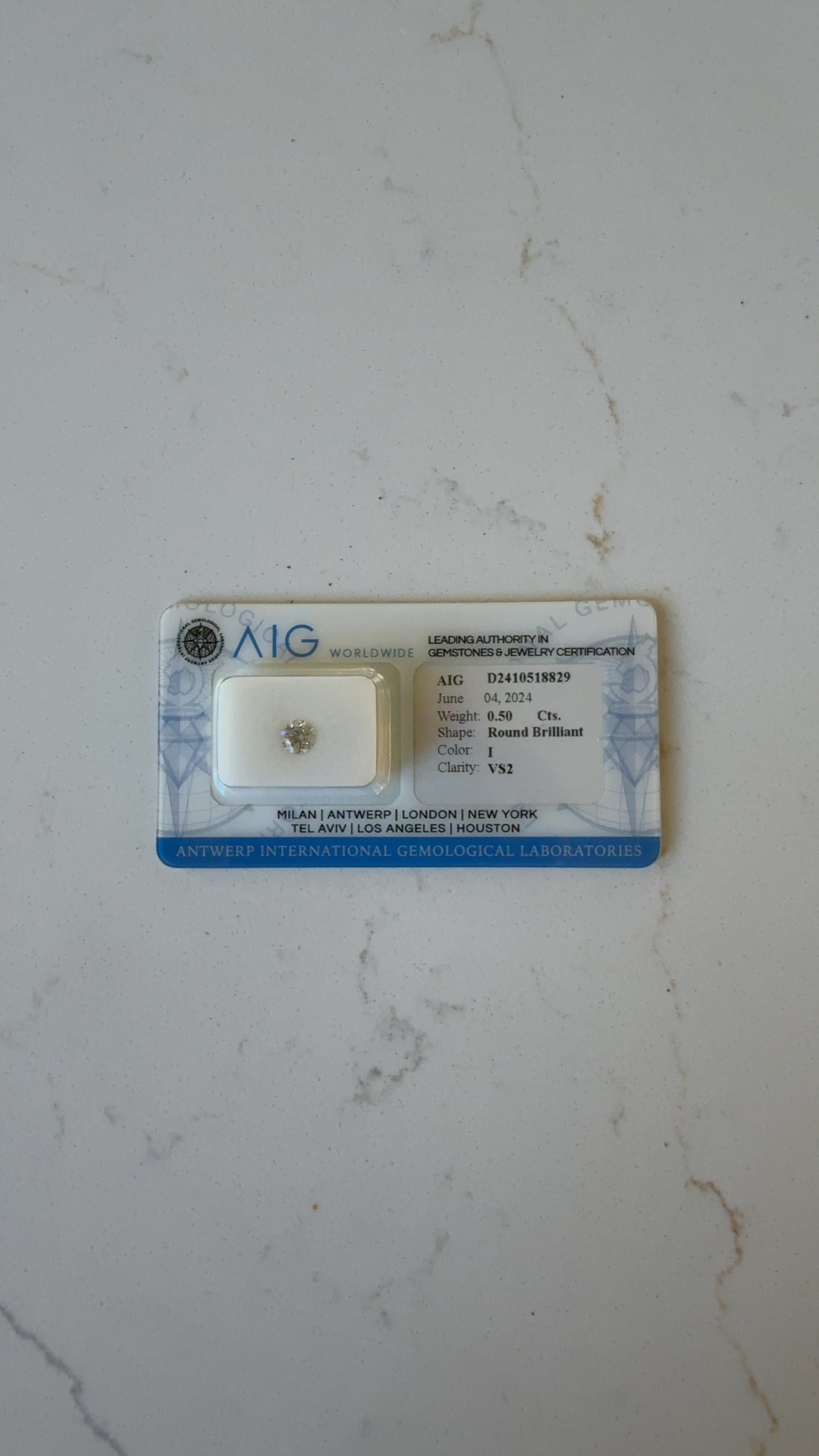
0.50 Carat Round Brilliant Diamond with AIG Certification
QUICK FACTS
Categories
Era
2024
Origin
🌍 International
Brand
Antwerp International Gemological Laboratories (AIG Worldwide)
Rarity
Average (4/10)
Discovered
Jan 17, 2026
1 months ago
DESCRIPTION
This appears to be a loose, unmounted diamond, housed within a sealed, tamper-evident package from Antwerp International Gemological Laboratories (AIG Worldwide). The accompanying certification card details the stone's characteristics: a weight of 0.50 carats, a round brilliant cut, I color grade, and VS2 clarity. The visible diamond exhibits typical brilliance for its cut style, suitable for immediate setting into jewelry. It's crucial to confirm the authenticity of both the diamond and the certification through professional verification.
CULTURAL ECHOES
Where This Object Echoes
The earliest known source of diamonds and their use as revered objects and symbols of power and divinity.
The diamond solitaire ring ascended to prominence as a symbol of eternal love and commitment, enduring to this day.
Ritual & Ceremonial Use
- •Engagement and marriage proposals, where a diamond ring serves as a central emblem of everlasting commitment.
- •Investment and wealth preservation, as diamonds have long been considered a portable store of value across cultures.
- •Celebrating significant life milestones such as anniversaries, births, and achievements.
Meaning Through Time
Initially recognized for their extreme hardness and light-reflecting properties, diamonds were seen as magical talismans, protectors, and symbols of royalty.
With advancements in cutting techniques, diamonds transformed into objects of opulence and beauty, adorning the nobility and signaling immense wealth and status.
Propelled by aggressive marketing and cultural association, diamonds became the quintessential symbol of eternal love, marriage, and a lasting family legacy.
HISTORICAL STORY
DID YOU KNOW?
Diamonds are the hardest known natural material, scoring a perfect 10 on the Mohs scale of mineral hardness, making them ideal for both jewelry and industrial applications.
The term 'carat' for diamond weight originates from the carob seed, which was historically used as a unit of measure due to its fairly consistent weight.
MATERIAL & CONDITION
Surface
The diamond appears to possess a high polish on its facets, indicative of a professional cut, which contributes to its refractive capabilities. The clarity grade of VS2 suggests very minor inclusions, likely not visible to the naked eye, leading to a generally clean appearance.
Weight & Feel
At 0.50 carats, this diamond would be quite light, weighing approximately 100 milligrams. Despite its small physical size, its density lends it a surprising heft when compared to other materials of similar volume.
Condition
The diamond itself presents as excellent, consistent with new-cut stones. It is housed in an AIG sealed blister pack, which ideally protects it from surface abrasions or contamination, maintaining its 'as-graded' condition.
RARITY ANALYSIS
Typical antique shop fare. Requires some searching but regularly available. This is where most genuine antiques fall.
Typical Characteristics
- Standard antique shop items
- Regularly available
- Moderate collector interest
EXPERT ANALYSIS
Gemologist & Mineral Specialist
Confidence is moderate due to the presence of a lab certificate detailing key characteristics, however, visual inspection alone cannot confirm the diamond's natural origin or rule out treatments. Furthermore, the standing of the issuing lab (AIG) is a factor, as their grading can sometimes be less stringent than top-tier laboratories.
KEY EVIDENCE
- 1The item is clearly labeled as a 'Diamond' by AIG Worldwide, a recognized, though not top-tier, gemological laboratory.
- 2The certification card specifies the 4 C's: 0.50 carats, Round Brilliant shape, I color, VS2 clarity.
- 3The diamond is presented in a sealed, tamper-evident blister pack, common for certified loose stones.
- 4The visible diamond shows fire and brilliance consistent with a round brilliant cut.
UNCERTAINTIES
- •The visual assessment cannot confirm the stated 'natural' origin of the diamond; it could potentially be lab-grown without further testing.
- •The exact cut grade (e.g., 'Excellent', 'Very Good') is not specified, which significantly impacts value.
- •The color grade 'I' can sometimes present a faint yellow tint, which is difficult to accurately assess from photographs alone.
WHAT WOULD IMPROVE CERTAINTY
- →Obtain independent gemological certification (e.g., GIA or AGS) to confirm the stone's characteristics and natural origin.
- →Verify the authenticity of the AIG certificate through their online database, if available.
- →Examine the diamond under magnification for a detailed assessment of inclusions and potential laser inscription.
- →Perform specific gravity and refractive index tests to confirm its identity as diamond.
ESTIMATED VALUE
Updated: Feb 26, 2026
- Market comparables from auctions & retail
- Condition, completeness & craftsmanship
- Current collector demand & trends
- Low = quick sale, high = patient seller
For informational purposes only, not a formal appraisal.

ABOUT GEMSTONES
Precious stones, semi-precious gems, minerals, crystals, and geological specimens.
Browse all GemstonesSHARE THIS CURIOSITY
Have your own curiosities to discover?
Scan Your Curiosity
COMMENTS
No comments yet. Be the first to share your thoughts!
Sign in to leave a comment