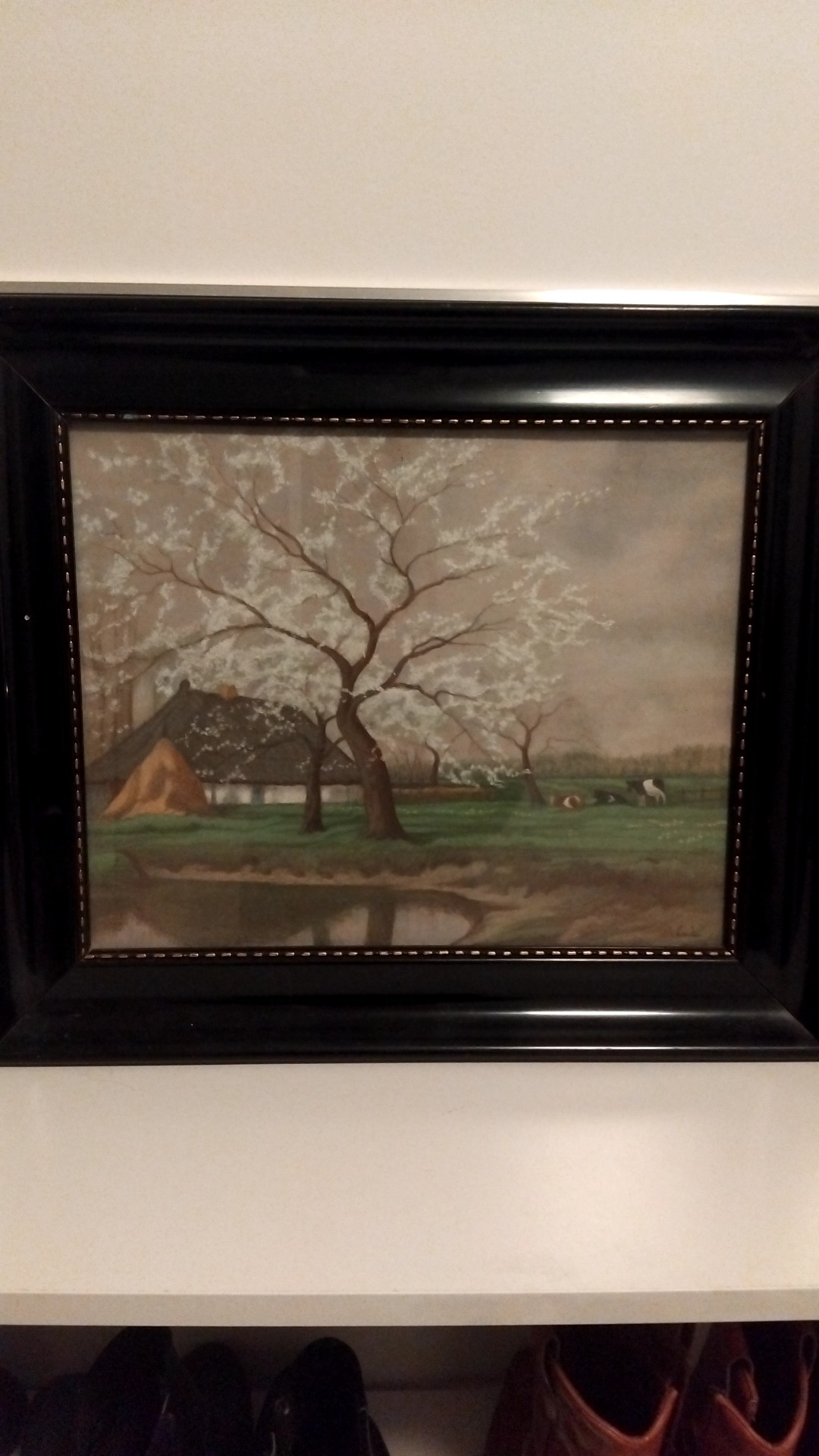
Pastoral Landscape with Thatched Cottage and Flowering Tree
QUICK FACTS
Categories
Era
Early 20th century
Origin
🌍 International
Rarity
Average (4/10)
Discovered
Jan 19, 2026
1 months ago
DESCRIPTION
This appears to be a pastel or charcoal drawing with white heightening, depicting a pastoral landscape scene. The composition features a thatched-roof cottage nestled amongst trees, one of which is prominently in bloom with white blossoms, perhaps a cherry or apple tree. In the mid-ground, a serene pond reflects a muted sky, while in the distance, a group of grazing animals (likely cows or sheep) completes the tranquil rural setting. The overall palette is subdued, focusing on greens, browns, and grays, with the bright white blossoms providing a focal point. The work is presented in a dark, possibly ebonized, wooden frame with a decorative inner fillet.
CULTURAL ECHOES
Where This Object Echoes
Echoes the tradition of idealized and sometimes allegorical rural landscapes, though with a different medium and later stylistic approach.
Shares a sensibility for capturing the everyday tranquility of rural life and natural settings, albeit with a softer, more atmospheric approach than typical oils of the school.
Ritual & Ceremonial Use
- •The placement of such a piece within a domestic setting for contemplation and aesthetic enjoyment of idealized nature.
Meaning Through Time
Pastoral scenes often represented a longing for simpler times amidst rapid industrialization and urbanization.
While still appreciated, these scenes increasingly became decorative rather than carrying deeper social commentary, often evoking nostalgia.
HISTORICAL STORY
DID YOU KNOW?
Pastel, often celebrated for its velvety texture and vibrant pigments, is technically a dry medium, making it challenging to blend seamlessly without specialized techniques.
The use of white heightening in pastel or charcoal drawings is a traditional method to add luminosity and dimension, particularly effective for depicting elements like blossoms or clouds.
MATERIAL & CONDITION
Surface
The drawing likely features a matte, slightly textured surface characteristic of pastel or charcoal on paper. The white highlights on the tree blossoms appear to be applied with a denser, perhaps chalkier, medium, providing a contrast in texture and visual prominence.
Weight & Feel
I anticipate this framed artwork to be moderately heavy, perhaps 3 to 6 pounds (1.4-2.7 kg), given the size of the frame and the use of glass protecting the artwork.
Condition
Visually, the artwork appears to be in good condition, protected behind glass. No obvious signs of foxing, fading, or creasing are discernable. The frame itself shows a glossy finish with no visible major scratches or losses from the provided images.
RARITY ANALYSIS
Typical antique shop fare. Requires some searching but regularly available. This is where most genuine antiques fall.
Typical Characteristics
- Standard antique shop items
- Regularly available
- Moderate collector interest
EXPERT ANALYSIS
Museum-Trained Art Historian
Confidence is moderate due to the clear visual cues pointing to a specific art form and era, but the absence of identifying marks and the difficulty in discerning fine details through glass from photographs prevent a more definitive assessment of its originality or artist.
KEY EVIDENCE
- 1The soft, diffused quality of the colors and textures strongly suggests a dry pigment medium, likely pastel or charcoal.
- 2The style—a somewhat idealized yet naturalistic depiction of a rural scene—is consistent with late 19th to early 20th-century European landscape traditions.
- 3The presence of a dark, relatively simple frame with an inner liner is characteristic of framing practices from the aforementioned period.
- 4The distinct white heightening on the blossoms indicates a specific, skilled application technique to enhance visual pop and texture.
UNCERTAINTIES
- •Lack of visible signature or any identifying marks.
- •The broad stylistic characteristics make precise attribution or dating challenging without further examination.
- •It is difficult to ascertain from the image alone if this is an original drawing or a very high-quality print reproduction.
- •The general theme is highly popular for decorative arts, which could include later reproductions or 'school of' works.
WHAT WOULD IMPROVE CERTAINTY
- →Examine the artwork out of the frame and glass to determine the exact medium (pastel, charcoal, crayon) and inspect the paper for watermarks or printer's marks.
- →Search the margins of the artwork for any obscured signatures, dates, or inscriptions.
- →Inspect the reverse of the frame and artwork for any gallery labels, auction stickers, or inventory numbers.
- →Perform a close-up examination under magnification to ascertain paint versus print dots if a print is suspected.
ESTIMATED VALUE
Updated: Feb 26, 2026
- Market comparables from auctions & retail
- Condition, completeness & craftsmanship
- Current collector demand & trends
- Low = quick sale, high = patient seller
For informational purposes only, not a formal appraisal.

SHARE THIS CURIOSITY
Have your own curiosities to discover?
Scan Your Curiosity
COMMENTS
No comments yet. Be the first to share your thoughts!
Sign in to leave a comment