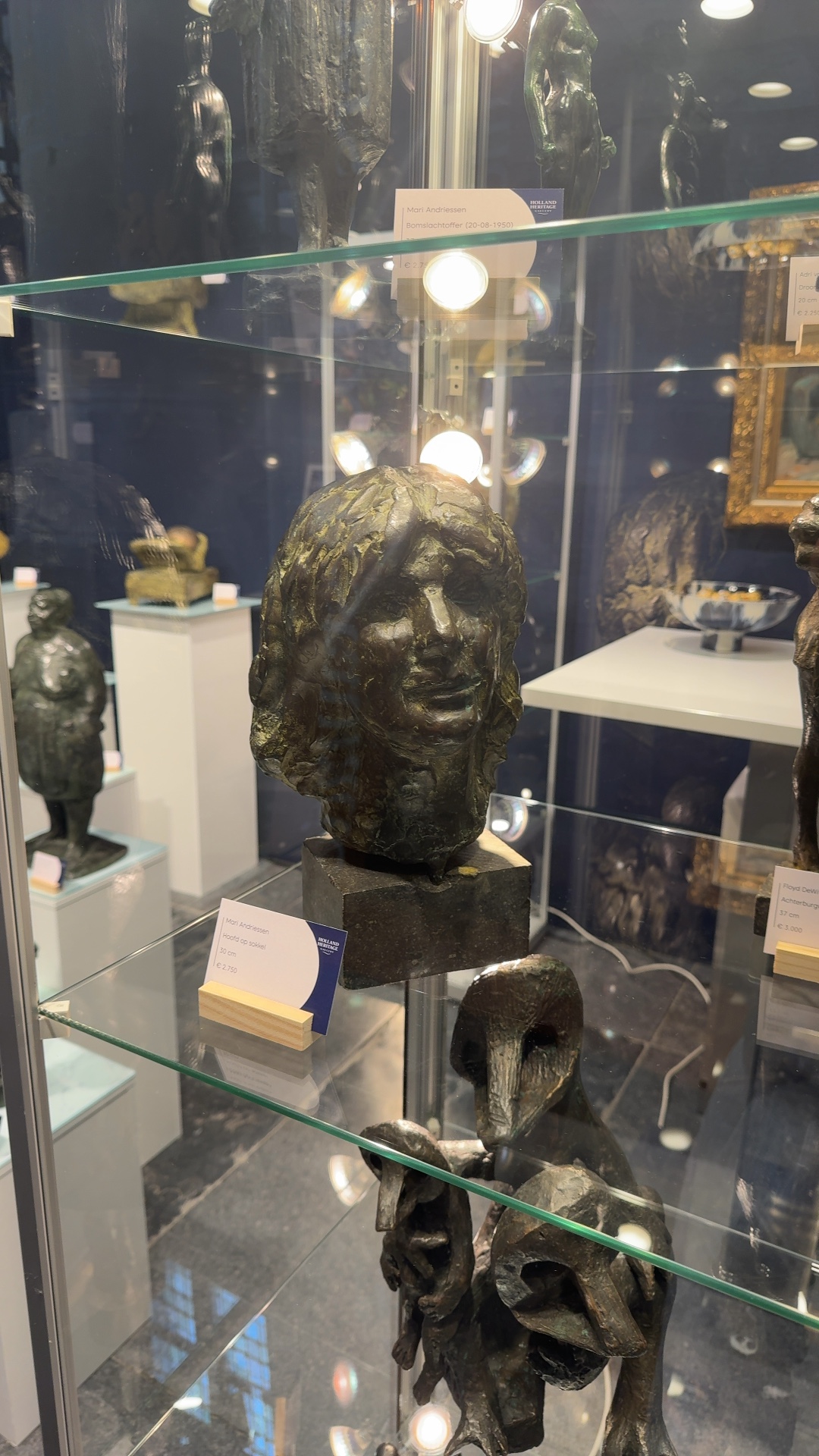
Mari Andriessen, 'Hoofd op sokkel' (Head on Plinth), Bronze Sculpture
QUICK FACTS
Categories
Era
Mid-20th Century (c. 1940s-1970s)
Origin
🇳🇱 Netherlands
Brand
Holland Heritage
Artist/Maker
Mari Andriessen
Rarity
Scarce (6/10)
Discovered
Jan 21, 2026
1 months ago
DESCRIPTION
This appears to be a bronze bust or head study, titled 'Hoofd op sokkel' (Head on Plinth), attributed to the Dutch sculptor Mari Andriessen. The work exhibits a distinctive, somewhat impressionistic modeling of the features and hair, characteristic of post-traditional figurative sculpture. The patination suggests an aged bronze, conveying depth and texture.
CULTURAL ECHOES
Where This Object Echoes
The expressive modeling and focus on capturing psychological depth rather than strict anatomical accuracy align with later European sculptural movements that prioritized emotion and artist's interpretation.
Andriessen's work is part of a broader trajectory of Dutch modern art that, while not always avant-garde, maintained a strong connection to figuration and humanist values, particularly after WWII.
Ritual & Ceremonial Use
- •Public commemoration through memorials and portraiture, where sculpture serves to embody collective memory and honor individuals or historical events.
- •Private contemplation and aesthetic enjoyment, as collectors acquire works for their homes or galleries.
Meaning Through Time
Sculptural portraiture began to move from academic idealism towards capturing individual psychology and an artist's subjective interpretation of the sitter.
Figurative sculpture, particularly in Europe, often carried themes of human resilience, memory, and the enduring spirit in the face of immense suffering, reflecting the collective experience of the war.
HISTORICAL STORY
DID YOU KNOW?
Mari Andriessen was instrumental in shaping the visual memory of World War II in the Netherlands through his many war memorials, including 'De Docker' in Amsterdam, which commemorates the February Strike.
Despite working predominantly in bronze, Andriessen was also skilled in wood carving, a medium he learned from his father, who was an accomplished cabinetmaker and sculptor.
MATERIAL & CONDITION
Surface
The bronze surface displays a dark, variegated patination, likely a chemical application, with hints of green and brown tones that enhance the textural quality of the sculpted hair and facial contours. The modeling is robust, reflecting the artist's direct handling of the material.
Weight & Feel
Given its material and size (30 cm), the sculpture would feel substantial and dense, characteristic of solid or relatively thick-walled cast bronze, firmly anchored to its stone plinth.
Condition
The bronze appears to be in good, stable condition with an intact and even patination. There are no immediately visible signs of significant damage, abrasions, or repairs to the sculptural form or the plinth. The display indicates a well-maintained or recently conserved piece.
RARITY ANALYSIS
Genuinely harder to find. Perhaps only dozens come to market annually. Collectors actively watch for these pieces.
Typical Characteristics
- Dozens per year at market
- Documented provenance valued
- Active collector pursuit
EXPERT ANALYSIS
Museum-Trained Art Historian
The confidence level is high due to the explicit attribution on the accompanying label and the strong stylistic congruence with Mari Andriessen's recognized body of work. The professional gallery context further reinforces the likelihood of an accurate attribution. However, the absence of a visible signature in the images prevents a near-certainty rating.
KEY EVIDENCE
- 1The presence of a gallery label explicitly attributing the work to Mari Andriessen and providing a title and dimensions.
- 2The stylistic characteristics of the bronze head, particularly the expressive modeling and surface texture, are consistent with Andriessen's known aesthetic.
- 3The use of bronze as a primary medium for sculptural works, a common material for Andriessen.
- 4The display within a professional gallery setting (indicated by other works and glass cases) lends credibility to the attribution.
UNCERTAINTIES
- •Lack of visible artist's signature or foundry mark on the sculpture itself.
- •Absence of direct provenance documentation (e.g., exhibition history, prior ownership) from the viewer's perspective, though implied by the gallery setting.
WHAT WOULD IMPROVE CERTAINTY
- →Examine the sculpture for an artist's signature, monogram, or foundry mark, typically located on the base or rear of the head.
- →Request further provenance information from the displaying gallery, including any exhibition history or prior sales records.
- →Consult a catalogue raisonné for Mari Andriessen, if one exists, to verify this specific work or similar head studies.
- →Inspect the quality of the bronze casting and patination for consistency with known examples of Andriessen's work.
ESTIMATED VALUE
Updated: Feb 26, 2026
- Market comparables from auctions & retail
- Condition, completeness & craftsmanship
- Current collector demand & trends
- Low = quick sale, high = patient seller
For informational purposes only, not a formal appraisal.
SHARE THIS CURIOSITY
Have your own curiosities to discover?
Scan Your Curiosity
COMMENTS
No comments yet. Be the first to share your thoughts!
Sign in to leave a comment