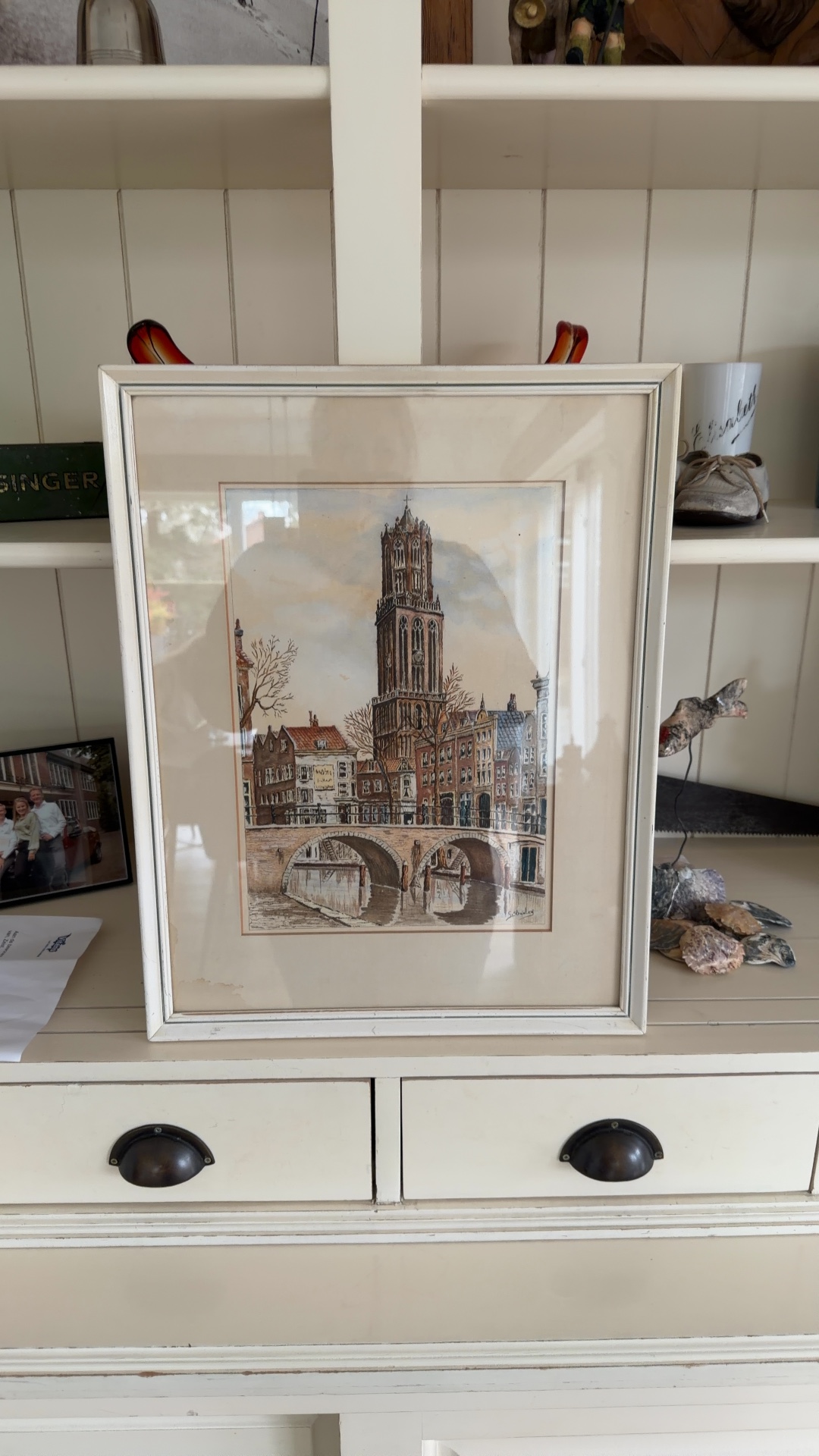
Cathedral Tower (Domtoren), Utrecht Watercolour
QUICK FACTS
Categories
Era
Mid-20th Century (1940s-1970s)
Origin
🇳🇱 Netherlands
Artist/Maker
G. Straalman
Rarity
Average (4/10)
Discovered
Feb 20, 2026
1 weeks ago
DESCRIPTION
This appears to be a framed watercolour painting depicting the Domtoren (Cathedral Tower) of Utrecht, Netherlands, alongside canals and traditional Dutch canal houses. The style suggests a picturesque, possibly mid-20th century, rendering of a classic European cityscape. The limited palette and distinct brushwork, especially in the architectural details and water, point to a skilled hand working within the watercolor medium.
CULTURAL ECHOES
Where This Object Echoes
The tradition of depicting everyday life, cityscapes, and landscapes with meticulous detail and a sense of atmosphere. Watercolour artists often follow in this vein, capturing architectural accuracy.
Ritual & Ceremonial Use
- •The practice of collecting local or regional art as souvenirs or expressions of civic pride.
- •The use of picturesque landscape and cityscape paintings to decorate homes, connecting inhabitants to their broader cultural or geographical context.
Meaning Through Time
Watercolour transitioned from primarily a preparatory sketching medium to a respected art form in its own right, valued for its luminosity and expressiveness.
Depictions of historic European city centers, often rebuilt or preserved, took on added significance as symbols of resilience, heritage, and continuity.
HISTORICAL STORY
DID YOU KNOW?
The Domtoren in Utrecht is the tallest church tower in the Netherlands, standing at 112.5 meters (368 feet), and its construction began in 1321, taking over 300 years to complete.
Utrecht's unique wharf cellars and canals were historically used for storage and provide a distinctive architectural element often captured in cityscapes like this.
MATERIAL & CONDITION
Surface
The artwork is executed in watercolour on what appears to be paper, showing the typical translucent layers and subtle tonal shifts characteristic of the medium. The texture of the paper provides a slight tooth that holds the pigment, and the colors are somewhat muted, which could be due to age or the artist's palette.
Weight & Feel
Given it's a framed watercolour on paper, the item would be relatively lightweight, perhaps 1-2 kilograms, depending on the framing materials, which appear to be wood or composite.
Condition
The painting itself appears to be in good condition with no obvious signs of significant fading or damage. The frame, however, shows some signs of wear, particularly along the edges and corners, suggesting minor abrasions or scuffs typical of age and handling. The matting inside the frame also appears to be slightly discolored or aged.
RARITY ANALYSIS
Typical antique shop fare. Requires some searching but regularly available. This is where most genuine antiques fall.
Typical Characteristics
- Standard antique shop items
- Regularly available
- Moderate collector interest
EXPERT ANALYSIS
Museum-Trained Art Historian
Confidence is good as the subject, medium, and general era are clear, and a signature is present. However, deeper research into the artist and an out-of-frame inspection would elevate certainty significantly.
KEY EVIDENCE
- 1The distinctive architectural subject, the Domtoren of Utrecht, is clearly identifiable.
- 2The medium is unequivocally watercolour, characterized by its translucent quality and visible brushstrokes.
- 3A legible signature 'G. Straalman' is present in the lower right corner.
- 4The style, depicting a familiar locale with picturesque qualities, suggests a regional artist working in the mid-20th century.
UNCERTAINTIES
- •Without further research into 'G. Straalman', it is difficult to determine if this is a known artist or a hobbyist.
- •The exact age of the paper and potential for acid-induced discoloration are not fully discernible through the glass.
WHAT WOULD IMPROVE CERTAINTY
- →A clearer, higher-resolution photograph of the signature for precise identification.
- →Examine the reverse of the frame and artwork for any labels, inscriptions, or gallery stamps.
- →A photograph out of the frame to assess paper condition and any potential foxing or acid burn.
- →Research the artist 'G. Straalman' through Dutch art directories or auction records to establish their oeuvre and market presence.
ESTIMATED VALUE
Updated: Feb 27, 2026
- Market comparables from auctions & retail
- Condition, completeness & craftsmanship
- Current collector demand & trends
- Low = quick sale, high = patient seller
For informational purposes only, not a formal appraisal.
SHARE THIS CURIOSITY
Have your own curiosities to discover?
Scan Your Curiosity
COMMENTS
No comments yet. Be the first to share your thoughts!
Sign in to leave a comment