F. Hundertwasser Styled Architectural Print/Work
QUICK FACTS
Categories
Era
Late 20th Century (post-1960s)
Origin
🇦🇹 Austria
Artist/Maker
Friedensreich Hundertwasser (Attributed - see red_flags)
Rarity
Average (4/10)
Discovered
Jan 31, 2026
4 weeks ago
DESCRIPTION
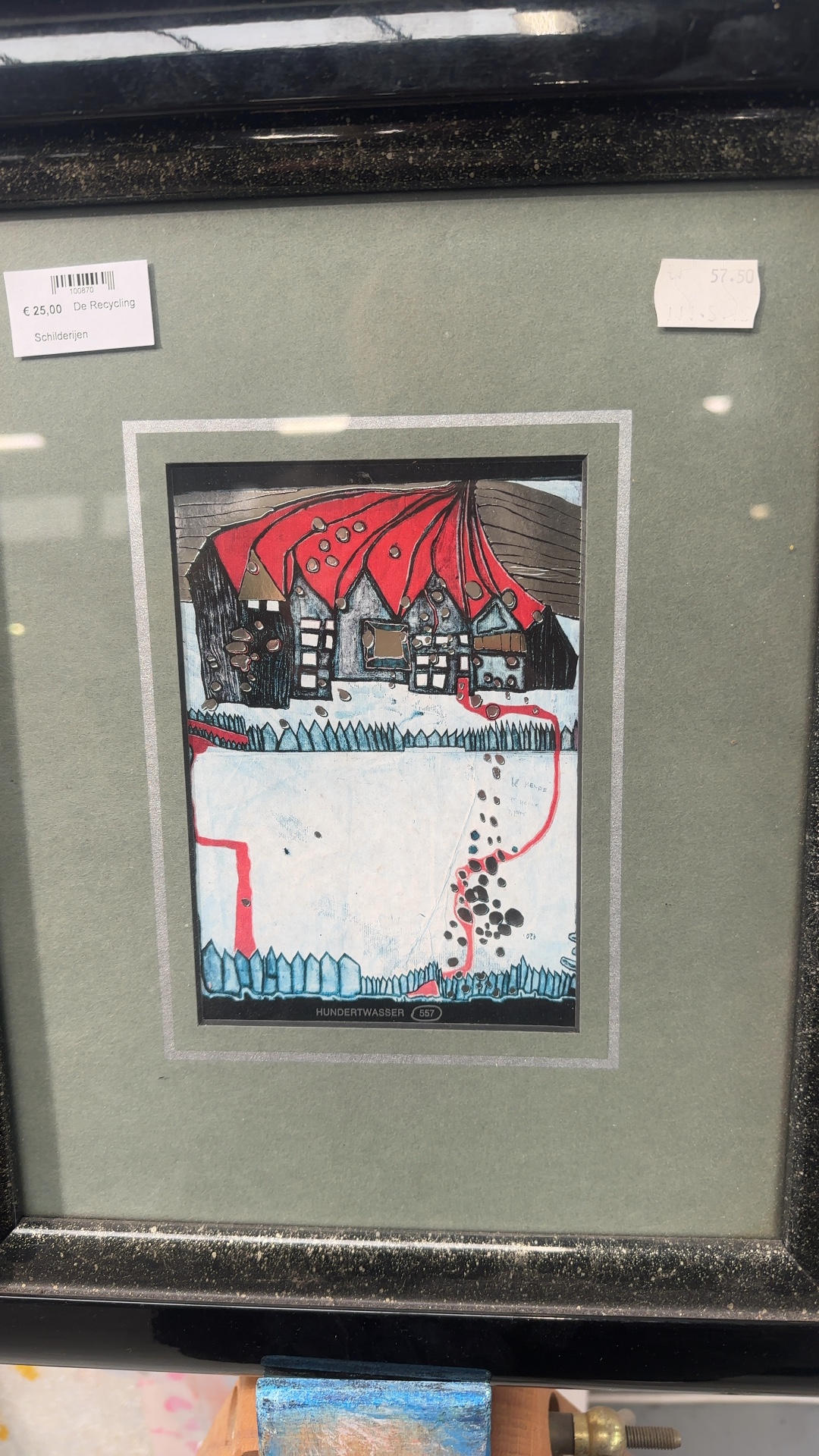
This appears to be a framed artwork, possibly a print or a mixed media work, depicting a whimsical architectural landscape in the style characteristic of Friedensreich Hundertwasser. The composition features a structure with undulating, often brightly colored, organic forms, reminiscent of Hundertwasser's 'onion dome' or 'tree tenant' architectural designs. The use of bold outlines, irregular patterns, and varied textures visible in the image, such as what appears to be metallic foil elements within the design, suggests an engagement with his unique aesthetic.
CULTURAL ECHOES
Where This Object Echoes
Hundertwasser's organic forms and rejection of straight lines share a spiritual kinship with Art Nouveau's embrace of nature and curvilinear ornament.
His use of vibrant, non-naturalistic colors and emphasis on emotional expression connects to the Expressionist movement, particularly Austrian Expressionism.
Ritual & Ceremonial Use
- •Hundertwasser promoted a 'window right' where each tenant could decorate their window area as they wished, transforming rigid architectural uniformity into a personalized, vibrant facade.
- •His architectural philosophy encouraged living spaces that integrate nature, blurring the lines between indoor and outdoor, fostering a daily ritual of connection with the environment.
Meaning Through Time
During this period, his work represented a radical departure from modernist austerity, symbolizing rebellion against functionalism and a return to romantic aesthetics.
His designs evolved to symbolize ecological consciousness and sustainable living, demonstrating architectural possibilities that prioritize nature and human well-being.
HISTORICAL STORY
DID YOU KNOW?
Hundertwasser was famous for his commitment to 'tree tenants,' where trees were planted inside buildings, growing out of windows and balconies, symbolizing environmental integration.
He designed several architectural projects, including the Hundertwasserhaus in Vienna, a vibrant apartment block that has become a major tourist attraction, characterized by its irregular floors and verdant rooftops.
MATERIAL & CONDITION
Surface
The surface appears to be a paper or board substrate, visible through a mat. The artwork itself shows varied textures, including what seems to be ink or paint on paper, possibly combined with metallic foil applications, notably on the red roof-like elements and some window details. The impression is of a lithographic or screen-printed base with possible overpainting or collage elements.
Weight & Feel
Given its framed presentation, the piece likely has a moderate weight due to the glazing and wooden frame. The artwork itself, if a print, would be relatively lightweight.
Condition
The artwork appears to be in good condition behind glass, with no immediately visible damage to the print or mixed media elements. The mat surrounding the artwork is clean, and the frame shows minimal wear, though some dust is visible on the inner edge of the frame.
RARITY ANALYSIS
Typical antique shop fare. Requires some searching but regularly available. This is where most genuine antiques fall.
Typical Characteristics
- Standard antique shop items
- Regularly available
- Moderate collector interest
EXPERT ANALYSIS
Museum-Trained Art Historian
Confidence is moderate. The visual style is undeniably Hundertwasser-esque, and the inscription 'HUNDERTWASSER' strongly suggests his authorship or attribution. However, without inspecting the print out of its frame and closely examining the printing technique and paper quality, definitive authentication as an original graphic work by the artist is not possible from images alone. The low price tag raises significant questions about its authenticity as an official edition.
KEY EVIDENCE
- 1Distinctive architectural style with organic forms, irregular shapes, and vibrant coloration, strongly indicative of Friedensreich Hundertwasser's aesthetic.
- 2The visible text 'HUNDERTWASSER' and a numbered sequence '657' on the lower edge, common indicators for his official prints and editions.
- 3Use of metallic foil or reflective elements within the composition aligns with Hundertwasser's experimentation with diverse materials and textures.
UNCERTAINTIES
- •The presence of the name 'HUNDERTWASSER' and a number does not guarantee authenticity as an original print; many authorized and unauthorized reproductions exist.
- •Image quality does not allow for close examination of print quality, paper type, or potential plate marks which are crucial for authentication.
- •The price sticker of '€25.00' seems incredibly low for an authenticated Hundertwasser print, even a small one, suggesting it may be a poster or an unauthorized reproduction.
WHAT WOULD IMPROVE CERTAINTY
- →Examine the work out of the frame: Look for edition numbers (e.g., /xxx), artist's signature (often signed in pencil), printer's chop marks, and watermarks on the paper.
- →Inspect the reverse of the work for any gallery labels, auction stickers, or provenance documentation.
- →Obtain high-resolution images of the entire piece, particularly the signature area and the edges of the print for any indications of print technique (e.g., dot patterns for offset lithography vs. rich ink for screenprint).
- →Consult a catalogue raisonné of Hundertwasser's graphic works to attempt to match the image and edition number.
ESTIMATED VALUE
Updated: Feb 27, 2026
- Market comparables from auctions & retail
- Condition, completeness & craftsmanship
- Current collector demand & trends
- Low = quick sale, high = patient seller
For informational purposes only, not a formal appraisal.
SHARE THIS CURIOSITY
Have your own curiosities to discover?
Scan Your Curiosity
COMMENTS
No comments yet. Be the first to share your thoughts!
Sign in to leave a comment