
TIME Magazine Promotional Card - 'Brings you the World' Edition
Select the photograph to look closer.
Estimated value
$1 - $10Rarity
Common(2/10)Category
Trading CardsBrand
TIMEEra
Circa 1970-1990Origin
United StatesVisual assessment
Photo-based interpretation · not authenticated
Save to revisit in your watchlist. This does not add the object to your own collection.
TIME MAGAZINE PROMOTIONAL CARD - 'BRINGS YOU THE WORLD' EDITION: IDENTIFICATION
This is a small-format promotional insert or subscription card, approximately 8.9 cm by 6.4 cm, mimicking the iconic 1923-established TIME magazine cover design. It features the classic red border, white serif logotype, and a central lithographic image of Earth against a black void. The tagline 'Brings you the World' is printed in white serif at the bottom. The card displays standard 20th-century offset printing characteristics on lightweight cardstock.
Compare with other trading cards in the archive: PokéPark's Pikachu - PCG-P Promotional cards [043/PCG-P], Cavallone Tropicale (Tropical Tidal Wave) - Italian 2006 World Championships Promo #36, Dark Charizard - Team Rocket (1st Edition Holo) [4/82].
CROSS-CULTURAL PARALLELS
Related cultural context
The 'Global Village' concept popularized by Marshall McLuhan in the 1960s is visually synthesized in this single image of Earth.
Use & cultural context
- •Direct mail subscription culture used in 20th-century households to curate information intake.
Meaning Through Time
Represented professional status and being 'well-informed' on a global scale.
SET RELEASE & PRINT RUN
This card was likely produced between 1970 and 1990 as a subscription direct-mail insert. The image of Earth from space reflects the post-Apollo 17 'Blue Marble' (1972) era of visual culture that dominated global media marketing. While it mimics the 1923 masthead, this specific card represents the
Read full storyShow less
mass-marketing push of Time Inc. during the late Cold War period when international circulation was a primary growth driver.
COLLECTOR INTEL
TIME magazine introduced its famous red border in 1927, exactly four years after its initial launch.
Promotional cards like this were produced by the millions and included in newspapers and other magazines to drive the 4 million+ peak circulation reached in the late 20th century.
SCARCITY
Common · 2/10 estimated rarity
This is a qualitative collection score, not a measured survival count, market percentile or proof of authenticity.
Visual assessment
Photographs alone cannot establish authenticity. The following analysis notes have not been independently verified; references to a match or confirmation are interpretations, not documentary evidence.
- Offset printing patterns are consistent with period commercial ephemera
- Low market value makes it an unlikely target for forgery
ANALYSIS NOTES
AI-assisted notes based on the photographs and supplied context. These are interpretations, not an examination by a human specialist or proof of authenticity.
Identification is high based on clear branding and observable printing techniques, though the exact year of production is estimated based on the Earth image used.
OBSERVATIONS & INTERPRETATIONS
- 1Masthead font matches TIME's post-1970s branding specs
- 2Dimensions and stock thickness are characteristic of magazine blow-in cards
- 3Ink saturation and halftone pattern suggest high-speed commercial lithography
UNCERTAINTIES
- •High volume of similar ephemera makes specific tracking difficult
WHAT WOULD IMPROVE CERTAINTY
- →Measure dimensions to confirm if it fits standard 2.5 x 3.5 inch sleeves
- →Check the reverse side for an expiration date or subscription offer code
COLLECTOR GLOSSARY (2 terms)
- Blow-in card
- A loose promotional card inserted into a magazine during the binding process.
- Chipping
- Small pieces of paper or ink missing from the edges of a card, common with colored borders.
Condition & estimated grade
A visual condition estimate. This is not a professional grading certificate.
Grading breakdown
Visual evidence of edge wear (chipping) and surface scratches on the high-gloss black field; corners show mild rounding and impact wear.
Condition
The card shows visible shelf wear including minor chipping along the red border edges and light surface scuffing on the black ink field. Softening is evident at the bottom right corner.
TRADING CARD MARKET VALUE
Estimate recorded: May 12, 2026
Estimate context (not a documented sale): Similar magazine inserts frequently sell in bulk lots on eBay for under $10.
Who buys this
Ephemera collectors and TIME magazine completists who archive auxiliary marketing materials.
What increases value
- •Cleanliness of the black field (dark colors show scratches easily)
- •Sharpness of the red border edges
What lowers value
- •Extremely high surviving population (millions produced)
- •Limited crossover appeal outside of brand historians
What makes top-tier examples
- •Mint condition with zero border chipping
- •Original mailing envelope or accompanying letter surviving alongside it
Grade & condition
Centering of the red border, surface scratching on the black ink, and corner sharpness.
Rarity & demand
For informational purposes only, not a formal appraisal.
Related objects

PokéPark's Pikachu - PCG-P Promotional cards [043/PCG-P]
Same category
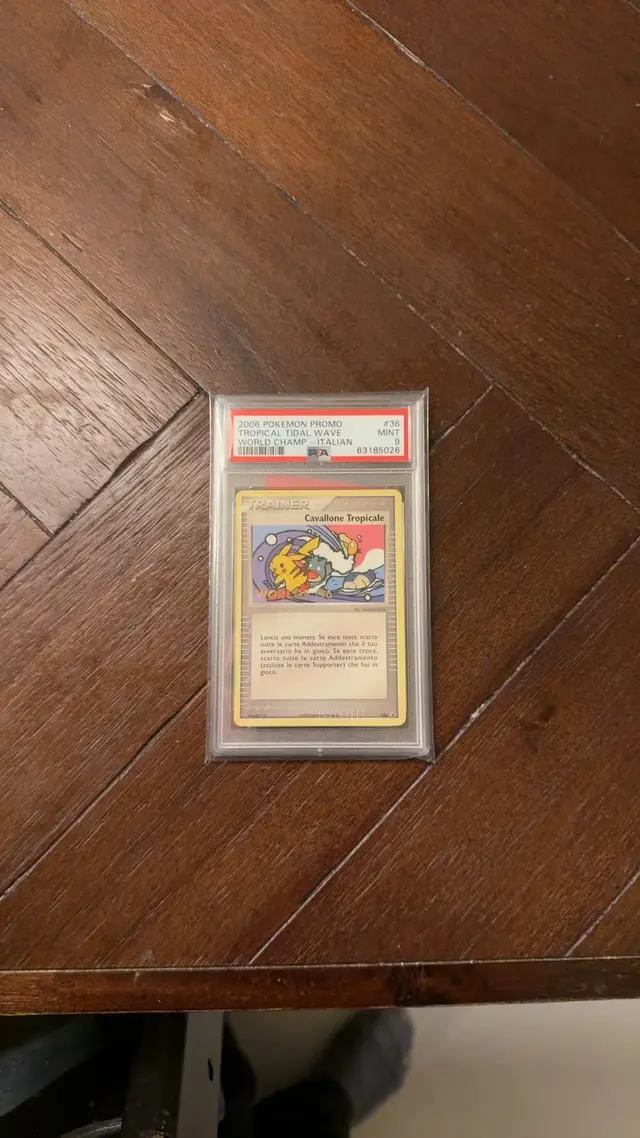
Cavallone Tropicale (Tropical Tidal Wave) - Italian 2006 World Championships Promo #36
Same category

Dark Charizard - Team Rocket (1st Edition Holo) [4/82]
Same category

Charizard - Base Set (1st Edition Shadowless) [4/102]
Same category

Charizard - Base Set (1st Edition Holo) [4/102]
Same category

Charizard - Base Set (1st Edition Holofoil) [4/102]
Same category
Explore Trading Cards
Sports cards, trading card games, vintage non-sport cards, graded cards and collectible card sets.
Trading Cards value and rarity guideSHARE THIS CURIOSITY
What’s in your collection?
Keep its photographs, maker’s marks and the story you know in one object record. Start with a photo.
Start for free. No credit card needed.
Questions & contributions