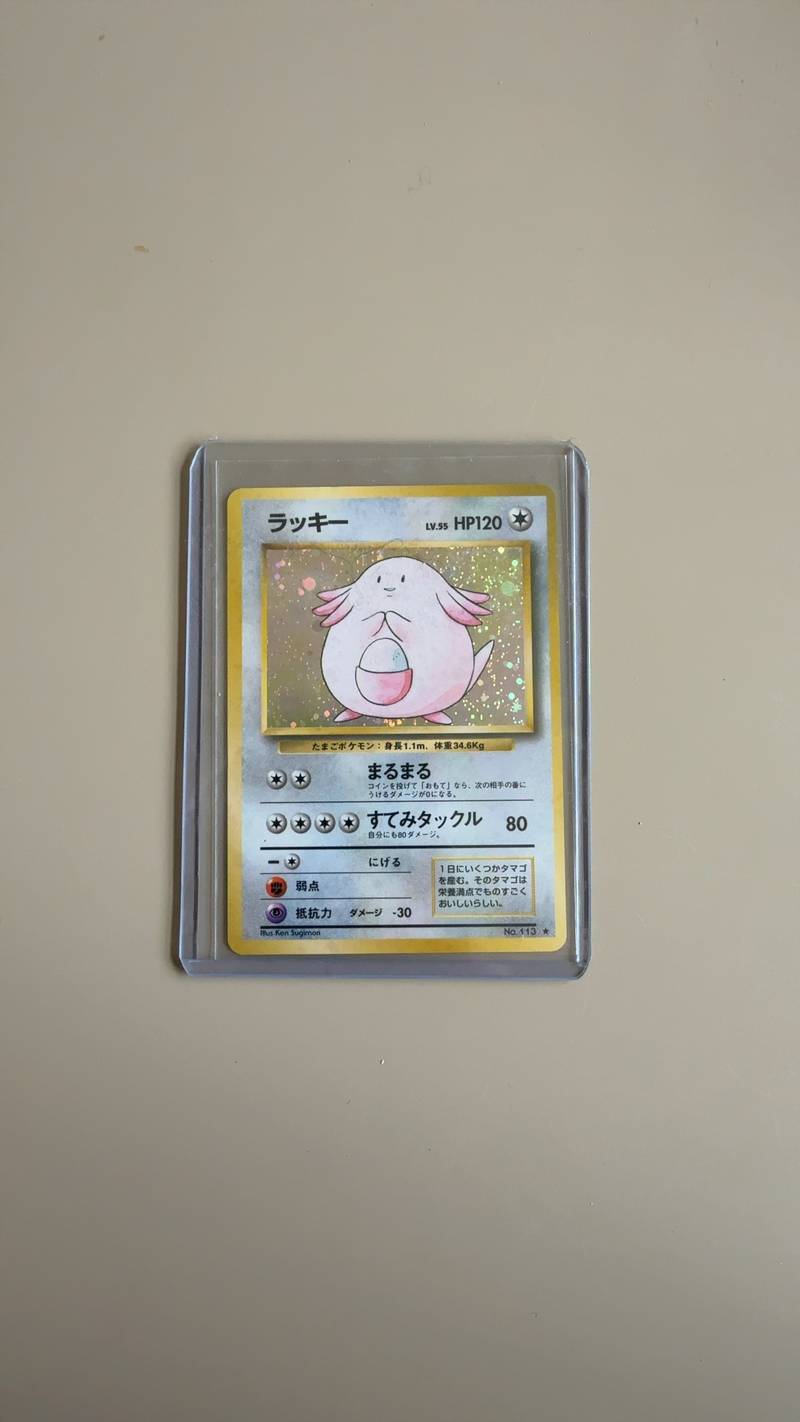
Chansey (Lucky) - Holo Rare [Japanese Base Set]
Estimated value
$15 - $35Rarity
Average(4/10)Category
Trading CardsBrand
PokémonEra
1996Origin
JapanArtist / Creator
Ken SugimoriAuthenticity
CHANSEY (LUCKY) - HOLO RARE [JAPANESE BASE SET]: IDENTIFICATION
A Japanese Pokémon Trading Card Game version of Chansey (known as 'Lucky' in Japan), illustrated by the Ken Sugimori. This is a Holo Rare from the original Japanese Base Set (known domestically as Expansion Pack), released in 1996. The card prominently features the classic 'cosmos' foil pattern in the illustration window and the original 'Pocket Monsters Card Game' back design, which was utilized in Japan prior to the global standardization of card backs in 2001. Notably, the bottom right corner displays a star rarity symbol, designating this as a standard print run copy rather than the highly 'No Rarity' first printing.
CROSS-CULTURAL PARALLELS
Where This Object Echoes
Chansey (Lucky) echoes traditional Japanese talismans of fortune and the cultural emphasis on communal caregiving and fertility, represented by the protective carrying of an egg.
Ritual & Ceremonial Use
- •Competitive TCG gameplay (the 'Damage Swap' stall strategy of the late 90s)
Meaning Through Time
A potent tabletop gaming piece for its massive hit points.
A vintage nostalgia artifact representing the origin of the world's most successful media franchise.
SET RELEASE & PRINT RUN
SCARCITY
Typical antique shop fare. Requires some searching but regularly available. This is where most genuine antiques fall.
Typical Characteristics
- Standard antique shop items
- Regularly available
- Moderate collector interest
Confidence Factors
- The original Japanese back layout (Media Factory era) features highly accurate, specific blue saturation and pixel patterns that are difficult to successfully counterfeit.
- The edge whitening reveals expected fibrous cardboard degradation consistent with authentic 1996 stock.
- Holo pattern reflects light correctly based on early set manufacturing logic.
GRADING EXPERT'S TAKE
Trading Card Market Analyst
Both the front and back of the card are clearly documented, allowing for a precise match to the Japanese Base Set release. The distinct presence of the rarity symbol definitively categorizes its print run, and the wear patterns read as completely authentic vintage degradation.
KEY EVIDENCE
- 1Presence of 'Pocket Monsters Card Game' old back design dates this prior to the 2001 e-Series transition.
- 2No. 113 index number and Sugimori artwork identify it specifically as Base Set Chansey.
- 3Visible star symbol in the bottom right signifies the standard Japanese print run, differentiating it from the hyper-valuable 'No Rarity' first edition.
- 4Rear top-edge whitening is the primary constraint on current market value.
UNCERTAINTIES
- •Surface condition is partially obscured by the sleeve and top-loader, making foil scratching difficult to fully assess.
WHAT WOULD IMPROVE CERTAINTY
- →Remove the card carefully from both sleeve and top-loader to examine the holographic window under a direct, angled light source for hairline scratches.
- →Assess the physical texture of the card to ensure standard thickness and rigidity.
CONDITION & GRADE
Grading breakdown
The severe whitening along the top rear edge and corner chipping immediately drops the maximum potential grade down to the 5 range. Without surface confirmation out of the sleeve, further micro-indentations could push it slightly lower, solidifying it as a 'binder copy' or mid-grade at best.
Condition
The primary condition detractors are clearly visible on the reverse face. The card exhibits moderate to heavy edge wear, commonly referred to as 'whitening' in the hobby, spanning the entire top edge and affecting all four corners. Front centering appears within an acceptable vintage tolerance, but the edge degradation significantly caps its grading potential.
TRADING CARD MARKET VALUE
Updated: Apr 11, 2026
Who buys this
Nostalgia collectors, vintage Pokémon investors, and specialists assembling complete regional Base Sets.
What increases value
- •original 16 holographic artwork by Ken Sugimori.
- •High nostalgia factor tied to the highest-HP card of the original game.
What lowers value
- •The presence of the star symbol blocks this from 'holy grail' pricing tiers (No Rarity).
- •Significant physical edge/corner rear whitening limits grading potential severely.
- •Japanese vintage holos generally command lower values than their English 1st Edition or Shadowless counterparts unless perfectly Mint.
What makes top-tier examples
- •PSA 10 Gem Mint condition (flawless edges and centering)
- •'No Rarity' print run variants missing the bottom corner star.
Grade & condition
Centering (front and back), severity of edge wear/whitening (which is the main detractor here), and any concealed holo scratching.
Rarity & demand
For informational purposes only, not a formal appraisal.
YOUR INPUT VS. SCAN
How your provided context compares with Curiosa.com scanner findings.
What Aligned
- User stated 'It has a rarity symbol in the corner, you can see the star' - Visual evidence perfectly confirms the black star in the bottom right corner.
ABOUT TRADING CARDS
Pokemon cards, sports cards, gaming cards, TCGs, and collectible card games.
Trading Cards value and rarity guideSHARE THIS CURIOSITY
Have your own curiosities to discover?
Scan Your Curiosity
COMMENTS